
Product Catalog
Swivel Casters with Total Lock — Wheel and Swivel Locked by One Pedal
Updated 2026-11
A brake stops a wheel; a total lock stops a wheel and a pivot. On a total-lock swivel caster, one pedal engages a dual-action mechanism — industry guides describe an internal wedge pushing a brake shoe into the tread while a secondary pin drops into a swivel-arrest notch on the raceway — so the caster becomes a fixed, non-rolling, non-pivoting point. That is what holds a medical cart dead still in a corridor, keeps an A/V rack from slewing when someone leans on it, and stops a loaded cart from creeping on a ramp. Published selection guidance is blunt about where it matters: specify total-lock when carts carry over 300 lb or sit on ramps.
The family covers three usable variants: total lock (wheel + swivel, the subject of this page), brake-only side brakes (wheel only — faster to engage and sufficient for most shop carts), and directional locks that pin the swivel at fixed positions for straight-line tracking. Our line builds total lock as the standard brake on double-ball-raceway swivel casters from 60 to 1,500 kg per caster, in Ø 25–300 mm, with one-pedal engagement — with side brake and directional lock available per configuration, confirmed at quotation.
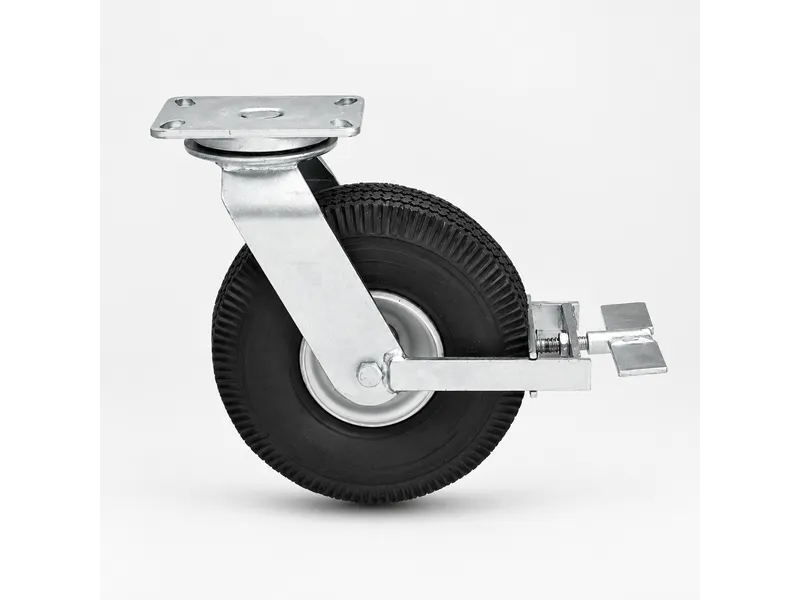
Specifications
| Type | Double-ball-raceway swivel casters with total lock; side brake and directional lock variants |
|---|---|
| Brake | Total lock (wheel + swivel head), one pedal |
| Load rating | 60–1500 kg per caster (tenant family range; per-configuration rating confirmed at quotation) |
| Size range | Ø 25–300 mm wheel diameter |
| Materials | Polyurethane (PU), cast nylon (PA6), forged steel wheels |
| Surface finishes | Zinc plating, chrome, powder coating; stainless steel construction available |
| Lock-class taxonomy (industry reference) | Total-lock / brake-only (tread) / swivel-lock / directional (position) lock — four mechanisms, not interchangeable |
| Lead time | 15–20 days (custom configurations 30–40 days) |
| MOQ | 200 pieces (standard catalog items ship in smaller quantities) |
| Warranty | 18 months |
Brake type, wheel material, finish and load rating are configured per order; the quotation states the rating and the brake specification for your exact configuration.
Applications & Selection
Which lock actually fits the duty
The industry taxonomy separates four mechanisms that buyers routinely conflate. Total lock (double lock) stops wheel rotation and swivel pivot together with one foot pedal — the specification for medical equipment, A/V carts and heavy equipment that must neither roll nor pivot. Brake-only (tread or side brake) stops the wheel but leaves the caster free to swivel — faster to engage, more forgiving on uneven floors, and sufficient for most shop and industrial carts where exact heading does not matter. Swivel lock holds only the direction, converting a swivel caster to temporary rigid for towing or long straight runs. Directional (position) lock indexes the swivel to 0°/90° positions for OEM equipment that moves along fixed aisles.
The engineering reason total lock exists is holding force against both axes. A braked cart on a ramp with a free-swiveling caster can still fishtail: the wheels are locked but the swivels steer, and a sloped floor steers them. Published guidance sets the practical threshold at carts over 300 lb or any ramp parking — below that, brake-only is usually the economical choice, and swivel locks are the wrong tool entirely for holding (they stop steering, not rolling).
On our line the total-lock brake is a one-pedal engagement on a double-ball-raceway swivel head, which matters at the upper load bands: the raceway carries the load while the lock pin only has to hold position, so pedal effort stays usable even on a 1,500 kg-class caster. Where corrosion or washdown is involved, stainless construction with the same brake geometry is quoted per configuration.
Selection points to settle before you RFQ
Decide the lock class first, per position, not per cart. The common industrial pattern is total lock on all swivel positions of a stationary-parking cart, or total lock on the swivels plus plain rigid casters at the back — a rigid caster needs no brake for direction, only for rolling. State which positions lock, because a four-way total-lock spec on a cart that only parks is paying twice.
Then the duty numbers: load per caster (divide total weight by three for a four-caster unit), ramp grade where the cart parks, engagement frequency per shift, and who operates it. Published manufacturer brake references distinguish face-contact brakes (brake shoe pressed against the tread, with total-lock variants also arresting the swivel) from cam brakes for heavy-duty loads and side brakes for infrequent locking — the right mechanism follows from engagement frequency and load, and pedal force requirements differ between them.
Finally the environment: wheel material against the floor (polyurethane for finished floors, cast nylon for debris and heavier static loads, forged steel for extreme duty), finish against the chemistry (zinc, powder coat, stainless), and any medical or cleanroom requirement that changes both the brake geometry and the documentation set. Say all of it in the RFQ — brake specification is where first-round quotes most often miss.
Frequently Asked Questions
What is the difference between total lock and a normal caster brake?
A normal brake stops only the wheel from rotating — the caster can still swivel, so a braked cart on a slope or a bumped cart in a corridor can change heading. Total lock stops both: one pedal engages a dual-action mechanism that pins the wheel tread and arrests the swivel raceway at the same time, so the cart can neither roll nor pivot. Industry guides classify them as separate mechanisms — total-lock (double lock), brake-only (tread lock), swivel-lock and directional lock — and recommend total-lock specifically for medical, A/V and heavy equipment, and for carts over 300 lb or parked on ramps.
Do all four casters on a cart need total lock?
Not necessarily — it depends on the cart. On a cart with four swivel casters where any corner can drift, total lock on all four is the safe spec. On the common swivel-front/rigid-back arrangement, the rigid casters cannot pivot, so they need only wheel brakes (or none, if the total locks hold the cart against rolling through them). Medical guidance goes further and specifies braking per position by risk. Decide by asking what motion must be stopped when parked: rolling, steering, or both — then lock only what needs locking and spend the difference elsewhere.
What should my total-lock caster RFQ include?
Load per caster, ramp grade and parking condition, which positions must lock and whether swivel arrest is required, engagement frequency and operator (pedal force matters for one-person operation), wheel material and diameter, mount type and plate size, environment (washdown, corrosion, temperature), and any certification or documentation requirement (medical, cleanroom). Quantity per configuration completes the quote.
Ordering & Documentation
Documents
Every order ships with a packing list and commercial invoice. Dimensional drawings (top plate, bolt pattern, overall height, swivel radius, brake pedal clearance) are available on request so your frame designer can check fit and foot access before production.
Quotation
A quotation needs: load per caster, brake type per position (total lock, side brake, directional lock), wheel material and diameter, mount type, finish, environment and quantity. The confirmed quotation states the brake specification and the rating for your configuration.
Sample & supply
Standard configurations are produced to order with an MOQ of 200 pieces; smaller trial quantities of catalog items can ship in some sizes — ask with your RFQ. Lead time is 15–20 days for standard configurations and 30–40 days for custom brake or mount work. A floor trial of one braked position on the actual ramp or corridor is the usual validation — pedal effort and holding on grade are both felt, not calculated.
Storage & shipping
Braked casters ship with the brake released and store in dry cartons; keep the pedal area free of packing foam that could wedge the mechanism. Before installation, cycle each brake several times by hand: it should engage positively, hold the wheel against a firm push with the swivel arrested, and release without sticking. A mechanism that binds or fails to release is flagged before it reaches the floor.