
Product Catalog
Total-Lock Medical Casters — Quiet Swivel Casters for Care Beds and Hospital Equipment
Updated 2026-11
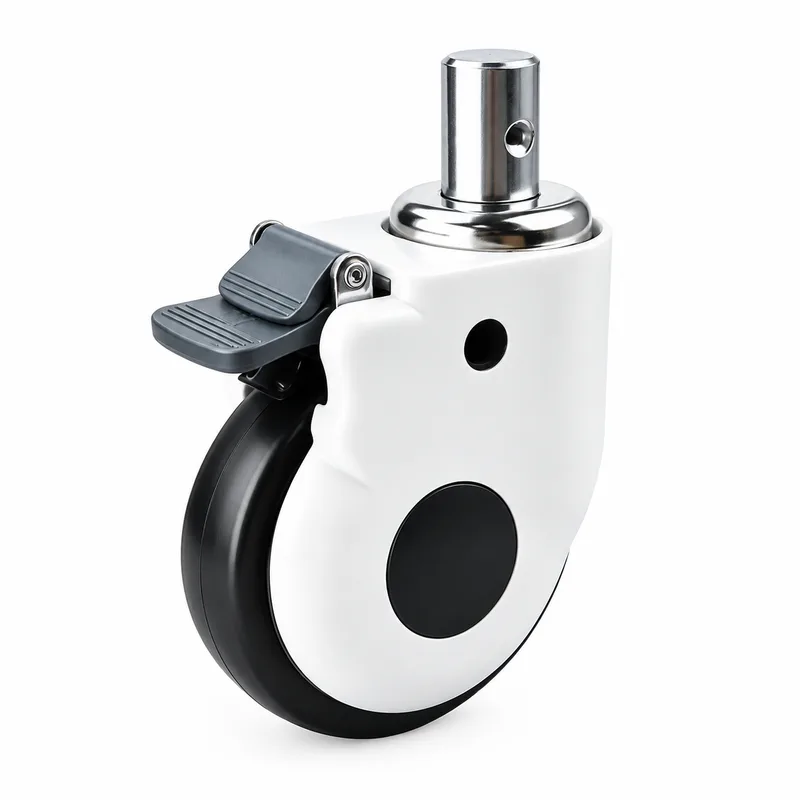
Total-lock medical casters are the quiet, light-duty swivel casters specified for care beds, hospital furniture, catering carts and other institutional equipment — casters whose brake must do what a hospital environment asks of it: one pedal that locks both the wheel rotation and the swivel, so a bed occupied by a patient cannot creep or swing while it stands.
The referenced equipment line covers swivel casters in three wheel diameters — 2.95, 3.94 and 4.92 inches — with steel sheet housings on a double-ball raceway and a choice of treads: solid rubber, polypropylene (PP) and thermoplastic rubber (TPR), including non-marking and electric-conductive tread options. Published dynamic ratings for the line run from 165 lb to 220 lb per caster depending on size, at speeds up to 1.86 mph — the walking pace at which this equipment actually moves. The rating for the size and tread you specify is confirmed at quotation.
Specifications
| Type | Swivel caster with total-lock option, plate mount |
|---|---|
| Wheel diameters | 2.95 in / 3.94 in / 4.92 in |
| Load rating | 165.35 lb / 176.37 lb / 220.46 lb (by size — manufacturer line reference, confirmed at quotation) |
| Speed rating | Up to 1.86 mph (walking-pace duty) |
| Housing | Steel sheet, medium grade, double-ball raceway |
| Tread / wheel materials | Solid rubber; polypropylene (PP); thermoplastic rubber (TPR) |
| Tread options | Non-marking; electric-conductive |
| Lead time | 15–20 days (custom configurations 30–40 days) |
| MOQ | 200 pieces (standard catalog items ship in smaller quantities) |
| Warranty | 18 months |
Load, speed and size figures are manufacturer-line reference values (metric-imperial converted), quoted per wheel size — not a family-wide rating and not a tenant supply commitment. The rating for your size, tread and brake configuration is confirmed at quotation.
Applications & Selection
What the medical environment asks of a caster
Hospital and care equipment rolls indoors, loaded with patients or meals, all day, over smooth floors, past people who are trying to rest. That environment sets four requirements at once: quiet rolling (a rattling catering cart is a noise complaint on every corridor), non-marking treads (vinyl and linoleum show every black streak), light effort (nurses steer beds one-handed), and a brake that makes the equipment positively stationary — not just "harder to push."
The total lock answers the last requirement. On a care bed, a brake that stops only the wheel leaves the swivel free, and a free swivel under a patient's weight lets the bed's casters twist out of line and drift. A total-lock pedal clamps wheel and swivel together, so a braked bed holds its heading as well as its position — which is why total lock is the specification of choice for beds and any equipment that stands occupied.
The electric-conductive tread option exists for a quieter reason: in rooms with sensitive electronics, a caster that bleeds static charge through its tread prevents the small shocks and discharge events that ordinary treads accumulate. Where the facility specifies ESD control, the conductive tread replaces the standard non-marking option — the two options trade against each other, so state which one your environment needs.
Selection points to settle before you RFQ
Size from load first: published dynamic ratings for the referenced line run 165 lb to 220 lb per caster by wheel size (2.95 to 4.92 inches), rated at walking pace. A care bed divides its occupied weight over four casters; a catering cart adds the loaded deck. If any single caster will see more than the class rating, step up a diameter — diameter, not tread hardness, is what buys capacity here.
Choose the tread by floor and by electronics. Solid rubber and TPR roll quietly and non-marking on vinyl and linoleum; polypropylene is the economy, easy-cleaning option where floors are hard and loads are light. Electric-conductive treads are a specification, not an upgrade — order them where the facility's ESD plan calls for them.
Confirm the brake by function: total lock (wheel + swivel) for beds and occupied equipment; a wheel brake may suffice for static carts that never steer under load. Our guide on how many braked casters a medical cart needs covers the two-of-four versus four-of-four decision.
Frequently Asked Questions
What does a total-lock brake do that a normal caster brake does not?
A normal brake stops the wheel from rotating; a total lock stops the wheel and the swivel. On medical equipment the difference is practical: an occupied care bed on wheel-braked casters can still swivel and drift its steering out of line, while total-locked casters hold both position and heading. For beds, gurneys and any equipment a patient leans on, total lock is the specified brake.
Which wheel size and load rating should I choose?
From load per caster and floor condition. The referenced line publishes dynamic ratings of 165 lb (2.95 in), 176 lb (3.94 in) and 220 lb (4.92 in) at speeds up to 1.86 mph; divide the equipment's working weight — occupied, loaded — by the number of casters actually sharing it, then step up a size if your floor has thresholds or transitions. The exact rating for your configuration is confirmed at quotation.
What should my medical caster RFQ include?
Load per caster (with the equipment's occupied/loaded weight), wheel diameter and tread choice (solid rubber, PP, or TPR; non-marking or electric-conductive), brake type — state total lock explicitly — mounting plate or stem dimensions, floor type, hygiene or cleaning chemicals involved, and quantity. Mention the destination facility type: hospital, care home and catering duty quote slightly different tread and bearing defaults.
Ordering & Documentation
Documents
Orders ship with a packing list and commercial invoice. On request we provide the caster's dimension sheet (plate size, bolt pattern, wheel diameter, overall height) and a tread/material statement for the quoted configuration, so your equipment drawings can be checked before production.
Quotation
A quotation needs: load per caster, wheel diameter, tread (including non-marking or electric-conductive specification), brake type (total lock), mounting dimensions and quantity. The per-size rating confirmed on the quotation — not the published line values — is the order commitment.
Sample & supply
Standard configurations are produced to order with an MOQ of 200 pieces; smaller trial quantities of catalog items can ship in some sizes — ask with your RFQ. Lead time is 15–20 days for standard configurations and 30–40 days for custom treads or conductive options. Samples ship freight collect and are refundable against a bulk order.
Storage & shipping
Medical casters are light and ship cartoned. Store them in their packaging away from direct sunlight — rubber and TPR treads age under UV — and keep brake pedals free of packing debris. Before installation, cycle each total-lock pedal a few times; a pedal that sat compressed in a carton should move freely before the equipment enters service.