
Product Catalog
TPR Wheel Casters — Non-Marking Thermoplastic Rubber Wheels for Carts and Equipment
Updated 2026-11
Thermoplastic rubber (TPR) wheels occupy a deliberate middle ground in caster tread selection: they roll like a rubber wheel — quiet, non-marking, gentle on finished floors — but they are injection-molded as one grey, homogeneous wheel, without a separate bonded tread layer. That one-piece construction removes the failure mode where a bonded tread separates from its core, and it makes the wheel inexpensive enough to specify on high-volume equipment: shopping carts, stretchers, utility carts and general material handling.
The published class covers three common sizes — 4 x 2 inches, 5 x 1-1/4 inches and 6 x 1-1/4 inches — with per-wheel capacities of 250 to 400 lb depending on size, ball bearings and a 1/2 inch axle/bearing bore as the standard fit, and a published service temperature band of -20°F to 180°F. The capacity for your size, bearing and duty is confirmed at quotation.
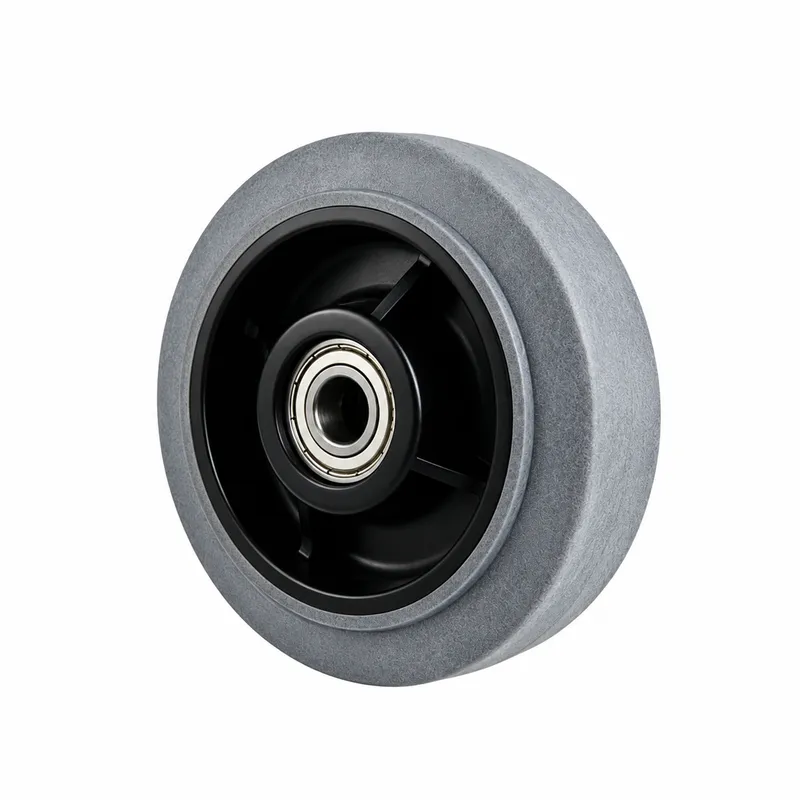
Specifications
| Wheel material | Thermoplastic rubber (TPR), one-piece molded |
|---|---|
| Sizes | 4″ × 2″; 5" × 1-1/4"; 6" × 1-1/4" |
| Capacity | 250–400 lb per wheel by size (single-publisher SKU reference — confirmed at quotation) |
| Temperature range | -20˚F to 180˚F |
| Bearing / axle | Ball bearings; 1/2" axle/bearing ID |
| Typical duty | Shopping carts, stretchers, general material handling |
| Lead time | 15–20 days (custom configurations 30–40 days) |
| MOQ | 200 pieces (standard catalog items ship in smaller quantities) |
| Warranty | 18 months |
Capacities are per-wheel SKU figures from a single published source (second independent source still in acquisition) and are rendered as reference values, not a family rating — the capacity for your size, bearing and floor is confirmed at quotation.
Applications & Selection
Where TPR is the right tread — and where it is not
Choose TPR when the floor matters as much as the load. The tread is soft and elastic like rubber, so it rolls quietly, grips on smooth concrete and tile, and leaves no marks on epoxy, vinyl or hardwood — the reason it is a common wheel on retail shopping carts, medical stretchers and institutional carts. Being injection-molded in one piece, it also shrugs off water, most cleaning chemicals and the occasional curb strike without the tread-delamination risk of a two-material wheel.
Respect the capacity band and the temperature band, because TPR is a thermoplastic: published per-wheel capacities run 250 lb to 400 lb in the referenced class, and service above the -20°F to 180°F band softens or stiffens the tread — near an oven line or in a freezer, a different wheel material is the correct answer. Continuous heavy loads also flat-spot soft treads faster than hard wheels; our flat-spot guide explains the mechanism and the habits that prevent it.
Against its neighbors: true rubber wheels ride rougher floors and carry moderate loads at similar noise levels but cost more; polyurethane carries more and resists debris and chemicals better but is harder and louder on hard floors. Our wheel material comparison walks the full trade table — TPR wins where quiet, non-marking rolling at light-to-medium load is the spec.
Selection points to settle before you RFQ
Size from load per wheel, divided honestly: a four-wheel cart shares its load over three wheels on an imperfect floor. Match the capacity against the per-size reference figures (250–400 lb), then confirm the exact rating for your bearing and duty at quotation — a soft tread's real capacity drops with speed and continuous rolling.
State the floor and the environment: finished indoor floors are TPR's home ground; debris-strewn jobsite floors chew soft treads. State the temperature the wheels actually see (dock, cold room, near equipment heat) against the -20°F to 180°F band, and the cleaning chemicals if the equipment is washed down.
Fix the hardware details early: 1/2 inch axle/bearing bore is the standard fit in this class — confirm your axle diameter, and choose swivel, rigid or brake configurations per position. For push-heavy duty, bearing type changes rolling effort more than wheel size does.
Frequently Asked Questions
Is TPR the same as rubber? What is the difference?
No — and the names overlap in catalogs. TPR (thermoplastic rubber) is an injection-molded thermoplastic compound engineered to behave like vulcanized rubber: soft, elastic, quiet, non-marking. Unlike true rubber it is molded as one homogeneous piece with no bonded tread layer, so it cannot delaminate, and it is cheaper at volume. The trade: TPR has a narrower temperature band and lower debris tolerance than many rubber compounds. For shopping carts, stretchers and indoor material handling, TPR is usually the better value.
Which TPR wheel size and capacity do I need?
From load per wheel and floor quality. Published per-wheel figures in the class are about 250 lb, 300 lb and 400 lb across the three sizes; divide the working load by three for a four-wheel cart, prefer the wider tread (the 2-inch-wide 4-inch wheel) for soft or uneven floors, and confirm the exact rating for your bearing and duty at quotation — published figures are reference values.
What should my TPR wheel RFQ include?
Wheel size (diameter x width), load per wheel, floor type and condition, service temperature, axle/bore diameter (1/2 inch is standard), swivel/rigid/brake configuration per position, and quantity. If the equipment is washed down or food-adjacent, say so — tread and bearing options quote differently for wet or hygiene duty.
Ordering & Documentation
Documents
Every order ships with a packing list and commercial invoice. On request we provide the wheel's dimension sheet (diameter, width, bore, bearing type) and a tread material statement for the quoted size, so your axle and fork drawings can be checked before production.
Quotation
A quotation needs: wheel size, load per wheel, floor and temperature conditions, bearing and bore, caster configuration (swivel/rigid/brake) and quantity. The confirmed quotation states the capacity for your exact configuration — published per-wheel figures are sizing references, not the order commitment.
Sample & supply
Standard sizes are produced to order with an MOQ of 200 pieces; smaller trial quantities of catalog items can ship in some sizes — ask with your RFQ. Lead time is 15–20 days for standard configurations and 30–40 days for custom bore or configuration work. Samples ship freight collect and are refundable against a bulk order.
Storage & shipping
TPR wheels ship cartoned and stack well, but keep them out of direct sunlight and away from heaters: the same thermoplastic behavior that bounds their service temperature (-20°F to 180°F) applies in storage, and UV-aged treads lose their non-marking quality. Store flat, not on edge, and keep bearing bores in their original packaging until assembly.