
Product Catalog
Scaffold Casters — Stem-Mount Total-Lock Casters for Scaffold Towers
Updated 2026-11
Scaffold casters are the ground contact of every rolling scaffold tower: heavy-duty swivel casters that mount not with a top plate but with a round stem, dropped into the caster socket at the bottom of each scaffold leg and held by a pin or a cross-drilled retention hole. The standard configuration pairs an 8 x 2 inch rubber-on-cast-iron wheel with a total-lock brake, because a scaffold is not a cart — it is an elevated work platform, and the four casters under it must become four rigid posts the moment workers climb.
The published class covers wheels in the 8 x 2 inch size with two common stem families: the 1-3/8 inch round stem (4 inches long, with a 1/2 inch cross-drilled hole for a securing pin) for standard steel scaffold frames, and a 1 inch round stem (1 x 2-3/4 inches, with pin) for lighter towers. Ratings in the class start around 500 lb per caster, with the upper end of the range reaching 950 lb per caster in polyurethane-tread versions. Whichever stem and tread your frames need, the rating that applies to your build is confirmed at quotation.
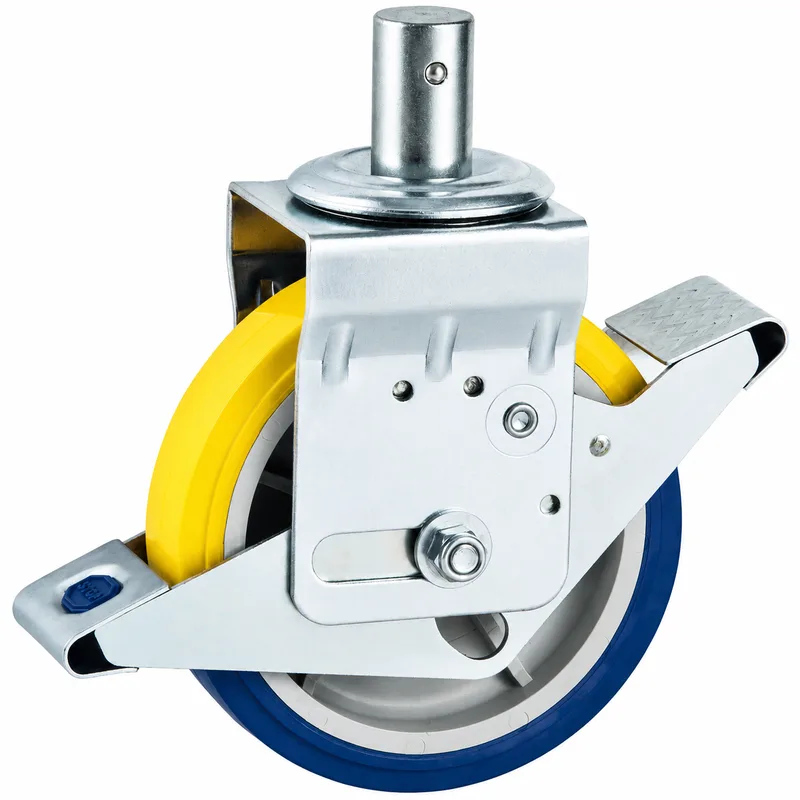
Specifications
| Type | Swivel caster with round stem mount and total-lock brake |
|---|---|
| Wheel | 8" × 2" |
| Wheel material | Rubber on cast iron |
| Stem options | 1-3/8" × 4" with 1/2" cross-drilled hole; 1" round (1" × 2-3/4") with pin; 1-3/8" round with pin |
| Load rating | 500 lb per caster (specific product rating); up to 950 lb per caster (upper end of class, polyurethane tread) — confirmed at quotation |
| Brake | Total lock (wheel rotation and swivel) |
| Lead time | 15–20 days (custom configurations 30–40 days) |
| MOQ | 200 pieces (standard catalog items ship in smaller quantities) |
| Warranty | 18 months |
Published ratings in this class are per caster and per tread: 500 lb is the specific rubber-on-cast-iron product rating, while 950 lb is the upper end of the class reached by polyurethane versions — the two figures are different claims and are never merged. Load rating and stem fit for your frame are confirmed at quotation.
Applications & Selection
Why scaffolds specify total-lock stem casters
A rolling scaffold tower moves on four swivel casters and works on zero of them. When the tower reaches position, each caster has to turn into a rigid post: the wheel must stop rotating and the swivel must stop steering, or the platform can creep and the tower can rack. That is exactly what a total-lock brake does — one pedal locks wheel rotation and swivel rotation together, converting the caster into a fixed leg. A simple wheel brake leaves the swivel free, which on a tall tower means the whole structure can still walk its casters out of square under load.
The stem mount is the other half of the specification. Scaffold frames carry a caster socket at the end of each leg, so the caster needs a round stem sized to that socket — 1-3/8 inch for standard steel frames, 1 inch on lighter aluminum and utility towers — and a way to keep the caster in the socket when the tower is lifted: the 1/2 inch cross-drilled hole or the supplied pin. A plate-mount caster is not a substitute unless the frame was designed for one.
Rubber on cast iron is the standard tread for jobsite floors because it pairs a floor-friendly rubber tread with a cast iron core that carries the load and resists the crushing that a jobsite full of debris inflicts on all-rubber wheels. Where the tower lives its whole life on smooth, finished floors and the priority is quiet, non-marking rolling, polyurethane-tread versions in the same class rate higher (up to 950 lb per caster in published lines) — at some cost in debris tolerance.
Selection points to settle before you RFQ
Measure the socket, not the brochure: stem diameter, stem length, and whether your frames retain the caster with the cross-drilled hole and a pin or only friction. State the stem option exactly — 1-3/8" × 4" with 1/2" cross-drilled hole, 1" round (1" × 2-3/4") with pin, or 1-3/8" round with pin — because stem mismatch is the most common reason scaffold caster orders do not fit.
Size the load per caster honestly. Divide the weight of the fully loaded tower — frame, platform, tools, personnel and material — by four, then remember that repositioning concentrates load: with only two or three casters briefly carrying during a move, and with imperfect floor contact, the working per-caster load is well above the static quarter. Published ratings here start at 500 lb per caster; the same divide-by-three discipline used in our caster load capacity calculation guide is the safe way to size.
Confirm the brake type by name. "Brake" alone quotes a wheel brake; scaffolds need total lock, which is a different part. If your site has finished floors, say so — tread choice (rubber on cast iron vs polyurethane) follows the floor and the debris, and the two treads rate differently.
Frequently Asked Questions
Are scaffold casters the same as scaffolding casters or scaffold jacks?
"Scaffold casters" and "scaffolding casters" are the same product: stem-mounted swivel casters with total-lock brakes for the sockets of scaffold frames. A "scaffold jack" is different hardware — a screw jack (base plate or swivel) used for leveling on uneven ground, without any rolling function. Leveling jacks and casters solve different problems, and towers that both roll and level use one of each. When you RFQ, state your frame's socket size and required stem — that identifies the product faster than the name.
Which stem size do I need — 1-3/8 inch or 1 inch?
Match the caster socket in your scaffold frames. Standard steel frames take the 1-3/8 inch round stem (4 inches long, with a 1/2 inch cross-drilled hole for a retention pin); lighter towers commonly use the 1 inch round stem (1 x 2-3/4 inches, with pin). Measure the socket's inside diameter and check how your frame retains the caster before ordering — a stem that is loose in the socket or unretained is a safety defect, not a fit nuisance.
What should my scaffold caster RFQ include?
Stem size and retention style (cross-drilled hole or pin), wheel size and tread (rubber on cast iron or polyurethane), required total-lock brake, load per caster with the tower's fully loaded weight, floor conditions, and quantity per stem type. Say explicitly that the brake must be total lock — wheel-and-swivel — because quotes against a generic "braked caster" line often default to wheel-only brakes at a lower price.
Ordering & Documentation
Documents
Every order ships with a packing list and commercial invoice. On request we provide dimensional sheets for the quoted caster — stem diameter and length, cross-drill position, wheel and overall height — so your scaffold shop can verify socket fit and retention before production.
Quotation
A quotation needs: stem option, wheel and tread choice, brake type (total lock), load per caster, floor and site conditions, and quantity per stem type. The per-caster load rating for the exact configuration quoted is confirmed on the quotation — published class figures (500 lb specific rating, up to 950 lb class maximum) are sizing references, not the order commitment.
Sample & supply
Standard configurations are produced to order with an MOQ of 200 pieces; smaller trial quantities of catalog items can ship in some sizes — ask with your RFQ. Lead time is 15–20 days for standard configurations and 30–40 days for custom stems or tread work. Samples ship freight collect and are refundable against a bulk order.
Storage & shipping
Scaffold casters ship complete with stems and brakes. Store them indoors and keep the stem surfaces clean and oiled — the stem is the precision fit into your frame's socket, and rust or grit there shows up as a wobbly tower. Before each use on site, check that the retention pin is in place and the total-lock pedal returns freely; a brake pedal packed with concrete dust should be cleaned, not forced.