
Product Catalog
Machine Skates — Low-Profile Roller Skates for Moving Heavy Equipment
Updated 2026-11
Machine skates — also called machinery skates, equipment skates or moving rollers — are low-profile platforms with roller decks that slide under a machine's lifting points or frame rails and turn a stationary piece of equipment into something two or three people (or a forklift and a jack) can move across a shop floor. Unlike casters, skates are temporary: they go under the load for a move and come off when the machine reaches its pad.
The published equipment class covers low-profile roller skates from roughly 1.5 tonnes to the 100-tonne class, with welded steel frames and steel or PU-coated rollers. Because a skate sits under the load instead of hanging from it, its height — not its diameter — is the critical dimension: the skate must slide under the clearance your jacking method leaves. That is why every machine-moving RFQ starts with two numbers: how heavy, and how much clearance.
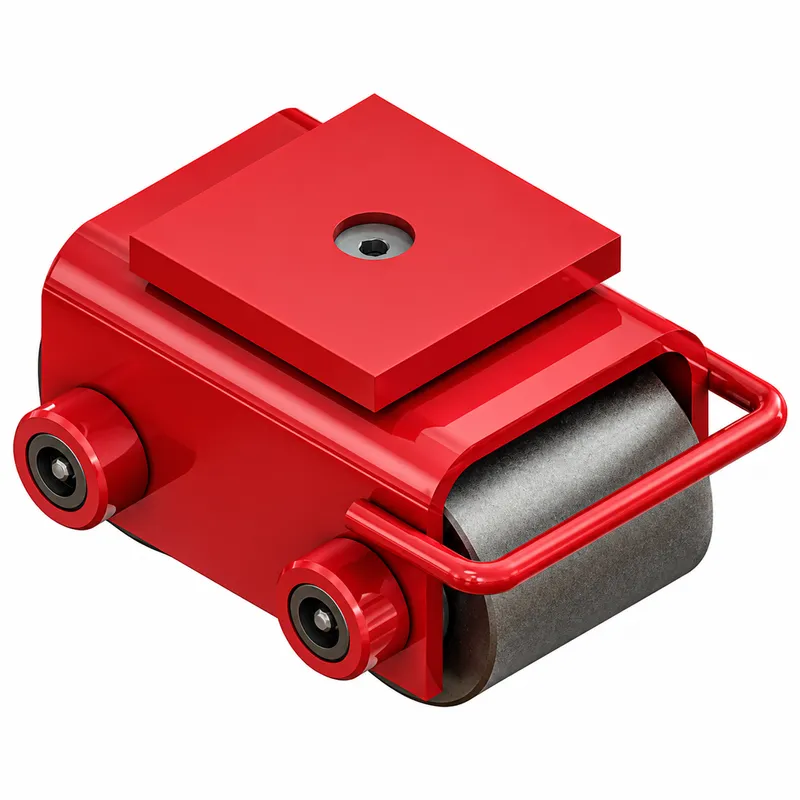
Specifications
| Type | Low-profile roller skate (machine-moving skate) |
|---|---|
| Capacity range | Industry reference: 1.5–100 t per unit class — final per-unit rating confirmed at quotation |
| Frame | Welded steel frame |
| Rollers | Steel or PU-coated rollers |
| Operation | Temporary placement under lifting points; steered by handle or supplemental steering skate |
| Lead time | 20–30 days |
| MOQ | 1–2 units |
| Warranty | 18 months |
Capacity is quoted per skate class and depends on roller type and floor condition. The 1.5–100 t span is a published industry reference range; the rating of the class quoted to you is confirmed at quotation before order confirmation.
Applications & Selection
What a skate does that a caster cannot
A caster must carry its load all day, every day, through swivels and floor joints — so its capacity is limited by bearings and swivel structure that must also survive motion. A skate only has to survive one move: it is placed under a jacked load, rolls a bounded distance on a known floor, and comes off. Removing the swivel, the brake and the daily-duty requirement is what lets a palm-sized steel platform carry tens of tonnes.
The low profile is the second half of the trick. A machine cannot be lifted far — the gap under its frame after jacking is typically a few centimeters. A skate built to slide into that gap needs minimal height, which is why the roller deck (rollers rotating on axles in a welded frame) beats a wheel: rollers let the platform stay flat and thin while still rolling.
Moving a machine safely is a load calculation before it is a hardware choice: total weight, number of skates sharing it, and the floor between origin and destination. Our caster load capacity calculation guide covers the same divide-by-three logic and worked examples — the arithmetic transfers directly to skate sets.
Selection points to settle before you RFQ
Weight and clearance first: state the machine's shipping weight and the clearance your jacking method achieves. The skate height must fit under the lifted frame, and the capacity must cover the load per skate — with three skates sharing a load on imperfect floors, size for the heaviest-loaded one, not the average.
Roller surface second: steel rollers give the lowest rolling resistance on smooth concrete and carry the most; PU-coated rollers protect epoxy-sealed and painted floors from marking at some cost in rolling effort. State your floor — the floor type selection logic used for casters applies here too.
Steering last: straight-line moves need only a handle bar; turns need a steerable (swivel-top) skate placed as the lead unit, or skates repositioned in stages. For long or frequent moves, say so — the skate set and the moving plan are quoted together.
Frequently Asked Questions
Are machine skates the same as machinery moving rollers or equipment skates?
Yes — those are regional and vendor synonyms for the same product: a low-profile roller platform placed under a load to move it. The names that cause real confusion are "skate" versus "dolly" (a dolly is usually a wheeled platform, taller, meant for lighter repeated use) and versus "caster" (permanent attachment). RFQs that state the machine weight and under-frame clearance get quoted correctly regardless of the name used.
How many skates do I need and what capacity each?
Three as the working minimum — three contact points are inherently stable on an imperfect floor, while four can rock. Divide the machine weight by three, then size each skate for its actual share: the skate under the machine's heavy end carries more than a third. Add margin for floor slope and door thresholds; the per-class rating for your floor and rollers is confirmed at quotation.
What should my machine skate RFQ include?
Machine weight (shipping weight, with the heaviest component stated separately if known), available clearance under the frame after jacking, floor type and condition, distance and path (straight or turning), roller surface preference, and how many moves the set must survive. Purpose-built moves — press bodies, CNC machining centers, injection molds — quote fastest when the machine footprint is included.
Ordering & Documentation
Documents
Orders ship with a packing list and commercial invoice. On request we provide the skate's dimension sheet (height, platform size, roller layout) so your rigging plan can be checked against the jacking clearance before the skates ship.
Quotation
A quotation needs: machine weight, clearance, floor type, move path, roller surface and set size. The quoted class and its per-unit rating are confirmed on the quotation against your stated load — the published industry range is for class selection, not the commitment.
Sample & supply
Machine skates are low-volume equipment: MOQ is 1–2 units, and lead time is 20–30 days. Because a skate set is quoted against a specific move, the practical "sample" is the quoted set itself — trial orders of one steer + two straight units are a common first purchase, expandable to larger sets on the same terms.
Storage & shipping
Skates are heavy steel and ship bare or palletized. Between moves, keep the roller axles greased and the deck faces clean — a chip of welding slag or a hardened grit line across the rollers marks floors and raises rolling effort. Store indoors; PU-coated rollers should be kept out of direct sunlight, which ages the coating. Never store a skate under a load for weeks — take the static load off the rollers when the move is done.