
Product Catalog
V-Groove Track Wheels — Cast Iron Wheels for Angle Iron Track
Updated 2026-11
V-groove track wheels roll on inverted angle iron track instead of the shop floor. The tread carries a precisely machined 90-degree V-groove with a relief groove at its root, which equalizes load across the two track edges and keeps the wheel centered without guidance rollers. The same wheel can also run on flat surfaces, which makes it a practical choice for carts that move between a fixed track section and open floor.
Typical uses include track-mounted material carts, sliding gates, kiln and oven carriages, conveyor push-line trolleys and any fixture that must repeat the same path thousands of times. Because the track carries the wheel on a defined rail, floor condition stops being the limiting factor — the limiting factors become track alignment, wheel material and bearing choice.
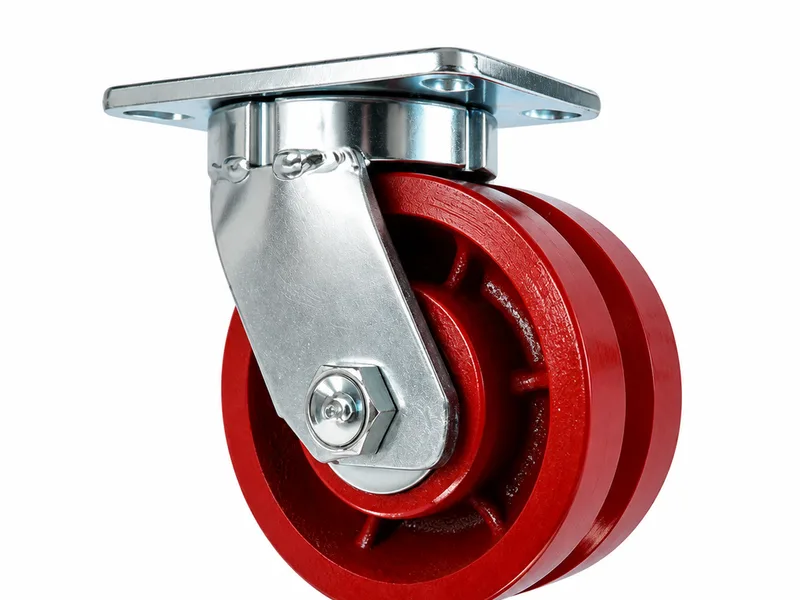
Specifications
| Wheel material | V-groove on cast iron |
|---|---|
| Groove geometry | Machined 90° V-groove with relief groove for load equalization |
| Size range | Ø 4–12 in (manufacturer category range — per-size data confirmed at quotation) |
| Manufacturer SKU reference (per-SKU, not ours) | A manufacturer V-groove wheel chart lists wheel diameters from 4 to 12 in and widths from 1.5 to 3 in, rating its 4 in × 1-1/2 in wheel at 700 lb and its 12 in × 3 in wheels at 6,000 lb (VIR-series part numbers) — chart values per SKU, never tenant ratings |
| Surface finish | Zinc plating |
| Track | Inverted angle iron track; also runs on flat surfaces |
| Lead time | 15–20 days (custom configurations 30–40 days) |
| MOQ | 200 pieces (standard catalog items ship in smaller quantities) |
| Warranty | 18 months |
Load capacity in published catalogs is quoted per wheel size (a 4-inch cast iron V-groove wheel is commonly rated around 600 lb; larger diameters rate higher). Treat published figures as per-size reference values, not a family-wide rating — the rating for your size and bearing is confirmed at quotation.
Applications & Selection
Where V-groove wheels earn their keep
The engineering problem a V-groove wheel solves is path repeatability. A free-rolling caster on a rough floor drifts, and every drift is corrected by the operator pushing the cart sideways. On a track, the V-groove engages the angle iron and the path is fixed: carts stay in line in dark aisles, gates close into the same frame every cycle, and kiln cars enter the chamber without scraping the walls.
Cast iron is the standard tread material here because track rolling concentrates load on two narrow edges — a soft tread (rubber, polyurethane) flattens and squirms under that edge loading, while cast iron resists it and tolerates the heat of oven and kiln surroundings. Where the track passes through a wash-down or outdoor section, the zinc-plated finish slows surface corrosion; the wheel itself stays cast iron because plating a tread that is machined after plating would defeat the geometry.
The relief groove at the root of the V matters more than it looks. Without it, debris carried along the track packs into the groove apex and lifts the wheel off its seat; the relief gives that debris somewhere to go and keeps both edges of the V in contact.
Selection points to settle before you RFQ
Track section first: state the angle iron size and whether it is mounted point-up. The wheel groove must match the track angle (90° is standard) and the wheel width must let the track leg ride up into the relief, not bottom out in the groove apex.
Load next: divide the total carried weight by the number of wheels actually sharing it — on a four-wheel track cart that is usually three, because alignment is never perfect. Cast iron wheel capacity scales with diameter and tread width; the sizing logic is the same one behind our caster load capacity calculation guide.
Bearings and environment last: straight roller bearings carry the most and tolerate slow, heavy pushes; ball bearings roll easier for hand-pushed carts. For oven or kiln surroundings, check the bearing temperature limit as well as the wheel material — the bearing is usually the first component to limit service temperature.
Frequently Asked Questions
Are V-groove wheels the same as flanged track wheels or V-groove conveyor wheels?
No, and the names get mixed in searches. A V-groove track wheel has a 90-degree groove machined into a cylindrical tread and rolls on inverted angle iron. A flanged wheel has a raised rim that runs against the side of a rail. A "V-groove conveyor wheel" is often a much lighter stamped wheel for gravity conveyor lines. When you RFQ, state the track section you run on — that disambiguates the type faster than any name.
What size V-groove wheel do I need for my load?
Size from load per wheel and duty. Published ratings are per wheel size (a 4-inch cast iron V-groove wheel is commonly listed around 600 lb; ratings rise with diameter). Divide total load by three for a four-wheel cart on imperfect track, then pick the next diameter up for rough or dirty track and continuous cycling. The exact rating for your size, bearing and speed is confirmed at quotation before order confirmation.
What should my V-groove wheel RFQ include?
Wheel diameter and tread width, groove angle (90° standard), track section size and orientation, load per wheel, bearing type, environment (temperature, wash-down, debris) and quantity per size. A photo or drawing of the track section shortens quoting the most, because groove fit to the track is the detail most often wrong in first-round RFQs.
Ordering & Documentation
Documents
Every order ships with a packing list and commercial invoice. For project purchases we can provide dimensional drawings of the wheel cross-section (groove angle, width, hub and bore) on request, so your track fabricator can check fit before production. Material and finish statements are quoted per order.
Quotation
A quotation needs: diameter, tread width, groove angle, bearing type, load per wheel, environment and target quantity. Per-size load ratings and any special groove dimensions are confirmed on the quotation — published catalog figures are reference values for sizing, not the order commitment.
Sample & supply
Standard catalog sizes are produced to order with an MOQ of 200 pieces; smaller trial quantities of catalog items can ship in some sizes — ask with your RFQ. Lead time is 15–20 days for standard configurations and 30–40 days for custom groove or bore work. Samples ship freight collect and are refundable against a bulk order.
Storage & shipping
Cast iron wheels are mechanically robust but the machined groove and bearing seats should be protected: store indoors, keep the groove free of grit before assembly, and do not stack wheels groove-to-groove without separators. In coastal or humid storage, keep the zinc-plated surfaces dry and cartoned; bearings should stay in their original grease until installation.