
Product Catalog
Kingpinless Casters — Impact-Resistant Swivel Casters Without a Kingpin
Updated 2026-11
A conventional swivel caster holds its races together with a kingpin — a central bolt that is also the structurally weakest point of the swivel section. Under shock loads (towing, dock work, drop-offs over door thresholds, uneven floor edges) the kingpin and its raceway take the impact first, and kingpin failure is the most common way a heavy-duty caster dies. A kingpinless caster removes the pin entirely: the top plate and the swivel raceway are formed from one piece of steel, so impact loads pass through a continuous ring instead of a fastener.
The result is a swivel section that survives high-impact and constant-swiveling duty — the standard specification for tow lines, AGV tail casters, dock and ramp service, and any cart that gets shoved rather than steered. Published industry lines span stamped kingpinless construction for medium duty up to forged kingpinless construction rated to tens of thousands of pounds; the rating that applies to your build is fixed by the series and confirmed at quotation.
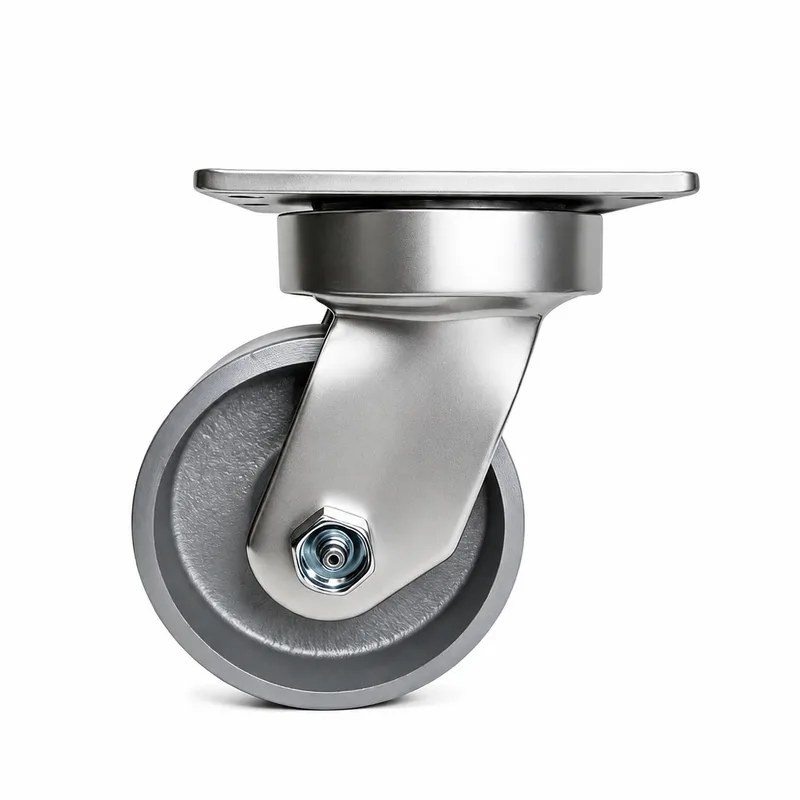
Specifications
| Swivel construction | Kingpinless — integrally formed raceway, no kingpin fastener |
|---|---|
| Construction options | Stamped kingpinless (medium/impact duty); forged kingpinless (heavy/impact duty) |
| Material options | Stamped carbon steel; polished stainless steel option |
| Surface finishes | Zinc plating; polished stainless |
| Typical duty | High-impact, constant-swiveling, towed applications |
| Manufacturer SKU reference (per-SKU, not ours) | A published 110-series kingpinless rigid SKU (6 x 2 in cast-iron wheel, roller bearing) rates 1,400 lb with 7-1/2 in mounting height, 4 x 4-1/2 in top plate and zinc finish; its series line is rated to 2,000 lb per caster — peer chart values for sizing context, never tenant ratings |
| Published series variants (industry reference) | A spring-loaded kingpinless series lists capacities at 50% of wheel deflection (21/32 in; total possible deflection 1-5/16 in); a dual-wheel kingpinless version adds a third full leg for durability — variant selection confirmed at quotation |
| Load rating | By series — confirmed at quotation (industry lines span roughly 1,200 lb to 30,000 lb by series and size) |
| Lead time | 15–20 days (custom configurations 30–40 days) |
| MOQ | 200 pieces (standard catalog items ship in smaller quantities) |
| Warranty | 18 months |
Load capacity is a per-series figure, not a family-wide number — industry catalogs list different series from about 1,200 lb up to 30,000 lb. The rating for the series, wheel size and bearing you specify is confirmed at quotation.
Applications & Selection
When the kingpin is the failure point, delete the kingpin
Kingpinless construction is specified for one reason: shock. A towed cart jerks its casters every time the tug starts; a dock cart takes the edge of every ramp joint; an AGV accelerates and brakes its tail casters thousands of times a shift. Each of these events drives a momentary load spike through the swivel raceway. On a pinned caster the spike concentrates at the kingpin, the raceway deforms, and swivel effort rises until the caster is replaced. On a kingpinless caster the same spike spreads around the continuous integrally-formed raceway.
The trade is repairability and price. A pinned caster can be disassembled — its races and swivel bearings are serviceable parts, which is why pinned construction still dominates maintenance-focused fleets (our kingpin, fork and bearing wear inspection guide covers that service path). A kingpinless caster is effectively a sealed structural unit: nothing to service, nothing to work loose, and when its (long) life ends it is replaced whole.
Selection points to settle before you RFQ
Decide stamped versus forged by impact, not by static load. Stamped kingpinless construction handles medium-duty impact duty at a lower price; forged kingpinless construction is the specification for continuous towing and heavy impact, where the raceway geometry must hold under repeated spikes. Our forged vs stamped bracket comparison walks through the same material logic.
Match the offset to the duty. Larger swivel offset reduces steering effort but increases the wobbling tendency at speed; towed applications typically want a moderate offset and a kingpinless raceway rated for the tow-line shock. If your build combines axial and radial loads at the swivel, bearing and fit selection at the raceway matters — see our clearance fit class guide for the fit-class logic.
State the environment. Where wash-down or corrosion drives the spec, the polished stainless option replaces plated carbon steel; the swivel section geometry is the same, but confirm the stainless series load rating separately, because it is usually lower than the equivalent carbon-steel series.
Frequently Asked Questions
What does "kingpinless" actually mean — is it just a caster without a bolt?
It is a different swivel structure, not just a deleted fastener. In a kingpinless caster the top plate and the lower raceway are integrally formed from one piece of steel, so the swivel races are concentric grooves in continuous material. There is no pin to shear, no nut to loosen and no separate race to deform out of round. That continuous load path is what makes the construction resistant to impact failure.
How do I choose between stamped and forged kingpinless casters?
By impact severity and duty cycle. Stamped kingpinless casters suit medium-duty carts with occasional impact; forged kingpinless casters are the standard for tow lines, dock service and constant hard swiveling, where industry lines rate up to 30,000 lb in the largest series. Size from load divided by three (not four), then step up a series when the duty is towed or high-cycle. Confirm the series rating at quotation.
What should my kingpinless caster RFQ include?
Load per caster, towed or pushed (and tow speed if towed), top plate size and bolt pattern, wheel diameter and material, bearing type, swivel offset if it is fixed by your design, environment (corrosion, wash-down, temperature) and quantity. Say explicitly that you want kingpinless construction — quotes sometimes default to pinned equivalents at a lower price.
Ordering & Documentation
Documents
Orders ship with a packing list and commercial invoice. On request we provide top-plate and bolt-pattern dimension sheets for the quoted series, so your frame shop can drill before the casters arrive. Series specification statements (stamped or forged, plated or stainless) are quoted per order.
Quotation
A quotation needs: load per caster, duty (pushed/towed, cycles per shift), plate and bolt pattern, wheel and bearing selection, finish, and quantity. The series and its load rating are confirmed on the quotation — that per-series figure, not a catalog headline number, is the commitment.
Sample & supply
Standard series are produced to order with an MOQ of 200 pieces; smaller trial quantities of catalog items can ship in some series — ask with your RFQ. Lead time is 15–20 days standard, 30–40 days for custom plates, wheels or stainless configurations. Samples ship freight collect and are refundable against a bulk order.
Storage & shipping
Kingpinless casters ship assembled. Store them plated-side dry and keep swivel sections free of concrete dust and welding spatter — grit packed into the raceway is the one storage-related failure this construction has. Do not lift a full cart by its casters; the raceway is designed for compression and steering loads, not hoist points.