
Product Catalog
Rigid Casters — Straight-Line Stability and Higher Load per Fork
Updated 2026-11
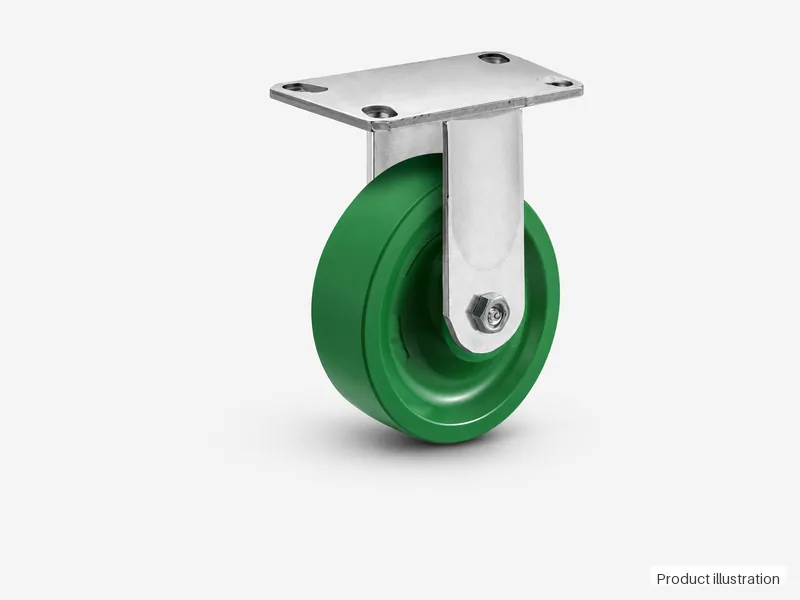
A rigid caster is the simplest load-carrying assembly in the catalog: a fork welded or bolted straight to a top plate, no swivel raceway between them, so the wheel can only roll forward and back. That restriction is the product. With no raceway to carry, the whole fork works as a structure — which is why a rigid caster of the same plate size and wheel carries more load than its swivel twin, holds a line under tow without wandering, and costs less. The trade is maneuverability: wherever the equipment must turn, the turn has to come from the casters you pair it with, or from the operator lifting the front end.
On our line, rigid casters are a configuration of the family rather than a separate product: the standard wheel materials — polyurethane, cast nylon (PA6), rubber and forged steel — all mount in rigid forks across the Ø 25–300 mm size range, produced and delivered through own production plus outsourcing. Typical duty is everything that moves in straight paths: in-plant trailers and tugger trains, assembly-line and flow racks, ladder and platform trucks (two rigid, two swivel), material bins, and the trailing ends of equipment that steers from its swivel ends.
Specifications
| Caster type | Rigid (fixed) fork — top plate mounting; directional movement limited to straight-line rolling |
|---|---|
| Wheel materials | Polyurethane (PU), cast nylon (PA6), rubber, forged steel — quoted per duty and floor |
| Load rating | Higher than the same-size swivel caster (no raceway in the load path); the per-size rating for your wheel, bearing and duty is confirmed at quotation |
| Size range | Ø 25–300 mm on our line (per-size dimensions, plates and bores confirmed at quotation) |
| Industry reference band | Published selection tables place common rigid casters from ~400 lb (5 in nylon, stem mount) to ~1,000 lb (8 in steel, round-plate mount) per caster — reference band, not a tenant rating |
| Mounting | Top plate (standard); stem and bolt-hole configurations quoted per application |
| Bearings | Plain bore · ball · roller — matched to load and speed at quotation |
| Lead time | 15–20 days (custom configurations 30–40 days) |
| MOQ | 200 pieces (standard catalog items ship in smaller quantities) |
| Warranty | 18 months |
Load figures marked as industry references are published comparison bands for sizing orientation, kept per configuration — never merged into a tenant family promise. A rigid fork carries more than a same-size swivel because there is no raceway in the load path; the actual rating for your size, wheel material and bearing is confirmed at quotation.
Applications & Selection
Where a rigid fork is the right answer
Choose rigid whenever the route is straighter than it is twisty. Towed equipment is the clearest case: a trailer that steers from its front swivel pair tracks badly on four swivels — the back end walks and the tow effort climbs — while trailing rigid forks hold the line. The same logic keeps tugger trains, in-plant trailers and long material trains on rigid rears. Published selection guidance makes the same point from the stability side: with the steering function removed, a rigid caster resists tipping and drifting better than a swivel of the same size, which is why heavy straight-path equipment such as generator and compressor bases defaults to rigid.
The second reason is load per millimetre of plate. The swivel raceway is the most loaded and most complex element of a caster; removing it deletes a wear part and a failure mode, and lets the same plate and wheel carry more. Industry selection tables reflect the ordering — steel-tread rigid casters at 8 in diameter sit around 1,000 lb per caster (published round-plate mount figure) where smaller nylon builds sit near 400 lb — and our own family is quoted the same way: capacity comes from the wheel, bearing and fork combination, and the rigid configuration gives the same wheel more headroom than a swivel housing would.
The third reason is cost and maintenance. Fewer parts, no raceway bearings to pack or replace, and a simpler weldment: rigid casters are the economy configuration where turning is not required. The standard layout that gets most of both worlds is two plus two — swivel casters on the steering end, rigid casters on the drive or trailing end — which is how platform trucks, ladder carts and most in-plant trailers are built.
Selection points to settle before you RFQ
Decide the steering split first. If the equipment must turn in place or thread aisles, this is not the product — see our swivel casters with total lock, or mix: state which positions are rigid and which are swivel so plate heights match across the set (a mixed set must level, or the deck racks). If the route is straight-line or towed, rigid is right, and the remaining choices are wheel-level ones.
Pick the wheel against floor, debris and load as you would for any caster: PU for quiet floor-protective rolling, cast nylon for push-effort and load in wet or corrosive washdown, rubber for noise and small-debris tolerance, forged steel for the heaviest loads and heat. Because a rigid fork removes the raceway from the load path, the wheel choice — not the fork — is what sizes the caster; our load-capacity and wheel-material knowledge pages carry the comparisons with numbers.
Fix the interface before quoting: top-plate size and hole pattern (or stem), mounting height, and the wheel bore and axle for frame-built applications. For towed duty, say so — towed rigid casters see side forces a hand-pushed caster never meets, and the bearing and fork are quoted differently for it. State the floor and the environment (temperature, moisture, chemicals) so the wheel and finish arrive matched to the duty rather than to the catalog default.
Frequently Asked Questions
Rigid vs swivel casters — how do I split a four-caster equipment set?
Let the route decide. If the equipment must turn within its own length or weave through aisles, use four swivels (or add brakes). If it moves mostly in straight lines, the standard split is two swivels on the steering end and two rigid casters on the trailing end: the swivels do the turning, the rigids hold the line, carry more per fork and cost less. Fully rigid sets are only for equipment that is pushed perfectly straight or towed on rails or marked paths — with no swivel anywhere, the operator ends up lifting the front end to change direction.
Why does a rigid caster carry more than a same-size swivel?
Because the load path is shorter and simpler. In a swivel caster, the entire load crosses a ball raceway between the fork and the mounting plate — a precision component that is also the caster’s main wear part and its load ceiling. A rigid fork bolts straight to the plate, so the same plate and wheel combination is limited by the wheel and fork alone. That is also why rigid casters have no offset and track straight under tow, while a swivel under tow constantly fights to trail. The exact per-size figure is confirmed at quotation against your wheel, bearing and duty.
What should my rigid caster RFQ include?
Load per caster with the duty class (static, rolling, pushed, towed), wheel material preference or the floor/noise/temperature constraints, wheel diameter and tread width, top-plate size and hole pattern (or stem type and size), mounting height, bearing type if you have a preference, the floor and environment, quantity per size — and, if ordering a mixed set, which positions are rigid and which are swivel so plate heights and holes match across the equipment.
Ordering & Documentation
Documents
Every order ships with a packing list and commercial invoice. On request we provide the dimension sheet for the quoted caster (plate, mounting height, wheel diameter and width, bore) so frame cut-outs and deck holes can be checked before production.
Quotation
A quotation needs: load and duty class, wheel material and size, plate or stem interface, environment and quantity. Rigid caster ratings are quoted per wheel, bearing and duty — published reference bands are sizing orientation, and the order commitment is the figure on the confirmed quotation.
Sample & supply
Standard sizes are produced to order with an MOQ of 200 pieces; smaller trial quantities of catalog items can ship in some sizes — ask with your RFQ. Lead time is 15–20 days for standard configurations and 30–40 days for custom plates, stems or wheel work. Samples ship freight collect and are refundable against a bulk order.
Storage & shipping
Rigid casters ship cartoned, plates face-protected. There is no raceway to pack or damage in storage; keep wheels clean and out of sunlight if the tread is rubber or PU, and keep bearings in their original grease until installation. Mixed swivel/rigid sets are cartoned and labeled by position so the mounting crew does not have to sort them on the floor.