
Product Catalog
Cast Iron Caster Wheels — High Load, Heat Tolerance and the Lowest Cost per Kilo
Updated 2026-11
Cast iron wheels are the load-and-temperature workhorses of the wheel catalog: a hard, dimensionally stable metal tread that carries more weight per dollar than any polymer, shrugs off heat that would melt or delaminate every soft tread, and rolls with almost no resistance because nothing in the tread absorbs energy. The same hardness is also the limitation — cast iron transmits every bump and will mark, chip and eventually damage finished floors — so it belongs on rough concrete, steel decks, and in ovens and foundries, not on epoxy showroom floors.
Cast iron is one of the standard wheel materials on our line (Ø 25–300 mm range), produced and delivered through own production plus outsourcing, so size and bore requirements outside the standard list are quotable rather than impossible. Typical service is exactly where polymers bow out: oven and kiln-adjacent racks (with high-temperature grease in the bearings), heavy stationary fixtures that move rarely but move heavily, and debris-strewn floors where a soft tread would be shredded in a season.
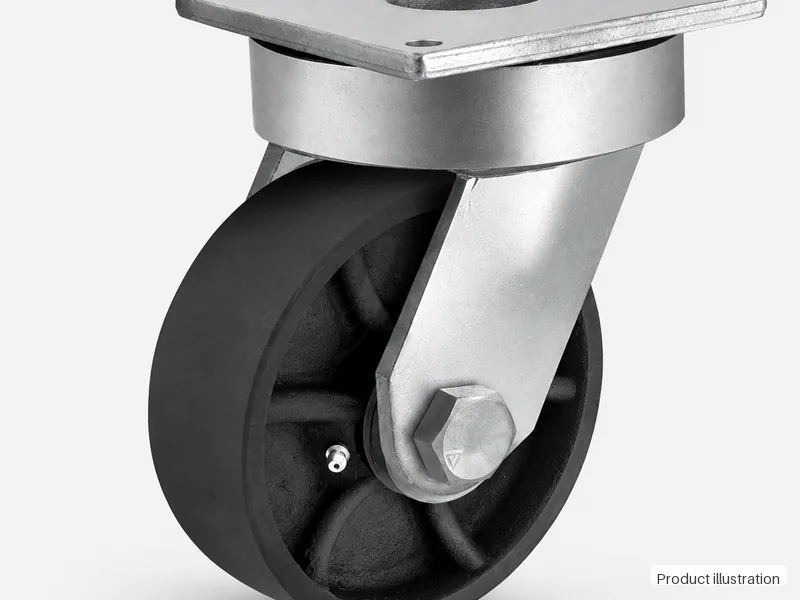
Specifications
| Wheel material | Cast iron (gray iron), machined tread; V-groove variants on the track-wheel page |
|---|---|
| Size range | Ø 25–300 mm on our line (per-size dimensions and bores confirmed at quotation) |
| Industry reference band | 1,000–3,000 lb per wheel at 5 in diameter (published comparison data, not a tenant rating); capacity rises with diameter and tread width |
| Temperature range | Industry reference: −40…500 °F for the wheel material — the bearing and grease usually limit first; high-temp grease quoted for oven duty |
| Tread hardness | Approx. Brinell 145 (manufacturer reference for gray iron V-groove-class wheels) |
| Manufacturer SKU reference (per-SKU, not ours) | A manufacturer cast-iron wheel chart rates 3 in × 1-5/16 in at 300 lb (straight roller) and 3-1/4 in × 1-1/2 in at 400 lb, all at approx. Brinell 145, with the line spanning 300–6,000 lb across 3–18 in — chart values per SKU, never tenant ratings |
| Rolling resistance | Very low — the lowest of the common tread materials |
| Floor protection | Very poor on finished floors; intended for concrete, steel decks and track |
| Bearing options | Plain bore · straight roller · tapered roller (duty-dependent, quoted per configuration) |
| Lead time | 15–20 days (custom configurations 30–40 days) |
| MOQ | 200 pieces (standard catalog items ship in smaller quantities) |
| Warranty | 18 months |
Load, temperature and hardness figures marked as industry or manufacturer references are published comparison data for sizing orientation — not tenant ratings and not family promises. Cast iron capacity is quoted per size, bore and bearing; the figure for your configuration is confirmed at quotation.
Applications & Selection
Where cast iron earns its keep
Three duty classes keep choosing cast iron. The first is raw load on forgiving floors: foundry carts, steel-mill and heat-treat fixtures, heavy tooling and dies, aerospace and shipyard dollies — anywhere the load per wheel climbs past what polymers carry and the floor is steel or rough concrete that a hard tread will not hurt. Published material comparisons put cast iron at 1,000–3,000 lb per wheel at 5 inches with a −40…500 °F band and the lowest cost index of the common materials, which is why it survives as the economy metal tread.
The second is heat. Polymer treads fail by softening or delamination at their continuous limits; cast iron does not care about oven-adjacent radiant heat, and the practical ceiling moves to the bearing and its grease. That is why oven racks, curing ovens, bakery and kiln cars run metal wheels with high-temperature grease — the wheel is rarely the first component to fail, and our bearing-temperature knowledge base covers how bearing type moves that ceiling.
The third is debris and abuse: scrap-handling, construction-site material trains, outdoor fixtures. A hard tread does not slice open on grit the way an elastomer does. The trade-offs are equally blunt: zero cushioning (fragile loads and operator comfort suffer), noise, floor damage, and brittleness — impact at the tread edge can chip cast iron where ductile iron or forged steel would dent. Where shock loads dominate, step up to forged steel; where the floor must survive, stay with polyurethane.
Selection points to settle before you RFQ
Size from load per wheel (total ÷ three for a four-wheel rig) and duty: cast iron ratings scale with diameter and tread width, so state the working load honestly and let the quotation fix the per-size rating rather than back-fitting from a catalog figure for a different size. If speeds exceed walking pace or duty is continuous, name it — metal wheels at speed on rough floor are a bearing and spall question.
Bearings decide more of the service life than the tread does. Plain bore is the cheap answer for slow, occasional moves; straight roller bearings carry more and tolerate slow heavy pushes; tapered rollers take combined loads on towed lines. For anything oven-adjacent, specify the ambient temperature so the grease is quoted to match — wheel material ratings mean nothing if the grease has already given up.
Fix the interface: bore and axle size, mounting (these wheels bolt into caster rigs or your own fabricated frames), and any groove requirement — a V-groove for angle-iron track is a different geometry and lives on our V-groove track wheel page. State the floor so the tread choice is on record; cast iron specified onto a finished floor is a complaint waiting to happen, and we would rather propose PU or a crowned metal tread at quotation than after delivery.
Frequently Asked Questions
Cast iron or forged steel wheels — which do I need?
Load class and impact. Cast iron carries 1,000–3,000 lb per wheel at 5 inches (industry reference) at the lowest cost, and is the right tread for heavy static loads, heat and debris on rough floors. Forged steel is the answer when loads run higher, duty is towed or impact-heavy, or a chipped cast iron tread is unacceptable — forged steel deforms instead of cracking, at several times the cost. If your loads sit under ~3,000 lb per wheel and the floor is rough concrete, cast iron is usually the economical choice.
How hot is too hot for a cast iron wheel?
The wheel material tolerates oven-adjacent temperatures (published references give cast iron a −40…500 °F band), but the practical limit is almost always the bearing and its lubricant. Standard grease fails well below the wheel’s limit, so for oven, kiln or curing-oven duty specify the ambient temperature in your RFQ and the configuration is quoted with high-temperature grease — and check our knowledge base on cast iron housed bearing temperature limits for the bearing-type comparison.
What should my cast iron wheel RFQ include?
Load per wheel, wheel diameter and tread width (or bore and axle if you are fitting to your own frame), bearing type, ambient temperature if elevated, floor or track type, mounting arrangement, finish requirement, and quantity per size. A sketch of the mounting interface shortens quoting; for anything running on track, send the track section size instead.
Ordering & Documentation
Documents
Every order ships with a packing list and commercial invoice. On request we provide the dimension sheet for the quoted wheel (diameter, tread width, hub, bore) and the material statement for your configuration, so fabricated frames and maintenance records can be checked before production.
Quotation
A quotation needs: diameter, tread width, bore and axle, bearing type, ambient temperature, mounting, finish and quantity. Cast iron load ratings are per size and bearing — published bands are sizing references, and the order commitment is the figure on the confirmed quotation.
Sample & supply
Standard sizes are produced to order with an MOQ of 200 pieces; smaller trial quantities of catalog items can ship in some sizes — ask with your RFQ. Lead time is 15–20 days for standard configurations and 30–40 days for custom bores, widths or mountings. Samples ship freight collect and are refundable against a bulk order.
Storage & shipping
Cast iron wheels are mechanically robust; the care points are the machined surfaces and the bearings. Store indoors, keep treads and bores free of grit, keep bearings in their original grease until installation, and do not stack wheels tread-to-tread without separators. In coastal or humid storage, carton the wheels and keep them dry — the cast surface will surface-rust, which is cosmetic on the tread but must be kept out of the bore.