
Product Catalog
Heavy Duty Casters — RM-Medium, RM-Heavy and RM-Extreme Series, 150–2000 kg
Updated 2026-11
Heavy duty casters are the components that let a die cart, a heavy trolley or a piece of machinery move at all — and at this load class the differences between grades stop being cosmetic. Our line is organized as three declared series rather than one vague family: RM-Medium carries 150–500 kg per caster as the entry tier, RM-Heavy carries 500–1500 kg, and RM-Extreme is the forged-steel top tier specified to 2000 kg per caster. Each series is a declared band from our product data, so you can match the tier to the load instead of guessing where a generic "heavy duty" rating ends.
Across the line, the wheel options are polyurethane on a steel core, cast nylon (PA6) and forged steel, on welded steel brackets with zinc-plated or powder-coated finishes. Standard series run at up to 4 km/h — the speed most hand-pushed and towed-at-walking-pace equipment actually sees — and a precision-bearing series raises that to 8 km/h. Wheel diameters run to 300 mm across the heavy-duty line.
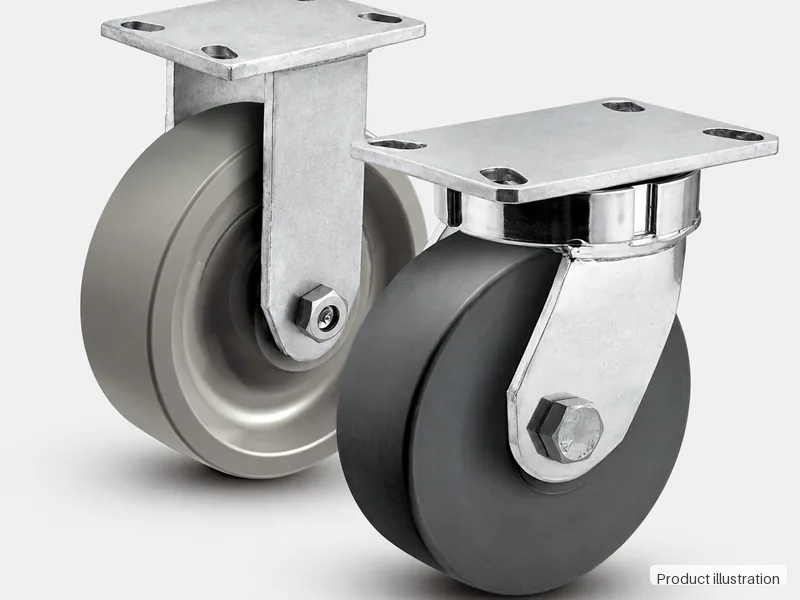
Specifications
| Series ladder | RM-Medium 150–500 kg · RM-Heavy 500–1500 kg · RM-Extreme 1500 kg+ (line specified to 2000 kg) — per-caster, tenant-declared series bands |
|---|---|
| Wheel materials | Polyurethane (PU) on steel core · Cast nylon (PA6) · Forged steel (RM-Extreme) |
| Brackets | Welded steel; heavy-gauge welded brackets on RM-Extreme |
| Surface finishes | Zinc plating · Powder coating |
| Speed rating | ≤ 4 km/h standard; ≤ 8 km/h precision-bearing series |
| Temperature range | −20…+80 °C (std PU); −40…+120 °C (special PU) |
| Size range | Ø 100–300 mm (heavy-duty line) |
| Lead time | 15–20 days (custom configurations 30–40 days) |
| MOQ | 200 pieces (standard catalog items ship in smaller quantities) |
| Warranty | 18 months |
Series load bands are the declared ranges of our product line (first-party product data), quoted per caster under standard conditions. The rating for your exact wheel material, bearing, speed and floor is confirmed at quotation; towed and impact duty is derated per the sizing rules below.
Applications & Selection
Matching the series to the duty
Start from load per caster, calculated honestly: divide the total carried weight by the number of casters that will actually share it — three, not four, on a conventional four-caster rig, because an imperfect floor never loads all four equally. Then add the duty margin before you pick a tier. A trolley that rolls 200 kg of tools by hand is an RM-Medium problem (150–500 kg per caster); a die cart or heavy industrial trolley in the 500–1500 kg class is RM-Heavy; machinery moving and towed fixtures that exceed 1500 kg per caster are what RM-Extreme and its forged steel cores exist for.
The wheel material decision is as important as the tier. Polyurethane on a steel core is the default because it rolls easily, protects concrete and resists oil and grease; cast nylon (PA6) takes higher point loads and tolerates wet and chemical environments but is harder on floors and louder; forged steel is the extreme-duty answer where loads, impact and tow lines would destroy any soft tread. Industry references group them the same way — polyurethane rated high for load capacity, nylon very high, steel extreme — which is why the series ladder offers all three rather than one.
Temperature bounds the tread choice inside the tier: standard PU wheels in this line are rated −20…+80 °C, and the special-PU option extends that to −40…+120 °C for freezer docks and heat-adjacent lines. Where the ambient sits outside even that band, the correct heavy-duty wheel is nylon or steel, not a derated polyurethane.
Selection points to settle before you RFQ
State the duty type, not just the load. Continuous rolling, shock loading and towing each justify a different margin above the working load — our heavy-duty selection guide and the safety-margin guide for heavy wheels walk the factor logic, and the worked-example guide shows the arithmetic end to end. A caster that is correct at rated load can still fail in tow service at half the load.
State the speed and the tow method if powered. The 4 km/h standard rating covers hand pushing and walking-pace towing; if equipment moves faster or cycles continuously, name it and quote the precision-bearing series (≤ 8 km/h) instead of hoping a standard bearing survives.
Fix the interface details: top plate size and bolt pattern, swivel versus rigid positions, brake requirements per position, and the floor (rough concrete eats soft treads; protected floors reward them). For RM-Extreme machinery-moving work, say whether the caster must also swivel under load — swivel effort and trail at 1500 kg+ is a design question, not an afterthought.
Frequently Asked Questions
What is the difference between RM-Medium, RM-Heavy and RM-Extreme heavy duty casters?
The declared per-caster load band and the construction behind it. RM-Medium (150–500 kg) is the entry tier for heavy trolleys and equipment on welded steel brackets. RM-Heavy (500–1500 kg) is the middle tier for die carts and heavy industrial trolleys. RM-Extreme (1500 kg+, line specified to 2000 kg) pairs forged steel wheel cores with welded heavy-gauge brackets for machinery moving and impact-heavy duty. All three share the same finishes and the same standard/precision-bearing speed split; the tiers differ in what the wheel and bracket are built from.
How do I size a heavy duty caster for my load?
Divide the total load by the number of casters actually sharing it (three for a four-caster rig on an imperfect floor), apply the duty margin for shock, towing or continuous rolling, and match the result to a series band. If the working number lands close to a band edge, take the higher tier — the margin is cheaper than a roadside failure. The exact rating for your wheel material, bearing and speed is confirmed at quotation.
What should my heavy duty caster RFQ include?
Total load and how the equipment contacts the floor (number and layout of casters), duty type (hand-pushed, towed, impact), speed, floor condition, environment (temperature, moisture, chemicals), preferred wheel material or the problem you want solved, top plate and bolt pattern, swivel/rigid/brake configuration per position, and quantity per size. For machinery moving, add the direction of travel and any path constraints — they drive the swivel-and-rigid layout.
Ordering & Documentation
Documents
Every order ships with a packing list and commercial invoice. On request we provide the dimension sheet for the quoted caster (top plate, bolt pattern, overall height, wheel size and bearing) and the wheel material statement for your configuration, so your equipment drawings can be checked before production.
Quotation
A quotation needs: series (or the load and duty so we can propose one), wheel material, size, bearing type, top plate and configuration per position, environment and quantity. The confirmed quotation states the rating for your exact configuration — series bands are declared ranges of the product line, and the order commitment is the figure on the quotation.
Sample & supply
Standard configurations are produced to order with an MOQ of 200 pieces; smaller trial quantities of catalog items can ship in some sizes — ask with your RFQ. Lead time is 15–20 days for standard configurations and 30–40 days for custom plates, bores or wheel materials. Samples ship freight collect and are refundable against a bulk order.
Storage & shipping
Heavy duty casters ship in protected cartons with the bearing seats greased. Store indoors, keep polyurethane treads out of direct sunlight and away from ozone sources (motors, welders) during long storage, and do not store casters stacked under load — a set tread deformity shows up later as a flat spot. Forged-steel wheels should be kept dry; the zinc or powder finish protects the bracket, not the machined bearing seats.