
Product Catalog
Nylon (PA6) Caster Wheels — High-Temperature, High-Load Wheels for Industrial Duty
Updated 2026-11
Cast nylon (PA6) wheels are the hard-tread answer to two problems at once: heat and hardness. Nylon tolerates service temperatures that would soften a polyurethane tread — the referenced high-temperature class in this family is published at −40 °F to 600 °F — and its hard, slick surface carries concentrated loads, resists chemicals and rolls with very little resistance on smooth concrete. It is the tread you find on bakery racks, autoclave-adjacent carts, laboratory equipment and washdown lines where a soft tread would fail or harbor contamination.
The reference configuration documented for this family is a 4″ × 2″ nylon wheel on a zinc-plated steel (stainless option) fork with a total-lock brake, rated 800 lb at that size. Family availability extends beyond that single SKU — nylon wheels are supplied across our range as the wheel option on medium and heavy-duty casters — but the published per-size figures below belong to the referenced SKU class, and your configuration is confirmed at quotation.
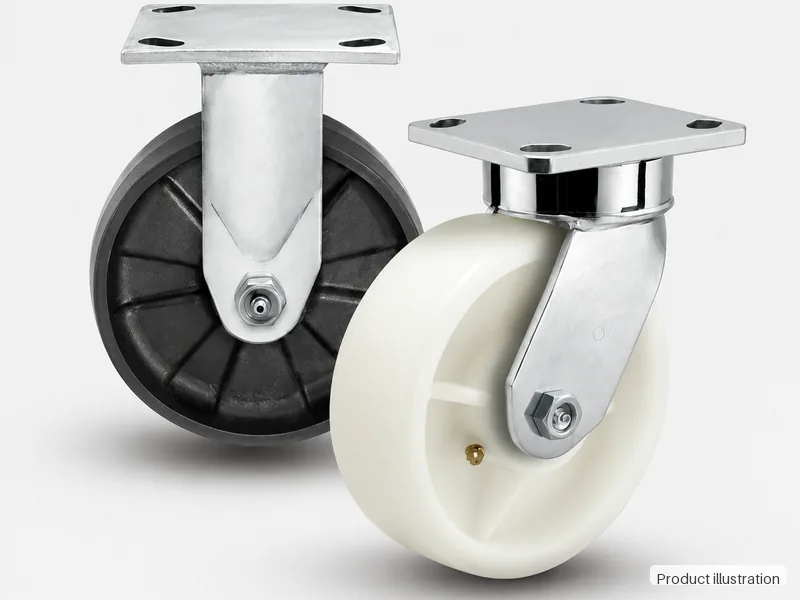
Specifications
| Wheel material | Cast nylon (PA6) |
|---|---|
| Referenced class | 4″ × 2″ wheel, roller bearing, total-lock brake, 4″ × 4-1/2″ top plate (3″ × 3″ bolt pattern) |
| Capacity (referenced SKU) | 800 lb at 4″ × 2″ — per-size figure, larger diameters rate higher; confirmed at quotation |
| Temperature (referenced product spec) | −40…600 °F (product spec table figure) |
| Manufacturer SKU reference (per-SKU, not ours) | A published 4″ × 2″ stainless hi-temp nylon SKU (roller bearing, total lock, 4″ × 4-1/2″ plate) rates 800 lb with 5.63″ overall height at −40…600 °F; the same page's overview text gives the nylon material a narrower −20…+480 °F band — peer chart values for sizing context, never tenant ratings |
| Glass-filled nylon class band (industry reference) | 800–2,500 lb per wheel at 5 in diameter, held at both temperature extremes (typically 33% glass fill, impact strength retained at −65 °F) — published material-comparison band, not a tenant rating |
| Fork / finish | Zinc-plated steel; stainless steel option |
| Brake option | Total-lock (wheel + swivel) mechanism |
| Lead time | 15–20 days (custom configurations 30–40 days) |
| MOQ | 200 pieces (standard catalog items ship in smaller quantities) |
| Warranty | 18 months |
The 800 lb capacity, 4″ × 2″ size and −40…600 °F temperature figures are per-SKU reference values from one published source (second source still in acquisition) and are not a family-wide rating — the rating for your size and duty is confirmed at quotation. Separately, the nylon material itself is commonly published with a narrower operating band (around −20 °F to +480 °F); the product-table and material-range figures are kept as two distinct claims and are not merged here.
Applications & Selection
Where nylon earns its keep
Heat is the first reason to pick nylon. Ovens, curing lines, autoclave-adjacent transport and bakery racks all sit far above the +80 °C ceiling of standard polyurethane — and nylon keeps its shape and its load capacity where PU would take a permanent set. The referenced −40…600 °F product spec belongs to a high-temperature class; verify the continuous (not just intermittent) temperature of your duty against it, because the material range and the assembled-product range are different claims.
Load concentration and low rolling resistance are the second reason. Nylon's hard tread carries high loads on a small contact patch and rolls easier than any soft tread, which matters on heavily loaded carts pushed by hand. The trade is floor contact: nylon is loud on hard floors and will mark or chip fragile floor surfaces, and on debris-strewn floors a hard tread rides over grit that a soft tread would embed. It also does not cushion the load — fragile cargo needs a soft tread or a spring-loaded caster instead.
Moisture is nylon's one behavioral quirk, and it deserves respect: PA6 absorbs water from the environment, which slightly softens and toughens the wheel and changes its dimensions at the margins. In constant washdown or soaking duty, state it in the RFQ — the failure-modes article covers how moisture changes nylon wheel behavior, and stainless forks pair naturally with it.
Selection points to settle before you RFQ
Temperature first, and precisely: give the continuous ambient and any peak (bake cycles, washdown steam), because nylon grades differ in crystallinity and fill, and the correct grade at 200 °C is not the correct grade at 280 °C — the published capacity-range comparison across wheel materials is the starting reference, and the exact grade is confirmed at quotation.
Then load and floor: per-wheel load by the three-of-four rule, floor type and how much noise the environment tolerates. Nylon in a hospital corridor is the wrong answer; nylon in a bakery is the right one. Where a duty sits between nylon and PU, the material-comparison article walks load, floor protection, rolling resistance and noise side by side.
Configuration last: the referenced class pairs the wheel with a total-lock brake (locks wheel and swivel together) — state whether you need braking per position, the top plate or stem mount, bearing type (roller bearings suit the slow, heavy pushes nylon usually serves) and the fork finish (zinc steel standard, stainless for wet or corrosive duty).
Frequently Asked Questions
How hot can a nylon caster wheel actually run?
Higher than polyurethane by a wide margin, but check which figure you are reading. The referenced high-temperature product class in this family is published at −40 °F to 600 °F (about −40 to +315 °C) at the product spec level, while the nylon material itself is commonly published with a narrower operating band around −20 °F to +480 °F — the two figures describe different things (assembled product vs material) and should not be merged. Size against your continuous duty temperature, confirm the rating at quotation, and remember the wheel's bearing and lubricant often limit service temperature before the nylon does.
Is nylon better than polyurethane for caster wheels?
Different problems. Nylon carries more concentrated load, runs far hotter, rolls easier and resists more chemicals; PU is quieter, floor-friendly, cushioned and grips better. Nylon on a bakery rack or washdown line is right; nylon on a hospital cart or finished floor is wrong. Our nylon vs polyurethane vs phenolic vs rubber comparison walks the full trade table by load, floor protection, rolling resistance and noise.
What should my nylon wheel RFQ include?
Wheel diameter and width, continuous and peak service temperature, load per wheel, wet/dry duty, floor type, bearing type, brake requirement per position (total-lock, side-lock or none), fork finish (zinc steel or stainless), top plate or stem dimensions, and quantity. Temperature and moisture are the two fields most often missing from nylon RFQs and the two that most often change the quoted grade.
Ordering & Documentation
Documents
Every order ships with a packing list and commercial invoice. On request we provide the wheel dimension sheet (diameter, width, bore, hub length, bearing), the nylon grade statement for the quoted configuration and the fork finish specification, so your drawings and duty review can be checked before production.
Quotation
A quotation needs: size, continuous and peak temperature, load per wheel, wet/dry and chemical exposure, brake and bearing selections, fork finish, mounting dimensions and quantity. The confirmed quotation states the rating for your exact configuration — the published per-SKU figures above are reference values, not the order commitment.
Sample & supply
Standard sizes are produced to order with an MOQ of 200 pieces; smaller trial quantities of catalog items can ship in some sizes — ask with your RFQ. Lead time is 15–20 days for standard configurations and 30–40 days for custom grades, bores or stainless configuration work. Samples ship freight collect and are refundable against a bulk order.
Storage & shipping
Nylon wheels are dimensionally stable in storage and ship cartoned. Keep them dry and out of direct sunlight — PA6 absorbs ambient moisture over long storage, which is harmless for the wheel but means bearings should stay packaged and greased until installation. Do not store nylon wheels near strong acids or oxidizers; the material is chemical-resistant to most industrial fluids but not to all.