
Product Catalog
Polyurethane Caster Wheels — Cast and Injected PU Treads on Iron or Steel Cores
Updated 2026-11
Polyurethane is the default industrial caster tread for a reason: it carries several times the load of rubber at the same size, rolls with low resistance, resists oil, grease and most chemicals, and still cushions the load and the floor. Our polyurethane caster wheels are cast or injected PU treads bonded to grey iron or steel cores, in sizes from 25 mm to 300 mm diameter, with a food-grade white PU option for food-adjacent equipment.
The load split matters when you size these wheels: our product data declares 1,500 kg dynamic and 2,500 kg static at the top of the family range. A wheel standing still holds more than a wheel rolling, and a wheel rolling continuously holds less than either — so the number that matters is the one matched to how your equipment actually works. Two durometer grades dominate industrial PU: ~80 Shore A for quieter, floor-friendlier rolling and ~95 Shore A for maximum load capacity, and the choice between them is the single most consequential PU selection decision.
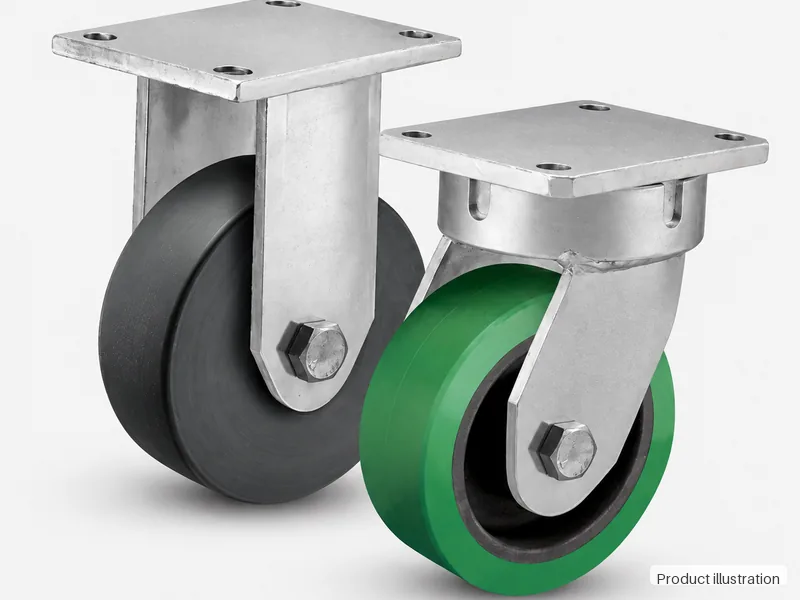
Specifications
| Wheel material | Polyurethane (PU) tread on grey iron or steel core |
|---|---|
| Load rating (family) | 1,500 kg dynamic · 2,500 kg static (owner-declared family figures — dynamic and static kept as separate claims) |
| Durometer grades | ~80 Shore A and ~95 Shore A are the common industrial PU grades (industry reference for grade selection — your quoted grade is confirmed at quotation) |
| Published series structure (industry reference) | Manufacturer PU lines split cast-iron-core series (PY/PX/PH) from aluminum-core series (PA/PD/PM), with line capacities 300-10,900 lb across 3-18 in diameter and 1-3/8 to 6 in tread width at 80/95 Shore A — manufacturer line context for selection, never a tenant family rating |
| Solid elastomer line (industry reference) | A published solid-polyurethane line bands 900-2,500 lb across 3.25-10 in — the no-flat solid option where resilient-but-puncture-proof duty is wanted; per-line figure, not ours |
| Temperature range | −20…+80 °C (std PU); −40…+120 °C (special PU) |
| Speed rating | ≤ 4 km/h (8 km/h precision bearing series) |
| Size range | Ø 25–300 mm |
| Food option | Food-grade white PU available |
| Lead time | 15–20 days (custom configurations 30–40 days) |
| MOQ | 200 pieces (standard catalog items ship in smaller quantities) |
| Warranty | 18 months |
The 1,500 kg dynamic / 2,500 kg static figures are the declared bounds of our PU wheel family, not a per-size rating — capacity scales with diameter, width and durometer, and the rating for your exact size and duty is confirmed at quotation. Industry manufacturers list PU wheel capacities across far wider bands (one major manufacturer quotes 300–10,900 lb across its line); treat published figures as reference points, not commitments.
Applications & Selection
Where polyurethane is the right tread — and where it is not
Specify PU when the load is real but the floor still matters: factory floors, warehouse concrete, tiled or coated surfaces that steel would chew up. PU rolls easier than rubber at equal load, shrugs off the oils and solvents that swell rubber, and outlasts soft treads under abrasive debris. It is the tread behind most RM-Medium and RM-Heavy heavy-duty casters, and it is what an AGV wheel usually is once you add tight manufacturing tolerances.
Know its two limits. First, temperature: standard PU lives between −20 and +80 °C; the special-PU compound extends the band to −40…+120 °C, but beyond that (oven lines, foundry proximity) a phenolic, nylon or cast iron wheel is the correct answer. Second, sustained heavy static load: a PU wheel parked under load for weeks can take a set — the 2,500 kg static figure is a capacity, not a license to park loaded equipment in one spot indefinitely; rotate parked equipment or specify a harder wheel.
Choose the durometer deliberately. Industry manufacturers build their PU lines around ~80 A and ~95 A grades for good reason: the softer grade rolls quieter, protects floors and conforms slightly to imperfect surfaces; the harder grade carries more and resists flat-spotting but transmits more vibration and noise. Load per wheel plus floor quality decides between them — the shore hardness guide and the PU load-capacity-by-durometer article walk the trade in numbers.
Selection points to settle before you RFQ
Calculate load per wheel with the three-of-four rule, then decide dynamic versus static honestly: equipment that rolls continuously, parks loaded, or sees shock loads needs the rating matched to that duty, not an average of them. If the duty is towing or impact-heavy, say so — PU on a steel core handles it, but the grade and core design change.
State the environment: temperature extremes (against the std/special PU bands), chemical exposure, washdown frequency, and floor condition. The food-grade white PU option exists for food-adjacent equipment — name the hygiene requirement in the RFQ so the correct compound and certification path is quoted.
Fix the hardware: bearing type (ball for easy rolling, roller for heavy slow duty), bore size, swivel/rigid/brake layout, and top plate. PU wheels are core-and-tread assemblies; if you need a replacement wheel only, state the existing bore and hub length so the new wheel mates with your fork.
Frequently Asked Questions
What is the difference between 80 Shore A and 95 Shore A polyurethane caster wheels?
Durometer — tread hardness — and it drives the whole personality of the wheel. 80 Shore A is the softer industrial grade: quieter, more floor-friendly, better on debris-strewn or uneven floors, slightly lower capacity. 95 Shore A is the hard grade: maximum load capacity, better flat-spot resistance, more vibration and noise transmitted to the cart. Both are standard industrial PU grades; the right one is decided by load per wheel, speed and floor, and our polyurethane shore hardness guide explains the trade with the underlying numbers.
Why are dynamic and static load ratings different for PU wheels?
Because the failure mechanisms differ. A static rating covers a standing load compressing the tread; a dynamic rating covers the same wheel rolling, where the tread surface cycles through contact and heats up and fatigues. That is why our family data declares 1,500 kg dynamic against 2,500 kg static — and why equipment that parks loaded for long periods needs the static figure respected, while continuously rolling equipment must size on the dynamic figure. Published catalog capacities elsewhere in the industry show the same pattern, at far wider spreads across wheel sizes.
What should my polyurethane wheel RFQ include?
Diameter and tread width, load per wheel and duty (rolling, parked, shock, towed), floor type, temperature and chemical exposure, preferred durometer or the noise/floor-protection constraint, bearing type and bore, hub length if a replacement wheel, swivel/rigid/brake configuration and quantity. Food-adjacent or washdown equipment should be named — it changes the compound and the documentation quoted.
Ordering & Documentation
Documents
Every order ships with a packing list and commercial invoice. On request we provide the wheel dimension sheet (diameter, width, bore, hub length, bearing) and the tread compound statement for the quoted configuration — including the food-grade declaration path where white PU is supplied.
Quotation
A quotation needs: size, durometer grade (or the duty constraints so we can propose one), bearing and bore, load and duty class, environment and quantity. The confirmed quotation states the rating for your exact wheel — family dynamic/static figures are declared bounds of the line, not per-size commitments.
Sample & supply
Standard sizes are produced to order with an MOQ of 200 pieces; smaller trial quantities of catalog items can ship in some sizes — ask with your RFQ. Lead time is 15–20 days for standard configurations and 30–40 days for custom durometer, core or bore work. Samples ship freight collect and are refundable against a bulk order.
Storage & shipping
PU wheels ship cartoned with tread protection. Store them indoors, out of direct sunlight, away from heaters, motors and welding bays — ozone and UV age polyurethane and cost it capacity and cushion. Do not store wheels stacked under load or on sharp-edge racks that dent the tread; keep bearing bores packaged until assembly.