
Product Catalog
Stainless Steel Casters — SS304/SS316 for Food, Pharma and Washdown Environments
Updated 2026-11
A stainless steel caster is defined by what survives the environment it lives in: daily caustic washdown, chlorinated cleaners, salt-laden air, blood, brine, acids. Our stainless line (RM-Clean) uses SS304 as the standard grade and SS316 where chlorides dominate — marine-adjacent plants, brine handling, aggressive sanitation chemicals — with passivated surfaces that keep the welds and machined areas as corrosion-resistant as the mill finish.
Where the environment is sanitary rather than merely wet, the design details matter as much as the alloy: smooth surfaces without crevices where soil collects, seal types that keep wash water out of bearings, and wheel materials that tolerate the same caustic chemistry as the fork. Industry references are consistent on the split: 304 (18% chromium, 8% nickel) is the workhorse sanitary grade, and 316 is specified where chlorides or reducing acids attack 304 over time.
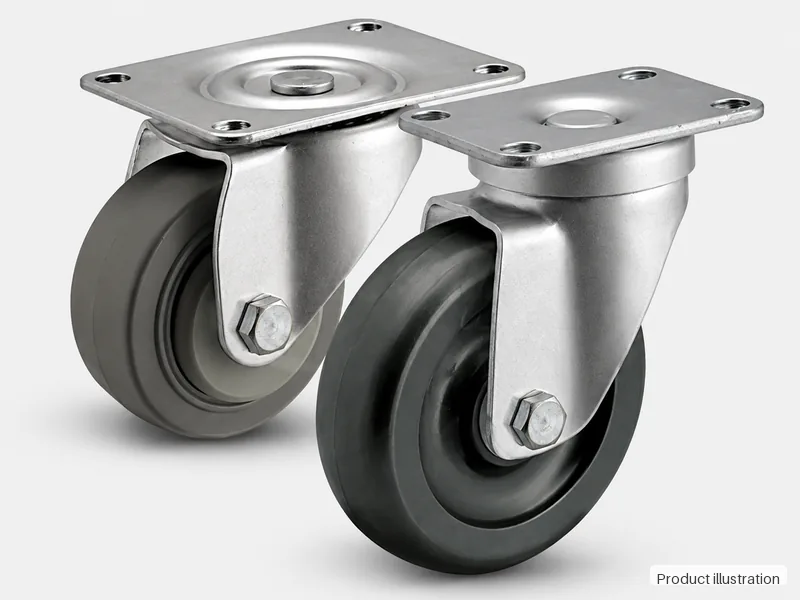
Specifications
| Materials | Stainless Steel 304 (standard) · Stainless Steel 316 (chloride environments) |
|---|---|
| Surface finish | Passivated |
| Service envelope | Freezer to washdown temperature ranges (duty-specific range confirmed at quotation) |
| Size range | Ø 25–300 mm |
| Typical environments | Food processing, pharmaceutical, chemical, marine and washdown service |
| Lead time | 15–20 days (custom configurations 30–40 days) |
| MOQ | 200 pieces (standard catalog items ship in smaller quantities) |
| Warranty | 18 months |
Grade selection (304 vs 316) and the service envelope are application-dependent: the correct grade, seal set and wheel material for your chemistry, temperature and sanitation regime are confirmed at quotation. Load ratings follow the quoted wheel and configuration, not the frame alloy.
Applications & Selection
Choosing between 304 and 316 — and the rest of the wet-duty design
304 is the default sanitary grade, and it is the right answer for most food and pharmaceutical washdown duty: it tolerates daily caustic and acid sanitation cycles when rinsed and drained. Move to 316 when chlorides are part of the picture — brine and cure houses, coastal plants, cleaning regimes heavy on chlorine-based chemistry — because 304's Achilles heel is chloride pitting, and once pitting starts in a wet environment it runs. The grade decision is a chemistry decision, not a status decision: paying for 316 in a dry bakery adds nothing, and specifying 304 into a brine line buys a pitting failure.
The wheel and bearing complete the sanitation design. A stainless fork under a low-grade wheel or unsealed bearing still fails in the same wash water, so wet-duty builds pair the frame with wheel materials that share the environment (nylon, polypropylene, stainless-core PU, or 316 where loads demand metal) and with sealed or stainless bearings. Our washdown guide and the surface-finishes article cover the full material stack, including why crevice-free welds and passivation matter as much as the alloy label.
Temperature spans in this duty class are wide by nature — freezer rooms at the low end, clean-in-place steam at the high end — so state the actual temperature cycle in the RFQ. "Freezer to washdown" is the family envelope; the range that survives your specific cycle depends on the wheel compound and bearing seal set quoted.
Selection points to settle before you RFQ
Name the chemistry and the cycle: what is washed off (fats, blood, brine, acids), which sanitation chemicals at what concentration, how many washdown cycles per day, and whether there is soak time. This is the input that decides 304 vs 316, the seal set, and the wheel compound — a plain "washdown duty" RFQ forces the supplier to guess.
State the sanitation surface requirements if the equipment is audited: some regimes require crevice-free welds, specific surface roughness, or white/nondeposit wheel compounds for food contact adjacency. These change the build, and they are cheaper to specify than to retrofit.
Load and configuration last: per-wheel load by the three-of-four rule, swivel/rigid/brake layout (hands-free or touch-free braking is often a hygiene requirement — toe guards and central brakes quote differently), top plate dimensions, and quantity per size.
Frequently Asked Questions
What is the difference between 304 and 316 stainless steel casters?
Chloride resistance. 304 (18% chromium / 8% nickel) is the standard sanitary grade and handles most food, pharma and general washdown duty well. 316 adds molybdenum, which is what stops chloride pitting — brine, marine air and chlorine-heavy sanitation chemistry. Industry references frame the choice the same way: 304 as the workhorse, 316 where chlorides or harsher chemicals attack 304 over time. Choose by chemistry, not by price or habit; the grade for your environment is confirmed at quotation.
Are stainless casters always the right choice for wet environments?
No — they are the right choice for corrosive and sanitary-wet environments. For plain water exposure without sanitation or corrosion pressure (an outdoor dock, a produce packing line), a zinc-plated caster with the right wheel and seals often does the job at lower cost. Stainless earns its premium where the chemistry is aggressive or audited: daily caustic washdown, blood and brine, pharma cleaning validation. Match the frame to the chemistry, then match the wheel and bearings to the same water.
What should my stainless steel caster RFQ include?
The chemistry and washdown cycle (what gets cleaned off, which chemicals, how often), grade preference or the environment so we can propose 304 vs 316, wheel material and load per wheel, temperature cycle, bearing and seal expectations, any audited sanitation surface requirements, mounting dimensions, brake layout and quantity. Chemistry plus temperature are the two fields that decide the build.
Ordering & Documentation
Documents
Every order ships with a packing list and commercial invoice. On request we provide the material statement for the quoted configuration (frame grade, wheel compound, bearing and seal types) and the dimension sheet (top plate, bolt pattern, overall height), so your sanitation review and equipment drawings can be checked before production.
Quotation
A quotation needs: environment chemistry and washdown cycle, grade (or the environment so we can propose one), wheel material, load per wheel, temperature cycle, bearing and seal set, mounting and brake configuration, and quantity. The confirmed quotation names the grade and seal set for your exact build.
Sample & supply
Standard configurations are produced to order with an MOQ of 200 pieces; smaller trial quantities of catalog items can ship in some sizes — ask with your RFQ. Lead time is 15–20 days for standard configurations and 30–40 days for custom 316 builds, plates or seal work. Samples ship freight collect and are refundable against a bulk order.
Storage & shipping
Stainless casters ship in cartons that keep them from rubbing against carbon-steel items — free iron transferred onto a stainless surface becomes a rust spot that the alloy underneath cannot fight. Store indoors, dry, and keep protective packaging on until installation; passivated surfaces keep best unpackaged only in genuinely dry storage. Bearings stay in their original grease until assembly.