
Product Catalog
Polyurethane Wheels on Aluminum Cores — Lightweight PU Tread Wheels
Updated 2026-11
A polyurethane wheel on an aluminum core is the same tread chemistry as every other bonded PU wheel — elastic, quiet, non-marking, resistant to oil, grease and most chemicals — built on a core that trades some load capacity for weight. Aluminum is roughly a third the density of iron, so the finished wheel is markedly lighter at the same size, and everything that has to accelerate, steer or reverse that wheel notices: the arm pushing the cart, the operator steering the swivel, and the motor and controller of an automated vehicle.
That is the configuration industrial manufacturers use for their dedicated ergonomic and automated-equipment PU lines — several published aluminum-core PU series exist specifically for push-effort and AGV-class duty alongside the heavy iron-core lines. On our line, the PU family bounds remain 1,500 kg dynamic and 2,500 kg static across all core types, with diameters from 25 mm to 300 mm; the aluminum-core build is the right choice when your load sits in the light-to-medium part of that range and rolling effort, noise or automation budget is what you are optimizing.
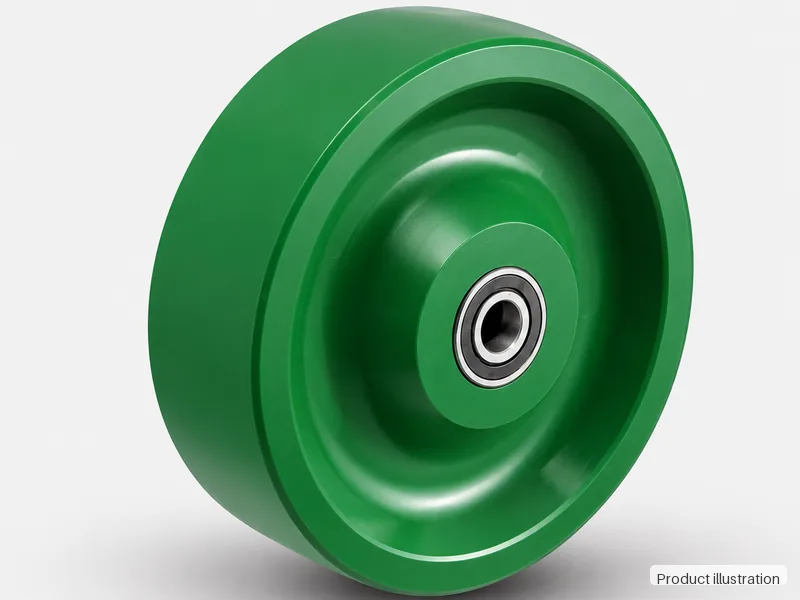
Specifications
| Wheel material | Polyurethane (PU) tread bonded to an aluminum core |
|---|---|
| Core character | Lightweight metal core — lower wheel assembly weight than cast iron at the same size; specified for light-to-medium loads |
| Load rating (family bounds) | 1,500 kg dynamic / 2,500 kg static across the PU family — aluminum-core builds are quoted toward the light-to-medium part of the range; the per-size rating is confirmed at quotation |
| Core-build comparison (PU family) | Same tread chemistry, same declared family bounds — 1,500 kg dynamic / 2,500 kg static across Ø 25–300 mm. Within that band the core decides the position: the aluminum-core build (this page) quotes toward the light-to-medium range at a lower wheel assembly weight, while the cast-iron-core build (Polyurethane Wheels on Cast Iron Cores) is specified for the upper end. The per-size rating is confirmed at quotation either way. |
| Size range | Ø 25–300 mm on our line (per-size dimensions and bores confirmed at quotation) |
| Durometer grades | ~80 Shore A and ~95 Shore A — the common industrial PU grades; the softer grade is the usual ergonomic-duty pairing (industry reference for grade selection) |
| Temperature range | −20…+80 °C (std PU); −40…+120 °C (special PU) |
| Typical duty | Hand-pushed carts, ergonomic trolleys, AGV/AMR equipment, order-picking and logistics fleets |
| Lead time | 15–20 days (custom configurations 30–40 days) |
| MOQ | 200 pieces (standard catalog items ship in smaller quantities) |
| Warranty | 18 months |
Family load bounds are declared figures for the whole PU wheel line and are not a per-size or per-core rating — the aluminum-core rating for your exact size, bearing and duty is confirmed at quotation. Where your load approaches the top of the family range, the cast-iron-core build is the configuration to quote instead.
Applications & Selection
Where the lighter core pays for itself
Wheel weight is not a spec-sheet detail — it is rolling effort. Every start, stop and direction change has to accelerate the wheel, and on a swivel caster the wheel and its fork swing through the steering axis on every correction. A lighter wheel assembly lowers push force at the handle, which is the whole point of the ergonomic caster programs that industry manufacturers build their aluminum-core PU series for: long-shift order picking, hospital and hospitality fleets, and any cart pushed hundreds of times a day. The published aluminum-core lines exist for exactly this duty class, alongside the heavy iron-core lines published in the same catalogs.
The second beneficiary is automation. An AGV or AMR pays for every watt its drive motors spend spinning wheels up, and lighter wheels mean smaller motors, lower peak current and longer battery life at the same payload. Our AGV/AMR caster work batches matched wheels for the same reason: on automated equipment, wheel-to-wheel consistency and low rotating mass are performance specifications, not comforts.
Aluminum also brings a corrosion character that iron does not: the core does not rust, which is why aluminum-core wheels are a common specification in wash-prone and humidity-prone environments. The trade remains load and abuse tolerance — under loads near the family maximum, the aluminum core flexes where an iron core would not, working the bond line and the tread; at that duty the cast-iron-core wheel is the correct specification, and cost per kilo carried favors it as well.
Selection points to settle before you RFQ
Size the load first, then let it pick the core. Divide the total load by the casters actually sharing it — three, not four, on a conventional rig — apply the duty margin, and if the resulting per-wheel number sits in the light-to-medium part of the family range, the aluminum core will roll easier and keep its capacity margin. Near the top of the range, quote the iron-core build instead; the confirmation at quotation settles it either way.
Pick the durometer for the floor and the shift. The ~80 Shore A grade is the usual ergonomic pairing — quieter, more floor-friendly, better on debris-strewn surfaces; ~95 Shore A buys capacity and flat-spot resistance at some cost in noise. Our shore-hardness guide and the PU load-capacity guide give you the numbers behind the trade.
State the automation or ergonomic context explicitly if it applies: towed or self-driven, cycles per shift, floor condition, and whether wheel-to-wheel weight or height consistency matters across a fleet. Then fix the hardware — bearing type, bore, hub length, mounting — as with any PU wheel RFQ. For wash-prone duty, say so: the aluminum core plus a sealed bearing is a common wet-environment pairing, quoted per configuration.
Frequently Asked Questions
Is an aluminum-core PU wheel weaker than a cast-iron-core one?
At the same size, yes in load capacity terms — that is the trade the lighter core makes. The aluminum core is the configuration manufacturers choose for ergonomic and automated-equipment duty in the light-to-medium load range; the iron core is the configuration for the top of the capacity range, where core rigidity under heavy load matters more than wheel weight. Both builds carry the same PU tread chemistry and temperature bands. Quote the load per wheel and the duty, and the confirmed rating for the exact configuration settles which core your application needs.
Polyurethane on aluminum vs solid polyurethane wheels — what is the difference?
Structure and ride. A bonded wheel has a separate PU tread on a metal core: the tread thickness and the core tune the cushion and the load path. A solid PU wheel is polyurethane through its whole cross-section — no bond line to fail, but also no stiff metal core, so it seats loads differently and gives up some of the composite tuning. Bonded aluminum-core wheels are the usual choice where ride quality, rolling effort and floor protection are the priority; solid PU wheels suit applications where debonding risk outweighs cushion. Our wheel-material comparison guide covers the full trade table.
What should my aluminum-core PU wheel RFQ include?
Diameter and tread width, load per wheel and duty class (hand-pushed, towed, automated, cycles per shift), floor type, durometer preference or the noise and floor-protection constraints, bearing type and bore, hub length if replacing an existing wheel, wash-down or humidity exposure, and quantity per size. For AGV/AMR programs, add the vehicle payload and whether wheels must be supplied as matched sets — consistency across the fleet is quotable when it is stated.
Ordering & Documentation
Documents
Every order ships with a packing list and commercial invoice. On request we provide the wheel dimension sheet (diameter, tread width, bore, hub length, bearing) and the tread compound statement for the quoted configuration, so fork and frame drawings can be checked before production.
Quotation
A quotation needs: size, core class (aluminum), durometer grade or the ergonomic and duty constraints, bearing and bore, load and duty class, environment and quantity. The confirmed quotation states the rating for your exact wheel — family figures are declared bounds of the line, not per-size commitments.
Sample & supply
Standard sizes are produced to order with an MOQ of 200 pieces; smaller trial quantities of catalog items can ship in some sizes — ask with your RFQ. Lead time is 15–20 days for standard configurations and 30–40 days for custom durometer, bore or hub work. Samples ship freight collect and are refundable against a bulk order.
Storage & shipping
Aluminum-core PU wheels ship cartoned with tread protection. Store them indoors, out of direct sunlight and away from ozone sources; keep bearing bores packaged until assembly. The aluminum core does not rust, but keep it free of grit and protected from impact in storage — a dinged core face can seat a bearing out of true. Do not stack wheels under load; a tread that takes a set in storage runs out of round in service.