
Product Catalog
Polyurethane Wheels on Cast Iron Cores — Max Load PU Tread Wheels
Updated 2026-11
Within the polyurethane wheel family, the core decides where the wheel stops being comfortable and starts being strong. A polyurethane wheel on a cast iron core is the maximum-load configuration of the family: the tread stays polyurethane — elastic, quiet relative to bare metal, resistant to oil, grease and most chemicals — while the cast iron core takes the structural job of carrying the load from the bore and bearings out to the bond line without deforming.
This split of labor is why industrial manufacturers build their largest poly-on-metal lines on iron cores: the published leader lines run to hundreds of separate cast-iron-core PU part numbers, with wheel capacities reaching into the thousands of pounds per wheel across the class. On our line, the PU family bounds are 1,500 kg dynamic and 2,500 kg static, with wheel diameters from 25 mm to 300 mm — and the iron-core configuration is the one to specify when your working load sits at the top of that range or the duty is continuous rolling rather than occasional moves.
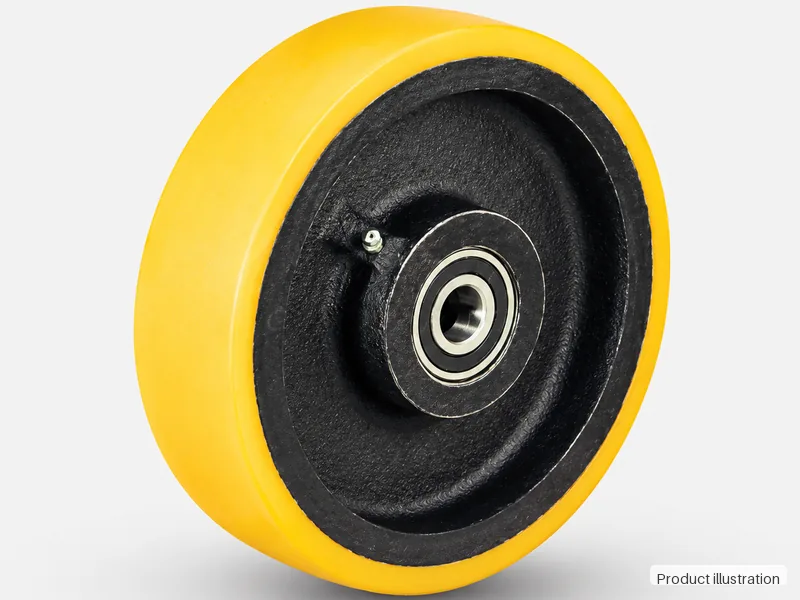
Specifications
| Wheel material | Polyurethane (PU) tread bonded to a cast iron core |
|---|---|
| Load rating (family bounds) | 1,500 kg dynamic / 2,500 kg static across the PU family — the iron-core build is specified for the upper end of the range; the per-size rating is confirmed at quotation |
| Core-build comparison (PU family) | Same tread chemistry, same declared family bounds — 1,500 kg dynamic / 2,500 kg static across Ø 25–300 mm. Within that band the core decides the position: the cast-iron-core build (this page) is specified for the upper end, while the aluminum-core build (Polyurethane Wheels on Aluminum Cores) quotes toward the light-to-medium range at a lower wheel assembly weight. The per-size rating is confirmed at quotation either way. |
| Size range | Ø 25–300 mm on our line (per-size dimensions and bores confirmed at quotation) |
| Durometer grades | ~80 Shore A and ~95 Shore A — the common industrial PU grades (industry reference for grade selection; the 95 A grade is the usual iron-core pairing at maximum load) |
| Temperature range | −20…+80 °C (std PU); −40…+120 °C (special PU) |
| Manufacturer line reference | One major manufacturer lists cast-iron-core PU wheels with line capacities of 300–10,900 lb, 3–18 in diameters and 1-3/8 to 6 in tread widths (reference band, not a tenant rating) |
| Bearing options | Quoted per configuration — plain bore, ball or roller bearings matched to load and speed |
| Lead time | 15–20 days (custom configurations 30–40 days) |
| MOQ | 200 pieces (standard catalog items ship in smaller quantities) |
| Warranty | 18 months |
The 1,500 kg dynamic / 2,500 kg static figures are the declared bounds of our PU wheel family, not a per-size rating — capacity scales with diameter, tread width and durometer, and the iron-core build is chosen when the duty sits near those bounds. Manufacturer line capacities are published reference bands. The rating for your exact size, bearing and duty is confirmed at quotation.
Applications & Selection
Why the iron core changes what the wheel can do
A bonded PU wheel works as a composite: the tread supplies grip, cushion and floor protection, and the core supplies stiffness. Under load, a soft or thin core lets the tread flex where it should not — the bond line works overtime, the tread squirms at the bore, and the wheel runs hot and ages fast. A cast iron core is effectively rigid at these loads, so the tread deforms only where it is designed to: at the contact patch. That is the mechanical reason the heaviest PU specifications in industry catalogs are iron-core builds, and it is why we point buyers at this configuration when their calculated load per wheel approaches the family bounds.
The second job of the iron core is dimensional stability at the bore. The bearing seats live in the core, and a core that creep-deforms under load eventually lets the bearing run out of true — first as rolling effort, then as noise, then as failure. Cast iron holds its machined seats under long static and rolling loads, which matters most on equipment that parks loaded and then has to roll on demand: die carts, press-side fixtures, heavy storage trolleys.
The trade is exactly the one you would expect: weight and cost. An iron-core PU wheel is heavier than an aluminum-core or solid PU wheel of the same size, which raises the swivel effort on hand-steered equipment and the inertial load on automated ones. Where the load does not demand iron, our aluminum-core PU wheels carry the same tread chemistry in a lighter assembly.
Selection points to settle before you RFQ
Confirm that you actually need the iron core. Calculate load per wheel honestly — total load divided by three for a four-wheel rig, before duty margins — and if the number sits comfortably in the middle of the family range, an aluminum-core or lighter PU build will roll easier and cost less. Specify the iron core when the load is near the top of the range, the duty is continuous rolling, or the equipment parks loaded for long stretches.
Choose the durometer against floor and noise as well as load. The ~95 Shore A grade is the usual iron-core pairing at maximum load because it resists flat-spotting under heavy rolling, but it transmits more vibration; the ~80 Shore A grade trades some capacity for quieter, floor-friendlier running. Our polyurethane durometer and load-capacity guides walk the trade with numbers.
State the environment: ambient temperature against the std/special PU bands, chemical or washdown exposure, floor condition, and duty cycle (rolls per shift, parked duration, towed or pushed). Then fix the hardware: bearing type and bore, hub length if the wheel replaces an existing one, and the caster or fork it mounts in. A wheel-only RFQ without the bore and hub length is the most common reason an iron-core replacement order does not fit.
Frequently Asked Questions
Polyurethane on cast iron vs polyurethane on aluminum core — which do I need?
Load decides. The cast iron core is the maximum-load configuration: it is effectively rigid under heavy loads, keeps the bearing seats true, and is the standard pairing for the top of the PU capacity range and for continuous heavy rolling. The aluminum core builds the same tread chemistry into a lighter wheel, which lowers swivel effort and is easier on hand-steered and automated equipment at light-to-medium loads. If your load per wheel sits well under the family maximum, aluminum usually rolls easier; at or near the maximum, specify iron. Both are confirmed at quotation against your stated duty.
Can the polyurethane tread delaminate from the iron core, and how is that prevented?
Bond failure is the known failure mode of any two-material wheel, which is why the bond line is where wheel quality is won or lost. Industrial PU wheels are manufactured with chemically prepared or profiled core surfaces and bonded or cast-in-place treads so the bond is stronger than the tread itself; the practical protections on your side are the ordinary ones — keep the wheel inside its temperature band (our family data declares −20…+80 °C standard, −40…+120 °C special PU), avoid long exposure to bond-attacking solvents, and do not run the wheel flat-spotted. A solid PU wheel removes the bond line entirely at some cost in cushion — the right answer where debonding risk outweighs ride quality.
What should my cast-iron-core PU wheel RFQ include?
Diameter and tread width, load per wheel with the duty class (rolling, parked, shock, towed), durometer preference or the noise and floor constraints, bearing type and bore, hub length, ambient temperature and chemical exposure, floor condition, and quantity per size. If the wheel replaces an existing one, send the old wheel measurements — diameter, width, bore and hub length — and the replacement mates with your fork on the first try.
Ordering & Documentation
Documents
Every order ships with a packing list and commercial invoice. On request we provide the wheel dimension sheet (diameter, tread width, bore, hub length, bearing) and the tread compound statement for the quoted configuration, so fork and frame drawings can be checked before production.
Quotation
A quotation needs: size, core class (iron), durometer grade or the duty constraints, bearing and bore, load and duty class, environment and quantity. The confirmed quotation states the rating for your exact wheel — family dynamic and static figures are declared bounds of the line, not per-size commitments.
Sample & supply
Standard sizes are produced to order with an MOQ of 200 pieces; smaller trial quantities of catalog items can ship in some sizes — ask with your RFQ. Lead time is 15–20 days for standard configurations and 30–40 days for custom durometer, bore or hub work. Samples ship freight collect and are refundable against a bulk order.
Storage & shipping
Iron-core PU wheels ship cartoned with tread protection. Store them indoors, out of direct sunlight and away from ozone sources such as motors and welders; keep bearing bores packaged until assembly. Do not stack wheels under load — a tread that takes a set in storage runs out of round in service. The iron core itself is maintenance-free; keep the machined bore faces free of rust and grit.