
Product Catalog
Conductive & Anti-Static Casters — ESD-Safe Wheels with Batch-Measured Resistance
Updated 2026-11
A conductive caster is a caster whose wheel is compounded to bleed static electricity off the equipment instead of letting it accumulate. Ordinary tread materials are insulators: a cart rolling across an epoxy floor builds charge with every revolution, and that charge leaves as a discharge — into a component, a sensor, or worse in an area with flammable atmospheres. A conductive PU tread gives that charge a controlled path through the wheel, the caster frame and the floor, and our batches ship with the surface resistance measured and recorded per batch, so the number on the casters you install is a measurement, not an assumption.
These casters serve electronics assembly and SMT lines, cleanroom-adjacent logistics, laboratory and hospital equipment fleets, and any facility running an ESD control program. On our line they carry the same family bounds as the standard PU wheel line — diameters from 25 mm to 300 mm, dynamic and static ratings confirmed per configuration — with the conductive compound replacing the standard tread.
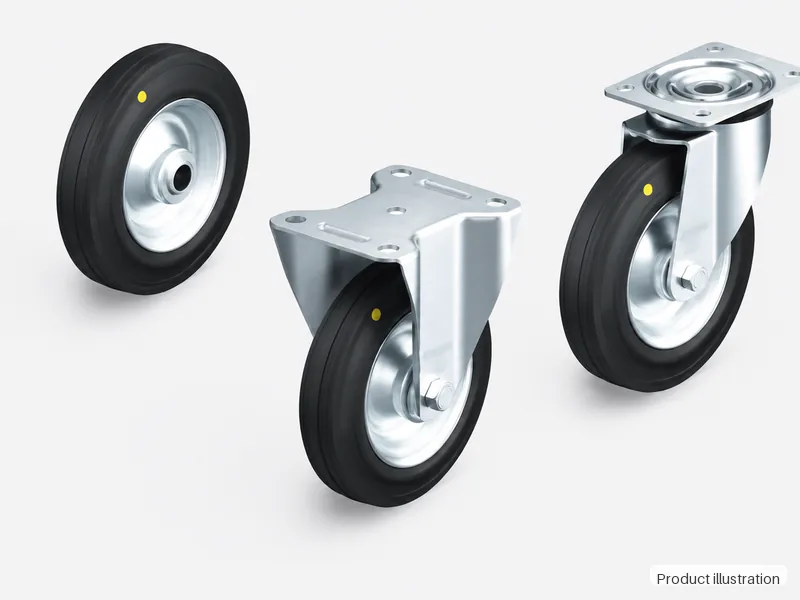
Specifications
| Wheel material | Conductive polyurethane (PU) tread; conductive/anti-static compounds for ESD areas |
|---|---|
| Surface resistance | Measured per production batch — records ship with the order on request (published reference classes below) |
| Size range | Ø 25–300 mm on our line |
| Load rating | PU family bounds confirmed per configuration at quotation |
| Manufacturer SKU reference (per-SKU, not ours) | One published ESD wheel line charts its 5.91 in (≈150 × 32 mm) dissipative wheel at 331 lb — per-SKU manufacturer reference for sizing context, never a tenant rating |
| Typical environments | Electronics assembly, SMT lines, cleanroom-adjacent logistics, laboratories, hazardous-atmosphere areas |
| Lead time | 15–20 days (custom configurations 30–40 days) |
| MOQ | 200 pieces (standard catalog items ship in smaller quantities) |
| Warranty | 18 months |
Surface resistance is a system property — wheel, floor, cart frame and operator footwear form the discharge path together, and published resistance classes only mean something for the whole chain. Our batch resistance records and the resistance class your ESD program requires are confirmed at quotation.
Applications & Selection
How a caster becomes part of the ESD control chain
Static control does not live in one component — it is a chain from the charged object to ground, and every link has to conduct. Published ESD fundamentals describe the same set of tools everywhere: ground the work, dissipate charge through conductive and dissipative materials, and verify the whole path. A conductive caster is the rolling link in that chain: its tread carries charge off the cart frame into the floor, where the facility's flooring and grounding take over. A conductive wheel on an insulating floor, or a conductive floor under an insulated cart, protects nothing — which is why the wheel is specified as part of the facility's ESD plan, not bought off a shelf on its own.
Published industry practice separates two resistance classes, and the difference matters when you order. Conductive-class wheels sit at or below roughly 10 kiloohms of resistance and suit general static bleed-off around less sensitive components; dissipative-class wheels sit between roughly 10 kiloohms and 1 gigaohm and are the class specified inside electrostatic protection areas (EPAs) where sensitive devices are handled. One manufacturer wheel line documents the split explicitly, alongside the governing standards for wheeled ESD equipment. The class your program requires — and the measured values of the batches we ship — are confirmed at quotation; we do not publish a resistance number as a blanket product rating because batch measurement is how the value stays honest.
Choose the conductive tread over the standard non-marking PU deliberately, because the two options trade: the conductive compound serves the ESD plan, the standard compound serves floor appearance and quiet rolling, and a facility rarely needs both on the same cart. Where equipment crosses EPA boundaries, fleets often run conductive wheels fleet-wide to keep the compliance question simple — one compound, one measured batch record, one answer for the auditor.
Selection points to settle before you RFQ
Start from the facility's ESD requirement, not the wheel: what resistance class does the program specify, is the area a formal EPA, and what floor system is installed? State the class and the floor in the RFQ — quoting a conductive wheel without the floor and frame context answers a different question.
Then the mechanical work, same as any PU wheel: load per caster (divided honestly, with duty margin), size from the Ø 25–300 mm line, bearing type, mount configuration per position, and the temperature and chemical environment — conductive PU shares the standard PU tread's temperature bands and oil resistance, and the per-configuration rating is confirmed at quotation.
Ask for the batch record. Our surface resistance is measured per production batch; requesting the record with your order turns the casters from "conductive-type" hardware into documented ESD components your quality system can file. For audits and customer compliance reviews, that record is usually the point of the whole specification.
Frequently Asked Questions
What is the difference between conductive and dissipative casters?
The resistance band and the use case. Conductive versions sit at the low-resistance end (published industry practice puts them at or below about 10 kiloohms) and bleed charge fast — right for general static control around less sensitive components. Dissipative versions sit in a higher band (roughly 10 kiloohms to 1 gigaohm), slowing discharge enough to protect sensitive devices inside electrostatic protection areas. Neither class works alone: the wheel, floor, cart frame and footwear have to form one conductive path. The class your ESD program requires is confirmed at quotation.
Do conductive casters have standards?
The wheels and ESD areas do, and they are worth naming in an RFQ. Published industry practice tests conductive mobility solutions against DIN EN 12530, while resistance limits for transport carts and discharging equipment fall under the IEC 61340-5-1 family (Table 3 of the 2017 edition governs resistance limits). Your facility's ESD coordinator will know which of the two your program audits against; quoting the standard with the RFQ makes the delivered casters checkable against it.
What should my conductive caster RFQ include?
The ESD requirement first: required resistance class or standard (DIN EN 12530, IEC 61340-5-1), whether the area is a formal EPA, and the floor type. Then the mechanics: load per caster, wheel diameter and width, bearing type, mounting (plate size, swivel/rigid/brake per position), environment (temperature, chemicals, wash-down), and quantity per configuration. Add that you want the batch surface-resistance record with the order — it ships on request.
Ordering & Documentation
Documents
Every order ships with a packing list and commercial invoice. Batch surface-resistance measurement records are provided on request and filed against the production batch; dimension sheets (plate, bolt pattern, wheel, overall height) and the tread compound statement are available so equipment drawings and ESD documentation can be checked before production.
Quotation
A quotation needs: the ESD requirement (class or standard), floor type, load per caster, size, bearing and mounting configuration, environment and quantity. The confirmed quotation states the load rating for your exact configuration and the resistance documentation that ships with it — published resistance classes are industry references for class selection, not the order commitment.
Sample & supply
Standard configurations are produced to order with an MOQ of 200 pieces; smaller trial quantities of catalog items can ship in some sizes — ask with your RFQ. Lead time is 15–20 days for standard configurations and 30–40 days for custom compounds or conductive-plus-brake builds. Samples ship freight collect and are refundable against a bulk order; a trial order with its batch record is a common way to validate the resistance requirement before a fleet conversion.
Storage & shipping
Conductive casters ship cartoned like standard PU wheels. Store them indoors out of direct sunlight; keep the tread surface clean — a film of dirt, oil or release agent on the tread is an insulating layer in exactly the place the wheel is supposed to conduct. Before installation, wipe the treads and check the swivel and axle hardware is tight: the discharge path runs through the caster frame, and loose hardware adds resistance the batch record cannot vouch for.