
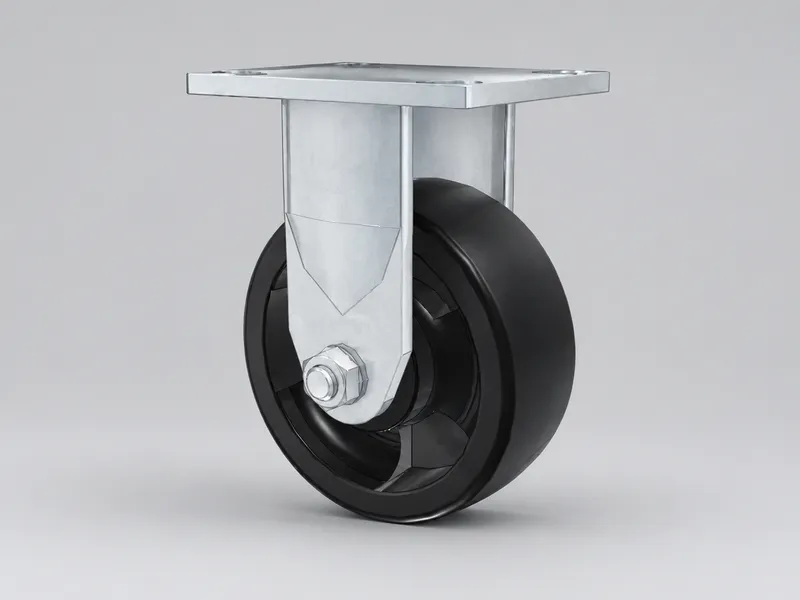
The RM-Hot series is the RollMaster high-temperature line: heat-resistant wheel materials — high-temp nylon, phenolic resin, cast iron, forged steel — paired with high-temperature bearing greases and heat-stable bracket fitments with larger running clearances, so the caster keeps rolling after repeated thermal cycles instead of seizing at the first heat soak.
Standard wheels fail in ovens by softening, de-bonding or seizing. Standard PU compounds soften well below +100 °C, and a grease that carburizes or a fitment whose running clearance closes up does the same damage more slowly. RM-Hot components are selected for repeated heating, not just peak temperature, and brake and swivel options are tested after thermal cycling.
Tread options in the series are rated from +120 °C up to +280 °C, with phenolic and cast iron carrying the highest bands. Typical RM-Hot duty: bakery racks, ovens, autoclaves, drying rooms and curing lines — anywhere a loaded cart goes into the heat and must still roll out.
Process Overview
A high temperature caster is defined by what survives the heat cycle, not by the peak number on a datasheet: a wheel material that does not soften or de-bond at oven temperature, a bearing grease that keeps rolling after repeated heat soaks, and bracket fitments whose running clearances stay open as the metal expands. The RM-Hot series builds all three - heat-resistant treads in high-temp nylon, phenolic resin, cast iron or forged steel, high-temperature greases as standard, and heat-stable fitments - so a loaded cart rolls out of the oven the way it rolled in.
The material decision follows the duty, not the preference: phenolic and cast iron carry the highest temperature bands in the series and high-temp nylon the lower ones, and because repeated thermal cycling, not peak temperature, is what seizes an ordinary caster, brake and swivel options are tested after thermal cycling. The exact wheel, grease and fitment combination for a specific oven profile is confirmed at quotation.
Casters by Load Range
| Series | Load per caster | Typical wheel options | Best for |
|---|---|---|---|
| RM-Light | up to 150 kg | Nylon, rubber, elastic | Light trolleys, medical and display carts |
| RM-Medium | 150–500 kg | Polyurethane, nylon | Warehouse carts, racks, AGV/AMR platforms |
| RM-Heavy | 500–1500 kg | Polyurethane on steel, forged steel | Die carts, machinery moving, heavy trolleys |
| RM-Extreme | 1500 kg and up | Forged steel, double wheel | Steel mills, ovens, extreme-load skates |
Specifications
- Tread options rated +120 °C to +280 °C (phenolic / cast iron for the highest bands)
- High-temperature bearing greases as standard
- Heat-stable bracket fitments with larger running clearances
- Brake and swivel options tested after thermal cycling
- Wheel materials: high-temp nylon, phenolic resin, cast iron, forged steel
- Thermal-cycling tested in house
Typical materials
High-temp nylon, phenolic resin, cast iron, forged steel
| Wheel material | Typical hardness | Floor protection | Where it fits |
|---|---|---|---|
| Cast polyurethane (PU) | Shore A 92–95 | Very good: non-marking compounds | AGV/AMR, trolleys on painted or epoxy floors, heavy duty |
| Injected PU | Shore A 90–95 | Good | Cost-sensitive medium duty, light equipment |
| Cast nylon (PA6) | Shore D 70+ | Fair: hard tread | High load, dry indoor logistics, washdown |
| Glass-filled nylon | Shore D 75+ | Fair | Higher loads and temperatures than PA6 |
| Solid rubber | Shore A 65–75 | Good | Shock absorption, outdoor thresholds, economy |
| Super-elastic rubber | Shore A 55–65 | Excellent | Quiet running: medical, hotel, laboratory |
| Phenolic resin | — | Fair | Baking lines and ovens up to +280 °C |
| Forged steel | — | None: needs steel plate or heavy concrete | Extreme loads, heat, harsh floors |
| Stainless (wheel/bracket) | — | Good | Food, pharma, washdown, corrosive areas |
Finishes
High-temperature paint or as-forged
| Bracket finish | What it does | Specify it when |
|---|---|---|
| Zinc plating (blue/white) | Baseline corrosion protection | Standard dry indoor use |
| Chrome plating | Hard, decorative, easy to clean | Visible / cleanroom-adjacent equipment |
| Powder coating | Custom color, good corrosion resistance | Brand colors, outdoor-adjacent use |
| Stainless steel 304 | No plating to fail | Washdown, food, medical |
| Stainless steel 316 | Resists chlorides | Salt, brine, marine air, harsh cleaning chemicals |
Testing
Thermal-cycling tested in house; the continuous temperature rating per tread option is confirmed at quotation — a continuous rating is not the melting point
| Selection factor | Rule of thumb | Effect on performance |
|---|---|---|
| Load sizing | Total load ÷ 3 (not ÷ 4) | On uneven floors only three wheels carry the cart |
| Wheel diameter | Bigger rolls easier | Larger wheels cut push force and bridge gaps |
| Tread hardness | Softer = quieter, harder = easier rolling | Pick the softest tread that carries the load |
| Bearing choice | Precision ball for manual pushing, roller for heavy loads | Bearings dominate rolling resistance at high load |
| Swivel vs rigid | 2 swivel + 2 rigid is the standard cart setup | All-swivel carts wander; all-rigid carts cannot steer |
| Floor condition | Rough floors need bigger wheels and softer treads | Small hard wheels on bad floors destroy both |
Surface Finish Reference
- Truck lock is zinc-plated, blue-passivated, Cr6-free.
- Guardrail systems must be smooth-surfaced.
- Connectors must have a corrosion-resistant finish.
- Stair rail systems must be smooth-surfaced.
- Surface roughness of Ra 0.8 µm or lower is specified for sealing, sliding, fatigue, or cleanliness mechanisms.
Common Applications
- Bake Oven
- Bakeries
- Bakery rack (oven)
- Furnace Operations
- autoclave
- Ceramics
- Metalworking Plants
RM series comparison
| Series | Load per caster | Typical wheel materials | Temperature range |
|---|---|---|---|
| RM-Light | Up to 150 kg/caster | Polypropylene (PP), Cast nylon (PA6), TPR, Solid rubber | - |
| RM-Medium | 150–500 kg/caster | Polyurethane (PU) on steel core, Cast nylon (PA6), Steel | −20…+80 °C (std PU); −40…+120 °C (special PU) |
| RM-Heavy | 500–1500 kg/caster | Polyurethane (PU) on steel core, Cast nylon (PA6), Forged steel / pressed steel | −20…+80 °C (std PU); −40…+120 °C (special PU) |
| RM-Extreme | 1500 kg+/caster (family line specified to 2000 kg) | Forged steel | −20…+80 °C (std PU); −40…+120 °C (special PU) |
| RM-Hot (this series) | - | High-temp nylon, Phenolic resin, Cast iron, Forged steel | +120…+280 °C (tread options) |
Ordering, Lead Times & MOQ
Standard catalog items in small quantities; custom MOQ depends on tooling.
Standard lead time 15-30 days; samples faster.
Business models: OEM manufacturing, ODM design, private labelling, standard catalog sales, replacement parts supply.
Frequently asked questions
What temperature ruins a normal PU wheel?
Standard PU compounds soften well below +100 °C, which is why oven duty starts at high-temp nylon, phenolic or metal wheels. Temperature attacks more than the tread: the grease carburizes and running clearances close, so a caster specified by tread alone can still seize. The RM-Hot series specifies all three — tread, grease and fitment clearance — against the same temperature.
How do I pick the RM-Hot tread for my oven?
State the peak temperature, the continuous temperature and the cycle count — they select different treads. The +120 to +150 °C bands are high-temp nylon territory; phenolic and cast iron carry the bands above that, up to +280 °C. Metal treads maximize heat capacity but are the harshest on floors, so where the out-of-oven route crosses a finished floor, the tread choice is a trade, and the quotation states it.
Do brakes and swivels survive oven duty?
Brake and swivel options in the series are tested after thermal cycling, not just at room temperature — the grease and the fitment clearance are part of the brake specification, not extras. If the brake must work at temperature, say so explicitly in the RFQ; a brake specified for ambient duty is not the same part.
What should an RM-Hot RFQ include?
Peak and continuous temperature, cycle frequency and dwell time, load per caster, wheel diameter and mounting style, and quantity. The confirmed quotation states the tread option and its continuous rating for your cycle. Standard lead time is 15-20 days (custom configurations 30-40 days). MOQ depends on tooling: standard catalog items ship in small quantities.
How do I calculate the required caster load capacity?
Total load = cart weight + payload. Divide by 3 (not 4) to stay safe on uneven floors. Add margin for speed, shock and rough floors.
What is the typical lead time?
Standard lead time 15-30 days. Samples faster than bulk orders. Confirmed at quotation.
What is the minimum order quantity?
Standard catalog items in small quantities. Custom casters depend on tooling. OEM/ODM/private label programs welcome.
What certifications do you hold?
ISO 9001 certified quality management. Load ratings based on EN 12530 testing protocols. In-house salt spray and dynamic load testing.
Can you manufacture under our brand?
OEM manufacturing, ODM design, private labelling. Custom brackets, compounds, colors and packaging. Samples then pilot then mass production.
Sources · 4
- casterresource.comIndustry publication
- atlantacaster.comManufacturer technical documentation
- casterconcepts.comManufacturer technical documentation
- casterhq.comIndustry publication
Technical references cited for verifiability — not supplier recommendations.Browse the research library.
Related products
Related Knowledge
Capability commitments on this page are owner-confirmed (2026-09-29).