
Product Catalog
Rubber Caster Wheels — Solid & Elastic Rubber for Quiet, Floor-Safe Rolling
Updated 2026-11
Rubber caster wheels are the quietest, most floor-forgiving wheels in the catalog, and the reason is mechanical: a soft elastomer tread deforms under the load, so the contact patch grows, sharp debris and floor seams are cushioned instead of transmitted, and the energy of a bump is absorbed as a momentary squish rather than a rattle through the frame. That is why rubber is the default wheel for equipment carrying sensitive goods — medical carts, instrument trolleys, catering and hospitality equipment — and for carts that cross expansion joints, thresholds and dock plates all day.
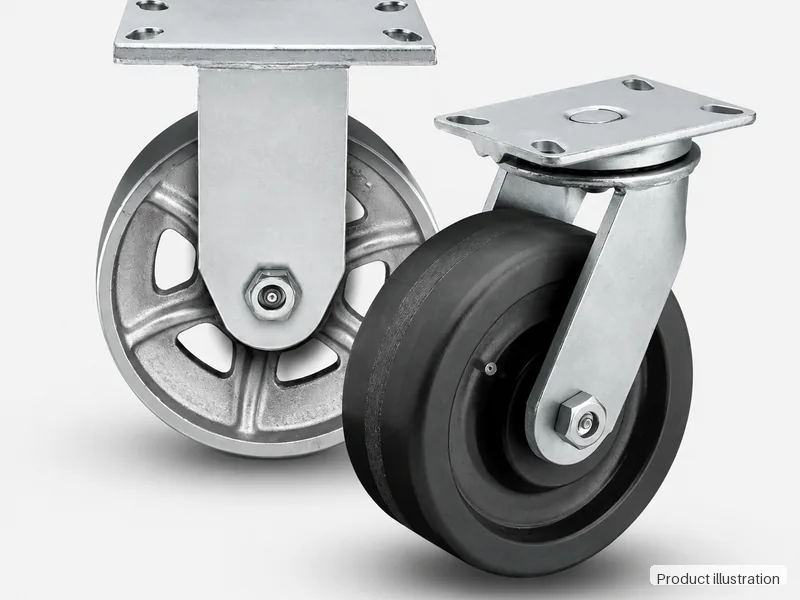
Our rubber line covers two constructions: solid rubber bonded to a steel core for higher loads and longer service, and elastic (super-elastic grey) rubber on steel or polypropylene cores where quiet, low-resistance rolling matters more than capacity. Compounds include oil-resistant and heat-resistant versions, brackets are zinc-plated steel, and hardness (Shore A) and bond strength are checked per batch — because a rubber wheel fails by delamination long before it fails by wear, and the bond is the part you cannot see.
Specifications
| Wheel materials | Solid rubber on steel core · Elastic (super-elastic grey) rubber on steel or PP core · oil-resistant and heat-resistant compound options |
|---|---|
| Family load band | 30–400 kg per caster (declared line band; per-size rating confirmed at quotation) |
| Industry reference band | Solid rubber commonly 200–500 lb per wheel at 5 in diameter (industry comparison data, not a tenant rating) |
| Temperature range | Industry reference for solid rubber: −20…160 °F continuous; compound-specific limits confirmed at quotation |
| Floor protection | Excellent (industry comparison consensus); non-marking compounds available |
| Rolling resistance | Medium-high vs PU/nylon — the trade for quietness and cushioning |
| Brackets & finish | Steel brackets, zinc-plated |
| Quality checks | Shore A hardness and tread bond strength checked per batch |
| Lead time | 15–20 days (custom configurations 30–40 days) |
| MOQ | 200 pieces (standard catalog items ship in smaller quantities) |
| Warranty | 18 months |
The 30–400 kg family band is our declared line range, quoted per caster under standard conditions. Industry comparison figures (the 5-inch 200–500 lb reference) are published comparison data for orientation between materials, not our rating; the figure for your diameter, compound and bearing is confirmed at quotation.
Applications & Selection
Where rubber earns its keep — and where it does not
Rubber is the right answer when the load is light-to-medium and the priority is what the wheel does to its surroundings: it protects the floor, the cargo and the ears. Hospital and lab carts, food-service equipment, hotel and janitorial trolleys, lightly loaded shelving units moved across finished floors, and any cart that crosses dock plates or door thresholds repeatedly all reward rubber’s cushioning. On rough concrete or jobsite debris, rubber on a cast-iron core keeps grip where harder treads skid — one reason scaffold and rental fleets still spec rubber despite the load penalty.
The honest limits: rolling resistance is the highest of the common tread materials, so a heavy cart on rubber takes noticeably more push effort than the same cart on polyurethane; load capacity per wheel is the lowest of the family (industry comparison data puts solid rubber at roughly half a polyurethane wheel of the same size); and rubber has real enemies — ozone (electric motors, welders), some oils and solvents, and prolonged outdoor sunlight. Our oil-resistant compounds answer the chemical case; they do not answer a 24/7 outdoor yard, where pneumatic or engineered-TPR constructions last longer.
Between the two constructions: solid rubber on a steel core is the durability choice where loads sit at the top of the band and the route is long; elastic grey rubber on a PP core is the comfort choice for lighter carts where quiet running and a low price matter most, with the plastic core removing corrosion from the wet-wipe-down equation entirely.
Selection points to settle before you RFQ
Load per wheel first, calculated the standard way: total load divided by three for a four-caster rig, then keep the working figure comfortably inside the band — rubber punishes running at its ceiling with flat-spotting and premature bond failure. If your number lands above roughly 400 kg per caster, move to polyurethane or nylon rather than asking rubber to stretch; the material families exist because the trade-offs are real.
Environment second: name the floor (finished, sealed concrete, rough outdoor), the temperature, and any chemical or washdown exposure. Ozone sources on the route (motor banks, welding bays) decide the compound as much as load does. For washdown and wet areas, say so — the PP-cored elastic wheel and stainless-fitted options exist for exactly that spec.
Bearings and speed last: rubber wheels are usually run at walking pace, so plain bore or ball bearings cover most cases; state expected daily distance and any towed use so the bearing and bond are quoted for the duty, not just the load. The same sizing arithmetic used across our catalog (total load ÷ sharing casters, then the duty margin) applies unchanged here.
Frequently Asked Questions
Rubber or polyurethane — which should I choose?
Rubber when cushioning, quietness and floor protection outrank effort and capacity; polyurethane when the cart is heavier, pushed all day, or the route is long. A useful shorthand from published comparisons: rubber wins on shock absorption and noise, PU wins on load capacity, rolling ease and abrasion life, and both protect floors well. If the load is under ~150 kg per caster, indoor, and noise-sensitive, start with rubber; above that or on long routes, start with PU.
How much load can a rubber caster wheel carry?
Within our line, the declared family band is 30–400 kg per caster, with the exact figure set by wheel diameter, tread width, compound and bearing. Published industry comparisons put solid rubber around 200–500 lb per wheel at 5 in diameter — treat those as material-to-material reference points, not as a rating for any specific wheel. The rating for your configuration is confirmed at quotation before order confirmation.
What should my rubber wheel RFQ include?
Load per wheel, wheel diameter and tread width (or the old wheel’s measurements), solid-steel-core or elastic-PP-core construction preference, the environment (temperature, oil, ozone sources, washdown), floor type, bearing preference, mounting (top plate size or stem), brake requirement and quantity per size. If quiet operation is the reason you are choosing rubber, say so — compound and tread thickness are selected differently for a hospital corridor than for a loading dock.
Ordering & Documentation
Documents
Every order ships with a packing list and commercial invoice. On request we provide the dimension sheet for the quoted wheel (diameter, tread width, hub, bore and bearing) and the compound statement for your configuration, so equipment drawings and maintenance records can be checked before production.
Quotation
A quotation needs: construction (solid steel-core or elastic PP-core), diameter and tread width, compound requirement (standard, oil-resistant, heat-resistant), bearing type, mounting, environment and quantity. The confirmed quotation states the load rating for your exact configuration — family bands and published industry figures are orientation data, and the order commitment is the figure on the quotation.
Sample & supply
Standard sizes are produced to order with an MOQ of 200 pieces; smaller trial quantities of catalog items can ship in some sizes — ask with your RFQ. Lead time is 15–20 days for standard configurations and 30–40 days for custom bores, compounds or mountings. Samples ship freight collect and are refundable against a bulk order.
Storage & shipping
Rubber ages in storage faster than any other tread in the catalog, so the storage rules matter: keep wheels indoors, out of direct sunlight, away from electric motors, welders and other ozone sources, and away from steam lines and heat. Do not store casters stacked under load — a tread held compressed for months takes a permanent set. Original packaging until fitting; bearings stay in their factory grease until installation.