
Product Catalog
Spring-Loaded Casters — Shock-Absorbing Swivel Casters for Impact and Vibration
Updated 2026-11
A spring-loaded caster puts a calibrated steel spring between the load and the wheel. Where a rigid caster passes every floor joint, tow-line jerk and dock-plate impact straight into the frame, the spring compresses at each event and gives the energy back over a longer time — the load rides over the bump instead of being thrown against it. The same deflection dampens the rumble and rattle that hard wheels transmit, which is why spring-loaded casters show up under towed conveyor carts, bakery racks on rough aprons, and vibration-sensitive instruments.
The number that matters on a spring caster is not just capacity — it is the deflection basis the capacity was rated at. Published manufacturer lines state it plainly: capacities listed at 50% of wheel deflection (21/32 inch of a 1-5/16 inch total), on heat-treated AISI 1045 steel with welded inside and out construction. Our line follows the same engineering logic and is quoted per application: the spring rate, the load band and the wheel are matched to your floor and duty, and the rating for your configuration is confirmed at quotation.
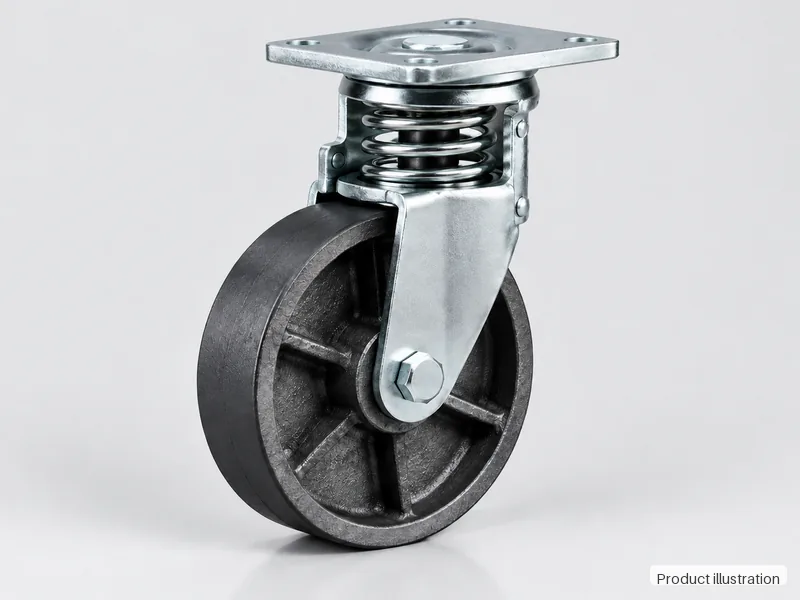
Specifications
| Type | Spring-loaded (shock-absorbing) swivel casters; kingpinless spring construction available |
|---|---|
| Spring function | Steel compression spring between load and wheel absorbs shocks and reduces noise (industry-standard design class) |
| Capacity basis | No published family rating — spring-rated capacity depends on the deflection basis; confirmed at quotation |
| Industry rating basis (reference) | Published manufacturer lines list capacities at 50% of wheel deflection (e.g. 21/32 in of 1-5/16 in total) |
| Construction (industry reference) | Heat-treated AISI 1045 steel top plate and yoke base, welded inside and out; zinc-plated finish |
| Typical duty | Towed fixtures, uneven or damaged floors, vibration-sensitive loads, impact-heavy routes |
| Lead time | 15–20 days (custom configurations 30–40 days) |
| MOQ | 200 pieces (standard catalog items ship in smaller quantities) |
| Warranty | 18 months |
Spring capacity is only meaningful together with its deflection basis — the same caster rated at 50% deflection carries less before bottoming out than its stamped maximum suggests. Published manufacturer figures above are reference values for how the class is rated, not our line rating; the spring rate and capacity for your load, speed and floor are confirmed at quotation.
Applications & Selection
Where a spring earns its place under the load
Every caster compresses a little under load — the tire squats, the bearing clears — but only a spring-loaded caster is designed to do it repeatedly and measuredly. The engineering problem it solves is transient force: a tow line snatching a train of carts, a loaded rack dropped off a dock plate, a corridor threshold hit at speed. Without a spring, each of those events arrives at the frame as a near-instantaneous load spike, and the weak point — a weld, a bearing race, the cargo itself — takes the hit thousands of times. The spring stretches the event out in time and cuts the peak.
The second payoff is acoustic. The same deflection that softens impacts keeps the wheel pressed to the floor instead of chattering across it, which is why published spring-caster lines lead with noise reduction through the dampening effect of the casters. Plants that ran hard-wheel carts on expansion-jointed floors and replaced one line with spring-loaded units usually report less component loosening first and a quieter aisle second — both come from the same mechanism.
Know the trade: a spring under a steady heavy load sags and stays sagged, eating travel and changing handling, so spring-loaded casters suit dynamic loads — moving, towing, impacting — far better than long static stands. They also cost more and add height. A rigid kingpinless caster on a decent floor is the right answer for static-heavy duty; the spring belongs where the floor or the route is violent.
Selection points to settle before you RFQ
State the event, not just the load: what hits the caster — tow-line starts, dock plates, door thresholds — and how often. Spring rate and travel are chosen against the impact event as much as the static weight, so an honest duty description quotes correctly the first time. Give load per caster (divide total weight by three for a four-caster unit on imperfect floors), speed if towed, and floor condition.
Ask how capacity was rated. The industry convention on published spring-caster lines is to list capacities at partial deflection (one manufacturer states 50% of a 1-5/16 inch total deflection), because a spring worked to full compression stops absorbing and starts transmitting. If a quote does not state its deflection basis, ask for it — two casters with the same load number can behave very differently at the same 30% overload.
Then the hardware: kingpinless swivel construction above roughly 1,500 lb class duty for constant towing; zerk-lubricatable swivel bearings for high-cycle duty; wheel material matched to the floor (polyurethane for finished concrete, cast iron or forged steel for debris and tow lines); and mount type per position. If the application is AGV or continuous-cycle, say so — the bearing and spring spec changes with duty cycle, not just load.
Frequently Asked Questions
Are spring-loaded casters the same as shock-absorbing casters?
Yes — the names describe the same design class: a caster with a built-in spring between the load platform and the wheel that absorbs impacts and damps vibration. Industry selection guides list "shock absorption: casters with built-in shock absorbers are ideal for transporting delicate equipment or in environments with uneven surfaces" as its own feature class, distinct from soft-tread wheels (which cushion only what passes through the tire). You will also see them sold as "vibration-damping" or "spring-loaded shock" casters. The spring rate and travel differ between models, which is why the deflection basis and duty are what the quotation should settle.
How is the capacity of a spring-loaded caster rated?
More conservatively than a rigid caster, and the basis matters. Published manufacturer lines in this class state the deflection their capacity figure assumes — for example, capacities listed at 50% of wheel deflection (21/32 inch of a 1-5/16 inch total). Run a spring to full compression and it bottoms out: it stops absorbing and starts transmitting the load it was meant to soften. So when you compare quotes, match deflection basis as well as the load number, and size with the same divide-by-three rule as any caster, then confirm the spring rate against your worst regular impact event.
What should my spring-loaded caster RFQ include?
Load per caster and the total carried weight, the impact event (tow-line start, dock plate, threshold — with speed if towed), floor condition along the route, whether the load is vibration-sensitive, wheel diameter and material preference, bearing type, swivel construction (kingpin or kingpinless), mount type and plate size, environment (wash-down, temperature, debris), and quantity per configuration. Photos or a short video of the route in service are the single most useful attachment — spring selection is about the ride, and the ride is visible.
Ordering & Documentation
Documents
Every order ships with a packing list and commercial invoice. Dimensional drawings (mounting plate, bolt pattern, overall height, swivel radius) are available on request so your frame designer can check fit before production, and the spring specification — rate band and travel — is stated on the quotation for the configuration quoted.
Quotation
A quotation needs: load per caster, impact event and frequency, speed if towed, floor condition, wheel material and diameter, bearing type, mount configuration and quantity. The confirmed quotation states the capacity and its deflection basis for your configuration — published class figures are sizing references, not the order commitment.
Sample & supply
Standard configurations are produced to order with an MOQ of 200 pieces; smaller trial quantities of catalog items can ship in some sizes — ask with your RFQ. Lead time is 15–20 days for standard configurations and 30–40 days for custom spring rates or mount work. Samples ship freight collect and are refundable against a bulk order; a two-to-four caster floor trial on the actual route is the usual validation, with attention to how the spring recovers between events.
Storage & shipping
Springs ship pre-compressed assemblies and tolerate storage well, but keep them in their cartons, dry, and do not store under load — a spring held partially compressed for months can take a set that shortens travel. Before installation, cycle each swivel by hand and compress the spring once with a firm push: it should return fully and quietly. A unit that clicks or stays sagged is flagged before it reaches the floor, not after.