
Product Catalog
Forged Steel Caster Wheels — Drop-Forged Heavy-Duty Wheels to 2,000 kg
Updated 2026-11
A forged steel wheel is the last wheel standing when every tread material has an excuse to quit. Forging shapes a heated steel billet under pressure instead of pouring it into a mold, and that working aligns the internal grain into continuous flow lines that follow the wheel's shape. The practical result on a plant floor is a wheel that shrugs off shock loads, impact over dock plates, tow-line jerks and debris-strewn concrete that would chunk a bonded tread or crack a cast wheel.
Our forged steel line is specified to 2,000 kg per caster, with wheel diameters from 25 mm to 300 mm, as-forged, zinc-plated or painted finishes, and high-temperature grease for oven-adjacent duty. It is the wheel material behind the RM-Extreme tier of our heavy-duty series and the standard answer for machinery moving, towed fixtures, foundry and heat-adjacent lines — anywhere the load, the impact and the floor are all trying to destroy the wheel at once.
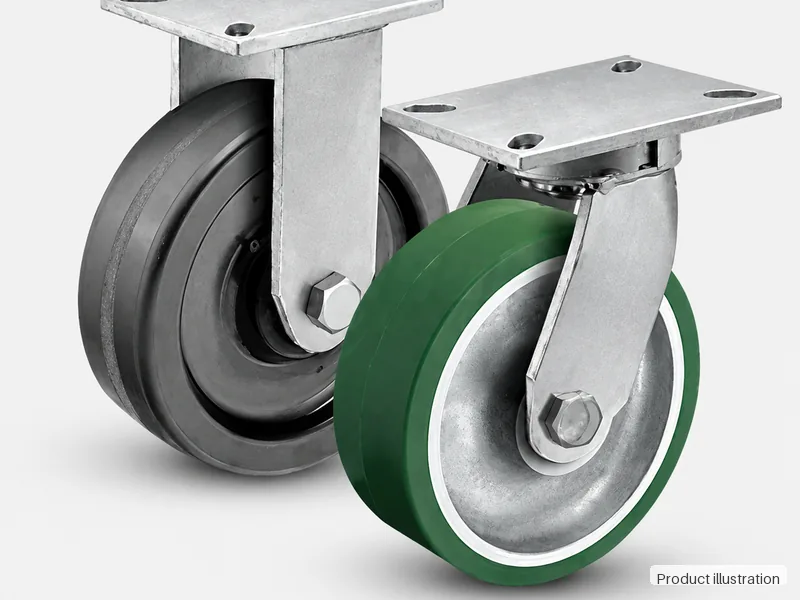
Specifications
| Wheel material | Forged steel (drop-forged); pressed steel option |
|---|---|
| Load rating | Specified to 2,000 kg per caster (tenant-declared line figure — per-size rating confirmed at quotation) |
| Size range | Ø 25–300 mm on our line |
| Surface finishes | As-forged · Zinc plating · Painted |
| Temperature duty | Oven-adjacent duty with high-temperature grease |
| Best suited for | Harsh and debris-strewn floors, tow lines, impact-heavy and heat-adjacent duty |
| Lead time | 15–20 days (custom configurations 30–40 days) |
| MOQ | 200 pieces (standard catalog items ship in smaller quantities) |
| Warranty | 18 months |
The 2,000 kg figure is the declared specification of our forged steel line under standard conditions — the rating for your wheel diameter, bearing and duty is confirmed at quotation. Industry catalogs publish forged steel wheels well above this class in the largest sizes; the figure that applies to your build is the one on the quotation.
Applications & Selection
Why the forging process changes how the wheel fails
The difference between forged and cast steel is not chemistry — the two steels are close to identical in composition — it is grain structure. A casting solidifies in the mold with a coarse, randomly oriented grain that can trap microscopic shrinkage cavities; a forging is worked solid, which closes those voids and aligns the grain with the load path. Industry engineering references put forged steel meaningfully stronger along its flow lines, which is exactly the orientation a wheel needs: the tread surface and the hub take compression and impact through the same continuous material.
On a caster, that internal quality shows up as failure behavior. A cast or bonded wheel under shock loading loses material — chunks of tread, cracks radiating from impact points — and its capacity effectively drops with every abuse event. A forged steel wheel deforms instead: it flats, discs or dents the floor-facing surface under loads beyond its rating, and it keeps rolling between maintenance inspections while it does. That is why tow lines, dock work, die carts and demolition-duty fixtures specify forged steel as the last material option, after polyurethane, nylon and cast iron have each been ruled out.
The trade is the floor. Forged steel is the harshest tread on finished concrete and epoxy, and the loudest; it belongs on shop floors, steel plate, and rough concrete where floor wear is acceptable and wheel survival is not negotiable. Where the environment is a wash-down or corrosive one, the zinc-plated or painted finish protects the wheel body — but the machined bearing seats stay bare steel and rely on the bearing seals and grease, which is also how the line takes oven-adjacent heat: high-temperature grease keeps the bearing, usually the first component to limit service temperature, working when the wheel material itself is comfortable.
Selection points to settle before you RFQ
Confirm the material order first: forged steel is the correct answer when load, impact and heat have eliminated soft treads. Published industry lines rate forged steel wheels into the thousands of pounds per wheel (a peer 8 × 3 in forged swivel SKU lists 5,400 lb), and our line is specified to 2,000 kg per caster — size from load per wheel divided honestly (three, not four, sharing on an imperfect floor), with the towed-duty margin applied, and the exact rating is confirmed at quotation.
State the floor and the environment. Forged steel needs a floor that can take it; on finished floors the same load class belongs on polyurethane. If the line runs near ovens, kilns or furnaces, name the ambient temperature — the wheel material tolerates heat the bearing grease does not, and high-temperature grease is quoted for that duty specifically.
Fix the interface: bearing type (roller for slow heavy pushes, precision for speed and tow lines), bore and hub length, top plate and bolt pattern, swivel or rigid per position, and the finish (as-forged for pure utility, zinc or paint where corrosion or appearance matters). For machinery moving, say whether the caster swivels under load — swivel effort at the top of the load class is a design question our custom OEM line quotes explicitly.
Frequently Asked Questions
Forged steel vs cast iron caster wheels — which do I need?
Forged steel when impact and shock are the killer: tow lines, dock work, drop-offs, debris — the forging's continuous grain structure resists the cracking and chunking that cast iron tolerates less of under repeated impact. Cast iron when the load is heavy but the duty is calmer and price matters: it rolls well, carries hard, and costs less, which is why it dominates general heavy trolleys. A useful heuristic: cast iron for weight, forged steel for abuse. The capacity comparison guide below walks the trade with numbers.
How much load can a forged steel caster wheel carry?
By size and bearing. Our forged steel line is specified to 2,000 kg per caster across Ø 25–300 mm; published industry lines rate forged steel wheels from a few hundred pounds in small diameters up to 5,400 lb and beyond in the 8-inch class, rising with diameter and tread width. Divide your total load by the wheels actually sharing it, add the impact or tow margin, and confirm the rating for your exact size and bearing at quotation — published figures are sizing references, not the order commitment.
What should my forged steel wheel RFQ include?
Wheel diameter and tread width, load per wheel and duty type (hand-pushed, towed, impact, cycles), floor condition, ambient temperature (especially near ovens or furnaces), bearing type and bore, finish (as-forged, zinc, painted), mounting (top plate dimensions, swivel/rigid per position) and quantity per size. If the wheel replaces an existing one, the old wheel's diameter, width, bore and hub length quoted together get you a like-for-like replacement fastest.
Ordering & Documentation
Documents
Every order ships with a packing list and commercial invoice. On request we provide the wheel dimension sheet (diameter, tread width, bore, hub length, overall height) and the material and finish statement for the quoted configuration, so fork and frame drawings can be checked before production.
Quotation
A quotation needs: size, load and duty (including towed or impact service), bearing type, bore and hub length, finish, mounting configuration and quantity. The confirmed quotation states the rating for your exact wheel — the 2,000 kg line specification is a declared figure, and the order commitment is the per-configuration figure on the quotation.
Sample & supply
Standard sizes are produced to order with an MOQ of 200 pieces; smaller trial quantities of catalog items can ship in some sizes — ask with your RFQ. Lead time is 15–20 days for standard configurations and 30–40 days for custom bores, hubs or finishes. Samples ship freight collect and are refundable against a bulk order.
Storage & shipping
Forged steel wheels are mechanically rugged but bare machined surfaces are not corrosion-proof: store indoors, keep bearing seats greased or in original packaging until assembly, and protect zinc-plated or painted faces from chipping in storage. In humid or coastal storage, rotate stacked wheels periodically so contact points do not trap moisture. Before installation, spin each wheel by hand — a wheel stored under load should turn free before it enters service.