
Product Catalog
Medium Duty Casters — the 150-500 kg Workhorse Class and How to Size It
Updated 2026-11
Medium duty casters are the class most factory and warehouse carts actually need: heavier than office and furniture casters, lighter (and cheaper) than the welded heavy-duty tier. Published industry guides describe the class as the workhorse for industrial environments — thicker steel housings in the 5-6 mm range, built for frequent use in factories and warehouses — and place its published bands roughly between 70-300 kg per castor (one industry guide) and 200-1,000 lb / about 90-454 kg per caster (a second publisher). Retail taxonomy is more generous: a distributor class chart lists medium duty casters up to 7,000 lb, which is why the class boundaries differ by publisher and must be read per source.
Our RM-Medium series carries the owner-confirmed band of 150-500 kg per caster, live on the site load-series table. That is the band we quote against. Industry class bands above are references for positioning; your per-configuration rating is confirmed at quotation, never assumed from a class table.
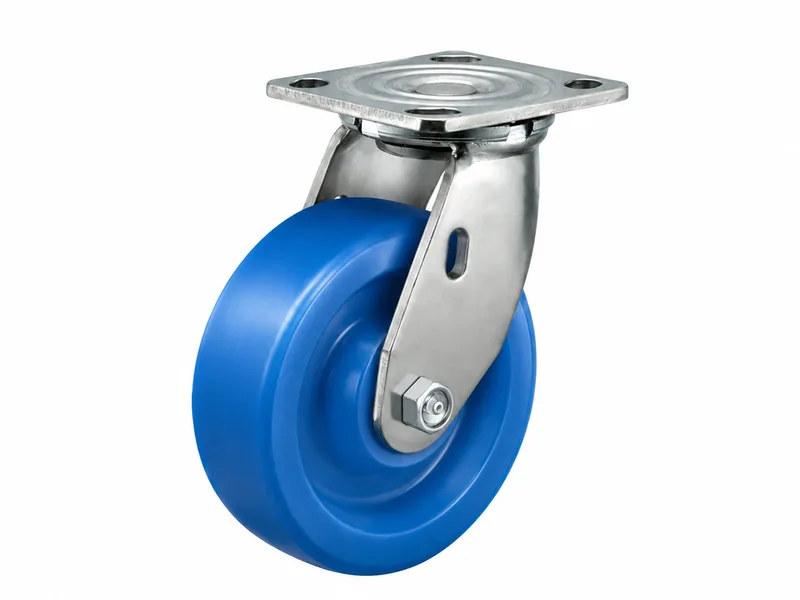
Specifications
| Tenant series band (RM-Medium) | 150-500 kg per caster (owner load-series table) |
|---|---|
| Class bands (industry reference) | ~70-300 kg per castor (one industry guide); 200-1,000 lb (90.7-453.6 kg) per caster (second publisher); retail taxonomy lists the class to 7,000 lb — bands are per-publisher, never merged |
| Wheel diameter pairing (industry reference) | Medium loads (150-500 kg): 4-inch to 6-inch wheels; light loads below 150 kg step down to 3-5 in, heavy loads above 500 kg step up to 6-12 in |
| Housing construction (industry reference) | Thicker stamped steel housings, 5-6 mm class — visibly heavier than furniture-grade casters, without the welded fabrication of the heavy-duty tier |
| Typical wheel materials | Polyurethane (PU), rubber, nylon (PA); cast iron appears at the top of the class |
| Typical duty | Factory and warehouse carts, racks, light industrial equipment, frequent daily movement on concrete |
| Lead time | 15–20 days (custom configurations 30–40 days) |
| MOQ | 200 pieces (standard catalog items ship in smaller quantities) |
| Warranty | 18 months |
The RM-Medium 150-500 kg band is owner first-party data. Every other band on this page is a published industry or retail-taxonomy reference — the three sources disagree with each other by design, because each draws its class line differently. Treat them as sizing context; the rating for your wheel, bearing and floor is stated on the quotation.
Applications & Selection
Where the medium class earns its keep
The published class logic is a cost/durability balance: light duty casters fail under constant factory use, heavy duty casters are more than the load (and the budget) needs. Medium duty sits between — frequent movement, moderate loads, occasional encounters with thresholds, dock plates and imperfect floors. Published buyer guidance fits the class to shop-floor carts, pick racks, tool carts and material trolleys that run every shift.
Wheel material follows the floor. Hard polyurethane on cast iron or steel cores carries the class-top loads and resists debris; rubber trades capacity for quiet; nylon wins on harsh or wet floors. Because the class straddles so many duties, the honest sizing input is not the class name but the three numbers that decide the build: true load per caster (total load divided by three for a four-wheel cart on uneven floors, per the published safety rule), wheel diameter against floor condition, and bearing type against speed and wash-down.
Selection rules to settle before you RFQ
Duty class names are not interchangeable between suppliers. One publisher caps the class near 300 kg per castor; another stretches it to 7,000 lb in retail taxonomy. When comparing quotes, compare the per-caster rating, housing gauge and wheel spec — not the class label.
Use the diameter ladder as a starting screen, not a verdict: published engineering guidance pairs 150-500 kg loads with 4-6 inch wheels, steps down below 150 kg and up above 500 kg. If your calculation lands on the boundary, move up a diameter or add casters — the ladder presumes normal speeds and reasonable floors.
Our supply path is own production plus outsourcing: medium duty builds across the standard wheel materials and mount styles are deliverable. The RM-Medium rating applies within its stated band; outside it, the quotation states what the configuration actually carries.
Frequently Asked Questions
What load range is "medium duty" for casters, exactly?
It depends on who drew the line — and honest catalogs say so. Published figures run from roughly 70-300 kg per castor (one industry guide) through 200-1,000 lb (about 90-454 kg) per caster (a second publisher), with distributor taxonomy listing medium duty up to 7,000 lb for the top of the class. Our RM-Medium series is specified at 150-500 kg per caster. Always size from the per-caster rating on the quotation, not the class name.
How do I calculate how many medium duty casters I need?
Total load (equipment + maximum cargo) divided by the number of casters, then a safety factor. Published guidance divides by three even on four-wheel carts, because on uneven floors one wheel can lift and the remaining three carry everything. State the true load per caster and the worst floor in your RFQ and the sizing makes itself.
What should my medium duty caster RFQ include?
Load per caster (and how it is distributed), wheel diameter and material preference, floor type and conditions, mounting style (top plate or stem with dimensions), bearing type, brake requirements, environment (temperature, moisture, debris), and quantity per configuration. A sketch of the mounting interface shortens quoting the most.
Ordering & Documentation
Documents
Every order ships with a packing list and commercial invoice. Dimensional drawings (top plate, bolt pattern, wheel cross-section, mounting height) are available on request so your cart fabricator can check fit before production. Load-series documentation for the RM-Medium band is published on the series page.
Quotation
A quotation needs: load per caster, wheel diameter and material, bearing type, mount interface, floor and environment notes, and quantity. The confirmed quotation states the rating for your configuration — class bands above are references, the quotation is the commitment.
Sample & supply
Standard builds are produced to order with an MOQ of 200 pieces; smaller trial quantities of catalog items can ship in some sizes — ask with your RFQ. Lead time is 15-20 days standard, 30-40 days for custom geometry or finishes. The usual validation: run a sample cart through the real route — worst floor, tightest turn, heaviest shift — before the batch order.
Storage & shipping
Medium duty casters ship with raceways greased and wheels free-turning; store flat in dry cartons. Before installation, spin each wheel and sweep each swivel by hand — notching or drag gets flagged and replaced before it is bolted under a cart that runs every shift.