
Product Catalog
Light Duty Casters — the 10-150 kg Class for Furniture, Displays and Light Carts
Updated 2026-11
Light duty casters are the most common casters in the world — on office chairs, file cabinets, display racks, plant stands and small utility carts — and the most over-spec question in caster purchasing is how much of the industrial class carries down to them. Published industry standards place the class at 10-150 kg per wheel, with anything above 150 kg categorized as medium or heavy duty. A second publisher draws the same class finer: roughly 50-200 lb (22.7-90.7 kg) per caster on 2-4 inch wheels, prioritizing maneuverability and affordability.
The class trades capacity for everything else buyers actually feel: easy swivel force, quiet rolling, floor protection on hardwood, tile and carpet, and low unit cost. Our supply covers the class in polypropylene, polyamide (PA), TPR and solid rubber wheels with stamped housings — per-configuration ratings confirmed at quotation, never assumed from a class table.
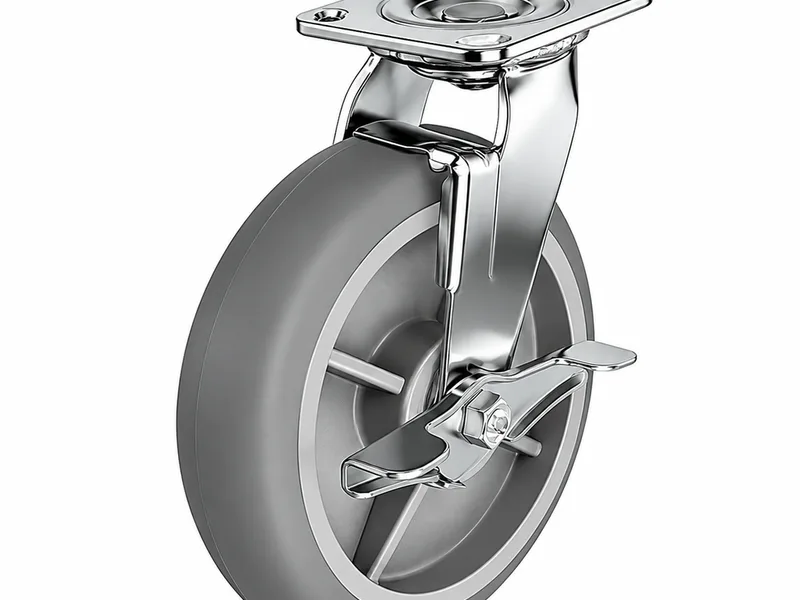
Specifications
| Tenant series band (RM-Light) | Up to 150 kg per caster (owner load-series table) |
|---|---|
| Class band (industry reference) | 10-150 kg per wheel (ICMA-attributed guidance); above 150 kg the class becomes medium/heavy duty |
| Per-caster detail (industry reference) | Typically 50-200 lb (22.7-90.7 kg) per caster; 2-4 inch wheel diameters dominate |
| Retail taxonomy (industry reference) | Distributor class chart lists light duty up to 350 lb — per-publisher bands, never merged |
| Typical wheel materials (industry reference) | Polypropylene (PP), nylon (PA), thermoplastic rubber (TPR), solid rubber — lightweight, quiet, gentle on finished floors |
| Typical duty | Office and residential furniture, retail displays, small carts and bins; frequent movement on smooth indoor floors |
| Lead time | 15–20 days (custom configurations 30–40 days) |
| MOQ | 200 pieces (standard catalog items ship in smaller quantities) |
| Warranty | 18 months |
The RM-Light band is owner first-party data. The 10-150 kg, 50-200 lb and 350 lb figures are three different publishers drawing three different class lines — each is a reference for its own taxonomy, and none is a tenant rating. Your rating for wheel size, material and mounting is stated on the quotation.
Applications & Selection
What the class is for — and where it stops
Published buyer guidance is consistent about the fit: light duty casters serve office furniture, residential items, retail displays and light commercial carts — loads light enough to move by hand, floors smooth enough not to fight a small wheel, and movement frequent enough that easy swivel matters more than brute capacity. The materials that make that ride — plastic wheels (polypropylene, nylon), rubber, soft TPR — are lightweight, quiet and gentle on hardwood, tile and carpet.
The class stops at load and environment. Push a 40 kg light-duty caster toward its 150 kg ceiling on rough concrete and the thin stamped housing and small-diameter wheel pay for the savings in flat spots, loosened swivels and short service life; published class guides steer utility and workshop duty to the medium class for exactly this reason. Wet floors, freezers and ovens each push the selection to a material or family page of its own.
Our supply path is own production plus outsourcing across the class. Where a furniture line needs a stem mount, a total-lock pedal or an ESD-safe wheel, those are separate family pages — the light-duty rating logic stays the same.
Selection rules to settle before you RFQ
Load per caster first: total load (including the item itself) divided by the number of casters, never exceeding the individual rating — the published guidance states the distribution rule explicitly. Small wheels concentrate load; when in doubt, step up a diameter rather than up a material grade.
Mount second: light duty is where stem mounts, grip-ring sockets and bolt-hole casters live alongside small top plates. Match the mount to the leg or base construction — a wrong stem fit fails before the load rating ever matters.
Floor and noise third: the same 3-inch wheel in PP, TPR and rubber rolls at three noise levels and three floor-protection grades. Published material guides rank TPR and rubber as the quiet choices; PP and nylon as the easy-rolling, easy-cleaning choices.
Frequently Asked Questions
What weight is "light duty" for a caster wheel?
Published industry guidance puts light duty at 10-150 kg per wheel; one finer-grained publisher describes the typical product as 50-200 lb (about 23-91 kg) per caster. Distributor taxonomy stretches the class to 350 lb. The bands differ because each publisher draws its own line — size from the per-caster rating on the quotation, not the label.
Can I use light duty casters on a workshop cart?
Not for real workshop duty. The class is built around smooth indoor floors and hand-moved loads; published class guides route workshop and utility duty to medium duty casters, whose thicker housings and larger wheels survive thresholds, debris and constant movement. If the cart only crosses a finished floor occasionally, light duty holds.
What should my light duty caster RFQ include?
Load per caster, wheel diameter and material (PP, PA, TPR or rubber), mounting style with dimensions (stem diameter and length, grip ring or threaded, or plate and bolt pattern), brake or locking needs, floor type, and quantity. For furniture programs, state the color and noise expectations too — both are specifiable at this class.
Ordering & Documentation
Documents
Every order ships with a packing list and commercial invoice. Dimensional drawings (stem profiles, plate dimensions, wheel cross-section) are available on request; material statements per batch are quoted with the order so furniture and display programs can document what rolls on their products.
Quotation
A quotation needs: load per caster, wheel diameter and material, mount interface, floor type, noise or appearance requirements, and quantity. The confirmed quotation states the rating for your configuration — class bands above are references, the quotation is the commitment.
Sample & supply
Standard builds are produced to order with an MOQ of 200 pieces; smaller trial quantities of catalog items can ship in some sizes — ask with your RFQ. Lead time is 15-20 days standard, 30-40 days for custom colors or mounts. For furniture programs the usual validation is a sample set rolled through the real space — carpet, thresholds, cleaning machines — before the batch order.
Storage & shipping
Light duty casters ship in cartons, wheels bagged to keep finished treads clean. Store flat and dry; TPR and rubber treads keep away from sunlight and heat sources. Before assembly, spin each wheel and check the tread for flats from storage weight.