
Product Catalog
Leveling Casters — Mobility and a Fixed, Level Support in One Component
Updated 2026-11
A leveling caster is two components in one: a swivel caster for moving, and a leveling foot for standing. Once the equipment reaches its position, a mechanical adjustment lowers an internal support pad into floor contact and lifts the wheels clear — the unit switches from a mobile state to a fixed-support state. Industry guides define it exactly this way (a swivel caster's mobility combined with a leveling foot's fixed support) and are equally clear about the selection error it prevents: dynamic load while moving and static support once fixed are different ratings and must be evaluated independently, not averaged into one number.
The mechanism matters for precision equipment. Workbenches, machine bases, lab benches, server and medical frames, retail fixtures — anything that must move occasionally but sit absolutely still and level in between. When the support pad takes the load, vibration transmission drops, the frame stops creeping, and stationary weight comes off the wheels onto a stable base instead of flat-spotting tires and point-loading floors. Our line covers plate-mount and threaded-stem types in nylon and PU wheel options, with published per-family figures spanning 50 kg to 1,200 kg per caster depending on model and a reference set rating of 1,000 kg per set of 4 — per-configuration values confirmed at quotation.
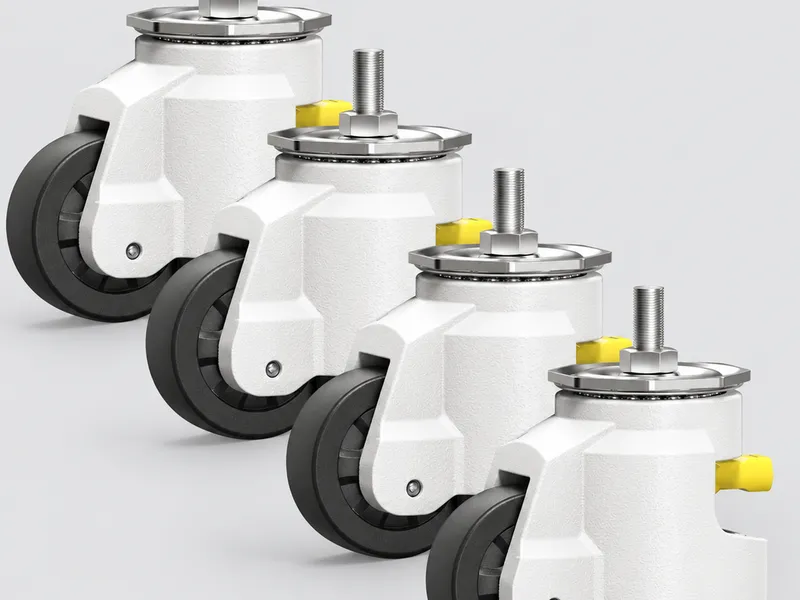
Specifications
| Type | Leveling casters (dual-state: swivel caster + integrated leveling foot); plate-mount and threaded-stem |
|---|---|
| Function | Adjustment lowers the support pad into floor contact and lifts the wheel — mobile state to fixed-support state |
| Wheel materials | Polyamide (PA), cast nylon (PA6), PU |
| Family load figures (industry reference) | Models from 50 kg to 1,200 kg per caster; reference set rating 1,000 kg (2,200 lb) per set of 4 — per-model values, never merged |
| Reference dimensions (industry reference) | Top plate 73 x 73 mm (2.87 in); wheel tread Ø 50 mm (2 in); overall height 86.6 mm (3.41 in); leveling height 7 mm — reference model |
| Operating types (industry reference) | Manual adjustment / linkage handle / foot lever; mounting: plate (4-bolt) or threaded stem |
| Lead time | 15–20 days (custom configurations 30–40 days) |
| MOQ | 200 pieces (standard catalog items ship in smaller quantities) |
| Warranty | 18 months |
Load and dimension figures above are catalog and published industry reference values kept per-model (a set-of-4 rating is not a per-caster rating and the 50-1,200 kg span covers different models). The dual ratings for your configuration — rolling and fixed-support — are stated separately on the quotation.
Applications & Selection
Why dual-state beats caster-plus-brake
A brake holds a wheel still; it does not take the load off the wheel. Equipment that sits for weeks on braked casters keeps its weight on four small tire patches — tires take a set, floors take the point load, and the frame still micro-moves with every nearby vibration. A leveling caster changes the load path instead: the support pads descend, the wheels unload, and the equipment stands on fixed feet with the casters along for the next move. For a precision workbench or a machine base, that difference is the difference between a frame that drifts and one that does not.
The second benefit is leveling itself. The support pads adjust individually, so a frame on an uneven floor comes level within the pad travel — published reference models carry about 7 mm of leveling height — which matters for anything with a machine bed, an optical axis, a chemistry bench or doors that must close true. Industry selection guides add the honest selection rule that keeps buyers out of trouble: evaluate the moving (dynamic) rating and the fixed-support (static) rating independently, because the equipment behaves as a caster in one state and as a machine mount in the other, and the two limits belong to different components.
Choose the operating type by duty. Manual-adjustment suits light, rarely-moved equipment; linkage-handle designs give fast, low-effort switching for heavy machines; foot-lever types suit production equipment that flips between mobile and fixed daily. Mounting follows the frame: plate-mount (four bolts) for heavy or precision equipment, threaded stem where the frame already provides a threaded socket. Published reference SKUs in the class run around 600 lb with 2-inch nylon wheels in aluminum-frame housings — useful context for where the class sits, never a substitute for quoting your frame.
Selection points to settle before you RFQ
Bring both load numbers: the weight while rolling (divided per the usual three-of-four rule) and the weight while standing — they size different components, and a quote that only sees one of them is wrong by design. Add the floor condition where the unit will stand (the support pads grip differently on smooth, textured or sealed floors) and the level tolerance the application actually needs.
Then the operating pattern: moves per day or per week, who operates it, and whether the switch happens under time pressure (foot-lever) or calmly (manual). Travel distance between positions decides wheel size — a 50 mm reference-class wheel is for short, smooth moves; longer or rougher routes need diameter. State stroke (leveling height) requirements from the floor's unevenness, not from a datasheet default.
Finally the mounting interface and environment: plate pattern or threaded-stem size against the frame's existing holes or sockets, corrosion exposure (washdown, chemicals) for the pad and spindle materials, and any hygiene or ESD requirement that touches wheel and pad compounds. Equipment in laboratories, food service and electronics rooms carries requirements that reach past the caster into materials — say so at RFQ, not after delivery.
Frequently Asked Questions
Is a leveling caster just a caster with a brake?
No — they solve different problems. A brake locks a wheel so the equipment cannot roll, but the load stays on the wheels and the frame can still rock and vibrate. A leveling caster switches the load path: the support pad lowers to the floor and lifts the wheel, so the equipment stands on a fixed, level foot while parked and rolls on the caster only when moving. Industry guides state the distinction directly — a leveling caster is not a "caster with a brake" but a component integrating mobility, support and height adjustment.
How is the load rating of a leveling caster read — per caster or per set?
Both figures exist in the market and they are not interchangeable. Published family figures in this class range from 50 kg to 1,200 kg per caster depending on model, and reference set ratings around 1,000 kg (2,200 lb) per set of 4 appear alongside them. Industry guidance adds the rule that matters most: evaluate the dynamic (rolling) load and the static (fixed-support) load independently — they load different components. Tell your supplier both numbers in the RFQ and require the quotation to state both ratings for the configuration quoted.
What should my leveling caster RFQ include?
Equipment weight (so both the rolling and standing loads can be derived), moves per day/week and who operates the switch, floor type and level tolerance, required leveling height (stroke) from the floor's unevenness, mounting interface (plate pattern or threaded-stem size and location), wheel material preference, environment (washdown, chemicals, ESD), and quantity per configuration. A photo of the frame base is the most useful attachment — the mount interface is the detail most often wrong in first-round RFQs.
Ordering & Documentation
Documents
Every order ships with a packing list and commercial invoice. Dimensional drawings (top plate and bolt pattern or stem size, overall and mounted heights, support-pad stroke) are available on request so your frame designer can check the interface and the level range before production.
Quotation
A quotation needs: equipment weight (rolling and standing), operating type (manual, linkage, foot lever), mount interface, wheel material, floor and level tolerance, environment, and quantity. The confirmed quotation states both ratings — rolling and fixed-support — for your configuration.
Sample & supply
Standard models are produced to order with an MOQ of 200 pieces; smaller trial quantities of catalog items can ship in some sizes — ask with your RFQ. Lead time is 15–20 days for standard configurations and 30–40 days for custom mount or stroke work. A trial of one unit under the actual equipment — cycle it mobile-to-fixed a dozen times and check level repeatability — is the usual validation.
Storage & shipping
Leveling casters ship with the support pads retracted and store in dry cartons; the pad compound is an elastomer and ages like one, so rotate stock and keep units out of sunlight. Before installation, cycle each unit through its full mobile-to-fixed travel several times: the pad should seat flat, lift the wheel clear, and return without sticking. A pad that seats unevenly or a spindle that binds is flagged and replaced before it goes under a frame that expects level.