
Product Catalog
Expanding Stem Casters — Casters That Grip Inside Round Tubing
Updated 2026-11
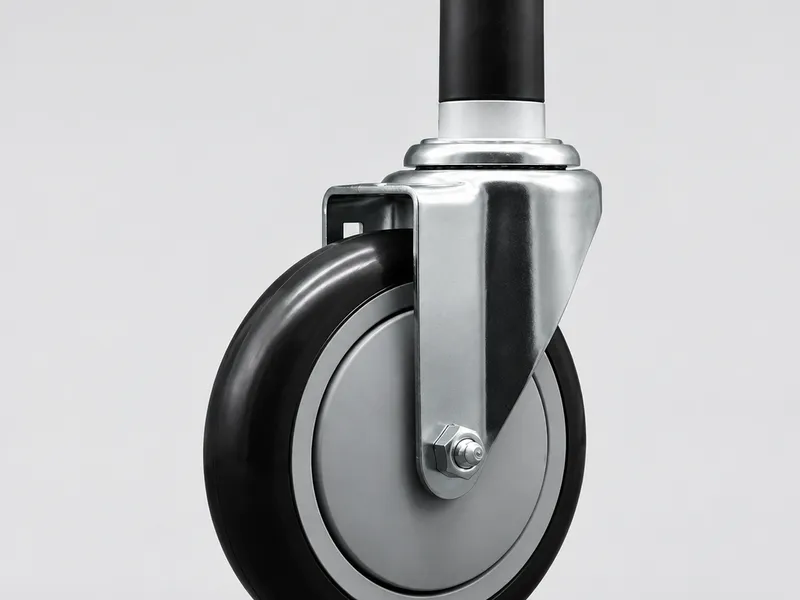
An expanding stem caster solves a mounting problem, not a rolling one. When equipment legs are round hollow tubing — wire carts, tube-frame racks, wire shelving, light fixtures — there is no tapped hole for a threaded stem and no flat face for a top plate. The expanding stem goes inside the tube instead: an adapter or stem body with a rubber or split-metal sleeve expands against the tube's inner wall as you tighten it, gripping the ID so the caster cannot pull out or spin. Industry selection guides classify it as one of the four standard mount types — plate, threaded stem, grip ring stem, expanding stem — and describe it exactly this way: the expanding stem clamps inside a hollow tube.
The published class covers small-to-medium wheels: 3 to 5 inch diameters with tread widths of 1-1/4 to 1-5/16 inches, and ratings running from roughly 210 to 350 lb per caster depending on size and wheel material (rubber, polyurethane, polyolefin, phenolic). Two fit rules decide almost everything: match the adapter's OD range to your tube's ID, and tighten so the stem cannot spin under load — a spinning stem wallows the tube and loosens the grip. Our expanding-stem line is quoted per application against your tube ID, wheel and duty.
Specifications
| Type | Expanding stem casters and expanding adapters for round hollow tubing; swivel and rigid |
|---|---|
| Class size range (industry reference) | 3, 3-1/2, 4, 5 in wheel diameter; tread 1-1/4 to 1-5/16 in (published class band) |
| Class load range (industry reference) | Roughly 210-350 lb per caster depending on size and wheel (published class band — per-size, not a family rating) |
| Tube fit | Adapter OD range matched to tube ID; published fits span 3/4 in to 1-1/2 in tube IDs |
| Wheel materials | Gray rubber, mold-on polyurethane, polyolefin, phenolic |
| Mount note (industry reference) | Industry guides call plate "the safest spec for any new design" — expanding stem is for retrofit into existing tube legs, not new heavy designs |
| Tenant family rating | Confirmed at quotation against your tube ID, load and duty |
| Lead time | 15–20 days (custom configurations 30–40 days) |
| MOQ | 200 pieces (standard catalog items ship in smaller quantities) |
| Warranty | 18 months |
Size, capacity and tube-fit figures above are published industry-class reference values. Expanding-stem capacity is limited by the tube wall it grips, not only by the caster — the rating for your tube, load and duty is confirmed at quotation.
Applications & Selection
Where an expanding stem is the right answer
The expanding stem exists because a large share of light equipment runs on round tube legs: wire shelving posts, tube-frame carts, wire carts, display racks, light-duty fixtures. Welding on plates or drilling and tapping thin tube walls ruins the leg, and grip-ring stems only work where the tube ID matches a standard ring size closely. The expanding adapter bridges that gap — it tolerates a range of tube IDs, installs with a spanner or hex fitting, and can be removed and swapped without damaging the leg, which matters for equipment that gets re-configured or re-wheeled during its life.
The physics of the mount set its limits. The caster's load passes through the expanding sleeve as friction and bearing pressure against the tube wall, so capacity is bounded by the tube's wall thickness and material as much as by the caster itself — a thin-wall aluminum tube grips less safely than a steel furniture tube of the same ID. That is why the published class tops out in the low hundreds of pounds while plate-mounted casters of the same wheel size rate far higher: the wheel is not the limiting member, the grip is. Respecting that boundary is the whole craft of specifying this mount type.
The honest trade-off, stated by the industry guides themselves, is that plate is the safest spec for any new design. Expanding stems are the retrofit and light-duty answer: existing tube legs, equipment you cannot weld on, carts whose load stays in the low hundreds of pounds. When a client asks for an expanding stem under a half-ton load, the right answer is a plate adapter welded to a sleeve — not a bigger expander.
Selection points to settle before you RFQ
Measure the tube, not the caster: outer diameter and wall thickness, so the inner diameter is known — the adapter's expansion range must overlap your actual ID with margin at both ends. State the tube material too, because grip safety in thin-wall or soft-alloy tube is a quoting condition, not a detail.
Then the service facts: load per caster with the divide-by-three rule, static vs rolling duty, whether the cart gets pushed by hand or towed (a towed cart loads stems in directions a hand-pushed one never sees), floor surface, and wheel preference against that floor (soft rubber for finished indoor floors, polyurethane or polyolefin for shop concrete, phenolic where heat is present). Engagement frequency matters as well — an adapter adjusted once a year is specified differently from one re-positioned daily.
Finally the geometry: swivel or rigid per position, overall height constraints of the equipment, and brake requirement if the equipment parks on slopes. Any hospital, laboratory or food-service application should say so — stem-mounted equipment in those sectors often carries hygiene or floor-protection requirements that change the wheel and finish before the mount is even discussed.
Frequently Asked Questions
What is the difference between an expanding stem and a grip ring stem?
Both mount inside round tubing, but they grip differently. A grip ring stem has pre-formed rings that snap into a compatible tube ID at a fixed size — fast to install, but the tube ID must match the ring size closely. An expanding stem or adapter uses a sleeve that expands against the tube wall as you tighten a nut or screw, so it tolerates a range of IDs and can be removed and re-fitted. Industry selection guides list them as distinct mount types — plate, threaded stem, grip ring, expanding — and the practical rule is: grip ring for standard tube sizes at light duty, expanding for variable or non-standard IDs and retrofits.
How much weight can an expanding stem caster carry?
Less than the same wheel on a plate — the tube grip is the limiting member. Published class ranges for the common 3-5 inch expanding-stem sizes run from roughly 210 to 350 lb per caster depending on wheel size and material, and published collections list individual SKUs from about 210 lb up to 350 lb. Capacity also depends on your tube: wall thickness and material set how much expansion pressure the wall can take. State the tube and the load in the RFQ and the rating for that combination is confirmed at quotation — do not size from a wheel rating alone.
What should my expanding stem caster RFQ include?
Tube OD, wall thickness and material (so the ID and grip safety are known), load per caster, duty (hand-pushed, towed, static), wheel material and diameter preference, swivel or rigid per position, brake requirement, environment (washdown, temperature, floor type), and quantity per configuration. A dimensioned sketch of the tube leg is the single most useful attachment — the fit between adapter range and tube ID is the detail most often wrong in first-round RFQs.
Ordering & Documentation
Documents
Every order ships with a packing list and commercial invoice. Adapter dimension drawings (expansion range, stem length, hex/spanner fitting size) are available on request so you can verify the fit against your tube ID before production.
Quotation
A quotation needs: tube ID (or OD + wall), load per caster, duty, wheel material and size, mount positions, brake requirement and quantity. The confirmed quotation states the adapter range and the rating for your tube-and-load combination — published class bands are sizing references, not the order commitment.
Sample & supply
Standard sizes are produced to order with an MOQ of 200 pieces; smaller trial quantities of catalog items can ship in some sizes — ask with your RFQ. Lead time is 15–20 days for standard configurations and 30–40 days for custom adapter work. A one-leg trial fitted to the actual tube, loaded and pushed on the real floor, is the usual validation — the grip either holds or it does not, and you want to know before the fleet is converted.
Storage & shipping
Expanding adapters ship with the sleeve relaxed and store in dry cartons; rubber sleeves age like any elastomer, so rotate old stock and keep them out of sunlight. Before installation, check that the sleeve is intact and the expanding fitting turns freely; after installation, re-check the torque on each adapter after the first week of service — initial settling is normal, and a half-turn of re-tightening is the difference between a stem that stays put and one that starts to spin.