
Product Catalog
Low-Profile Rack Casters — Minimum-Height Casters for Racks, Cabinets and Server Frames
Updated 2026-11
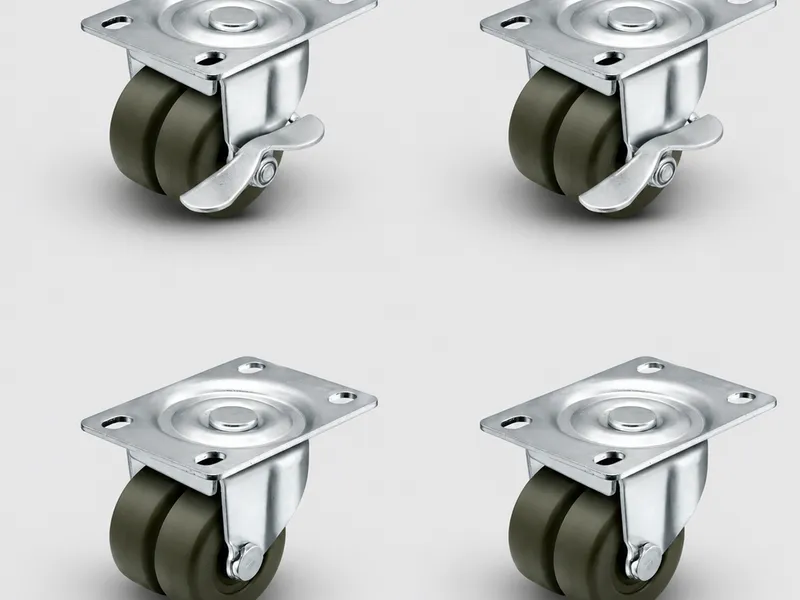
A low-profile caster trades wheel diameter for height. Where a standard industrial caster needs a 4-5 inch wheel to clear the floor and carry its load, a low-profile unit wraps a small wheel — commonly 1-3/8 to 3 inches — in a compact rig, cutting overall height to roughly 2 to 3 inches. Retail and published collections position the class exactly there: maximum capacity, minimal height. It is the caster of server racks and server-frame mobility kits, electrical cabinets, display cases, media consoles and any frame where the caster has to fit under a fixed bottom edge.
The trade is real and worth stating honestly: smaller wheels roll worse over obstacles and carry less per wheel. Published low-profile SKUs commonly rate from about 150 lb to 500 lb in the 2-3 inch sizes, with reference units reaching 1,000 lb — a published Shepherd low-profile SKU pairs a 3" x 1-1/8" glass-filled-nylon wheel with a 1,000 lb dynamic rating, a 3-1/8" x 4-1/8" top plate and an integrated Sure-Lok brake. Those are per-SKU reference figures, not a family promise: our low-profile line is quoted per application against your rack, floor and load, with capacity and height confirmed at quotation.
Specifications
| Type | Low-profile swivel casters (plate and stem mount) for racks, cabinets and equipment frames; brake options available |
|---|---|
| Class wheel sizes (industry reference) | Commonly 1-7/16 in to 3 in diameter (published collection range) |
| Class load band (industry reference) | Commonly 150-500 lb per caster in 2-3 in polyolefin sizes; published reference SKUs to 1,000 lb dynamic — per-SKU, not a family rating |
| Reference SKU (industry reference) | Shepherd low-profile: 3" x 1-1/8" glass-filled nylon wheel, Sure-Lok brake, 1,000 lb dynamic, 3-1/8" x 4-1/8" plate, 4.03 in mount height |
| Height logic | Overall height scales with wheel diameter — the binding constraint is the frame's under-edge clearance |
| Tenant family rating | No published tenant family rating — height, plate and capacity per configuration confirmed at quotation |
| Lead time | 15–20 days (custom configurations 30–40 days) |
| MOQ | 200 pieces (standard catalog items ship in smaller quantities) |
| Warranty | 18 months |
All size and capacity figures above are published industry or manufacturer-SKU reference values, kept per-SKU and never merged. The height, plate and rating for your frame and floor are confirmed at quotation.
Applications & Selection
The height-versus-capacity trade, made explicit
Every caster dimension chains back to wheel diameter: the wheel sets the axle height, the axle height plus rig depth sets overall height, and overall height is exactly what a rack or cabinet cannot give up. A server frame designed for a 3-inch under-clearance simply cannot take a standard 5-inch-wheel caster, no matter how good its load rating. The low-profile class exists to fit that envelope: compact rigs around small wheels push overall height down to the 2-to-3-inch band while keeping a usable top plate and, in many reference designs, an integrated side brake.
What you pay for the height is obstacle ability and, above the class ceiling, capacity. Wheel diameter governs the obstacle a caster can climb — the widely used rule of thumb is three to four times the obstacle height — so a 2-inch wheel manages door thresholds and cable ramps but not apron seams. Loads follow the same logic: published SKUs in 2-3 inch polyolefin sizes rate 150-500 lb, and the 1,000 lb-class reference units use dense glass-filled nylon wheels and heavier rigs to get there. If your floor is bad or your load is heavy, the honest fix is a taller envelope for a bigger wheel — not a low-profile caster asked to do a standard caster's job.
The classic deployment is the server rack: a frame that must roll out for service, sit dead still in production, and fit a raised-floor or plinth height budget. That is why low-profile racks almost always pair with brakes or total locks, and why stem-versus-plate mounting is decided by the frame's base rail — plate where there is a flat base flange, threaded stem where the frame provides sockets. Our line quotes all of it per configuration.
Selection points to settle before you RFQ
Start with the two hard numbers: available under-frame height (the true clearance, not the nominal — measure the lowest bolt or cable) and load per caster with the divide-by-three rule. Height picks the wheel diameter class; load then tells you whether that class can carry the frame at all, or whether the frame needs a riser base. Resolving that conflict before quoting is exactly what the height-versus-capacity analysis is for.
Then the floor and motion profile: hard smooth floors (data centers, labs, showrooms) let small wheels work well; any carpet, threshold or cable ramp argues for the largest wheel the height allows. State movement frequency — a rack that moves twice a year for cleaning is specified more cheaply than one repositioned daily, and duty changes the bearing and brake spec. Parking requirement decides the brake: side lock for hold-still, total lock where the frame must not pivot either.
Finally the environment and mounting: washdown or corrosion argues for stainless or plated rigs; electronics rooms care about non-marking wheels and static considerations; and the mount (plate pattern or stem size) must match the frame's base rail or socket, which is a measurement, not a preference. Send the RFQ with the clearance, the load table and the floor description, and the quote lands right the first time.
Frequently Asked Questions
What makes a caster "low profile" — is there a standard definition?
There is no formal standard; the industry usage is a compact rig around a small wheel (commonly 1-3/8 to 3 inch diameters) giving overall heights in the roughly 2-to-3-inch band, versus 4-plus inches for standard industrial casters. Published collections position the class as maximum capacity at minimal height, with the 2-5/8" x 3-3/4" plate as the popular size. When you RFQ, specify the height you must fit and the load you must carry — the numbers define the class better than the name.
How much weight can a low-profile caster carry?
Less per wheel than a standard caster of the same quality, and the published figures are per-SKU: 150-500 lb is the common band for 2-3 inch polyolefin sizes, with heavier reference units — such as a published 3-inch glass-filled-nylon low-profile SKU — reaching 1,000 lb dynamic. Small wheels also concentrate load on the floor, which matters on raised floors and soft coverings. Size with the divide-by-three rule on a four-caster frame and confirm the rating for your exact configuration at quotation.
What should my low-profile caster RFQ include?
Available under-frame clearance (measured to the lowest point), load per caster, floor surface along the actual route, movement frequency, brake requirement (side lock, total lock, none), mount type with the frame's plate pattern or stem socket size, environment (electronics room, washdown, corrosion), and quantity per configuration. The clearance measurement and the floor description are the two details that most often change the quoted spec.
Ordering & Documentation
Documents
Every order ships with a packing list and commercial invoice. Dimensional drawings (top plate and bolt pattern or stem size, overall mounted height, wheel and tread dimensions) are available on request so your frame designer can check the fit against the measured clearance before production.
Quotation
A quotation needs: available under-frame clearance, load per caster, floor surface along the actual route, brake requirement, mount type (plate pattern or stem socket), wheel material preference, environment and quantity. The confirmed quotation states the overall mounted height and the rating for your configuration — published class bands and reference SKUs above are sizing references, not the order commitment.
Sample & supply
Standard sizes are produced to order with an MOQ of 200 pieces; smaller trial quantities of catalog items can ship in some sizes — ask with your RFQ. Lead time is 15–20 days for standard configurations and 30–40 days for custom mount or brake work. A one-position trial fitted to the actual frame — check the clearance, roll the route, cycle the brake — is the usual validation before a rack fleet is converted.
Storage & shipping
Low-profile casters store in dry cartons; keep the brake pedals and swivel paths free of packing foam that could wedge the mechanism. Before installation, spin each wheel and cycle the brake — the compact rig leaves little room for service access once mounted, so a stiff swivel or a dragging brake is far easier to replace before the frame is lowered onto it.