
Product Catalog
Maintenance-Free Casters — Sealed-for-Life Bearings, No Greasing, No Downtime
Updated 2026-11
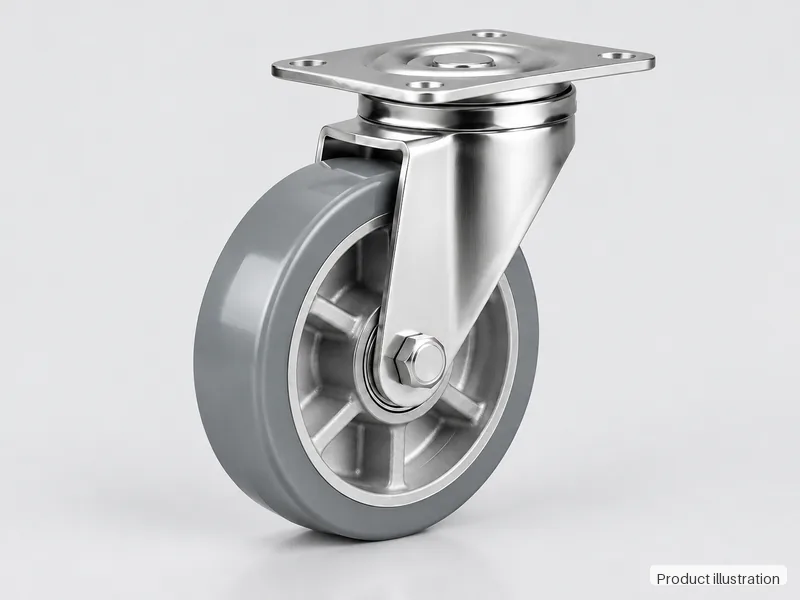
A maintenance-free caster is designed so that its service schedule is: none. The grease fittings are gone, the swivel and wheel bearings are sealed for life, and the kingpin — where a conventional caster gradually loosens — is either pre-set or replaced by a kingpinless construction. Published manufacturer lines describe the design intent plainly: sealed ball bearings keep contaminants out, and no grease fittings or kingpin re-tightening means less maintenance labor and less downtime. For a fleet of hundreds of carts, that difference is not cosmetic — it is the lubrication round that stops happening, and the casters that stop failing from a missed one.
Honesty requires the boundary the industry itself draws: "maintenance-free" is not a standardized term. Trade guidance for cleanroom buyers says it directly — if a supplier claims a bearing is maintenance-free, ask how long that rating applies. Our line treats the term as an engineering target with a stated basis: sealed bearing classes selected for the duty, sealed swivel construction, and a documented expectation (continuous indoor duty, defined wash-down and load conditions) rather than an unqualified promise. What that means for your duty — and what the seals do and do not cover — is stated on the quotation.
Specifications
| Type | Sealed swivel and rigid casters — sealed-for-life wheel and swivel bearings, no grease fittings |
|---|---|
| Maintenance design | No re-greasing, no kingpin re-tightening (industry design class); duty-basis expectation stated per quotation |
| Bearing class | Sealed ball bearings, kept free of contaminants (dust, moisture, debris, fibrous chop) |
| Capacity | No published family rating — confirmed per configuration at quotation |
| Industry class positioning (reference) | Published selection guidance positions lifetime-sealed bearings for continuous-duty (8+ hour daily) applications |
| Typical duty | Continuous-use carts and AGV-adjacent fleets, food service and pharma-adjacent wash-down-adjacent areas, anywhere a missed lube round becomes a failure |
| Lead time | 15–20 days (custom configurations 30–40 days) |
| MOQ | 200 pieces (standard catalog items ship in smaller quantities) |
| Warranty | 18 months |
"Maintenance-free" is not a standardized industry term — the honest question is how long the sealed rating applies under your load, speed and wash conditions. Published class claims above are industry references; the sealed-bearing basis and expected service conditions for your configuration are stated on the quotation.
Applications & Selection
What "maintenance-free" actually removes from your schedule
A conventional industrial caster needs three recurring attentions: wheel-bearing lubrication, swivel-bearing lubrication, and kingpin re-tightening as the assembly works in. Each one is a labor line and a failure opportunity — the caster that missed its grease round is the one that seizes, flats its tread and takes the cart down. A maintenance-free design removes the schedule instead of lengthening it: the bearings are sealed at manufacture for their service life, there are no fittings to grease because there is nothing to grease, and the swivel is built so it does not loosen in service. Manufacturer lines serving high-duty applications frame it as exactly this labor-and-downtime reduction.
The sealed bearing is the load-bearing part of the claim. Seals keep the lubricant in and the environment out — dust, moisture, wash-down chemicals, and in composite-fabrication plants even airborne fibrous chop. That is the same reason sealed bearings are standard in cleanroom and pharmaceutical guidance, and it cuts both ways: a seal that survives your chemistry and temperature is the whole product. This is why the quotation states the sealed rating basis — duty hours, load, wash conditions — instead of leaving the term unqualified.
Maintenance-free does not mean damage-proof. Seals age, abuse (pressure washing past the seal rating, loads several times the rating, towed speeds beyond spec) still ends service life early, and a wheel tread still wears with mileage. What the design buys you is a fleet whose performance does not depend on a lubrication round happening on time — and a predictable, plan-able replacement rhythm instead of emergency failures.
Selection points to settle before you RFQ
State the duty basis first: hours per day, load per caster, speeds, wash-down frequency and chemistry, and ambient temperature at the wheel. Lifetime-sealed bearing classes are positioned for continuous-duty applications in published guidance, but the seal compound and grease (factory-packed for life) must match your wash chemicals and temperature band — that match is what the quotation commits to.
Then capacity and construction as with any caster: load per caster with the divide-by-three rule, wheel material by floor (polyurethane for finished floors, nylon or stainless where chemistry leads), swivel vs rigid per position, brakes where the equipment stands occupied. Where swivel-loosening is the historical failure, kingpinless construction is the structural answer — ask for it quoted alongside the sealed standard.
Finally, ask the boundary question in the RFQ, not after the failure: how long does the maintenance-free rating apply at my duty? A supplier who can answer with duty hours, load and wash conditions is selling an engineering basis; one who cannot is selling an adjective. The fleet-sized payoff is real either way — you are buying the removal of a schedule, so make the basis explicit and hold the quote to it.
Frequently Asked Questions
Are maintenance-free casters really maintenance-free?
They are maintenance-schedule-free, which is the useful part: no re-greasing, no kingpin re-tightening, sealed bearings that keep lubricant in and contamination out for their designed service life. But the term is not standardized in the industry, and honest trade guidance says to ask any supplier how long the rating applies. Treat it as an engineering claim with a basis — duty hours, load, wash conditions — and the quotation should state that basis. Tread wear and abuse damage still exist; what is gone is the lubrication round your fleet used to depend on.
What is the difference between sealed and sealed-for-life bearings?
A sealed bearing has contact seals that keep lubricant in and contaminants out; a sealed-for-life bearing is that, specified with factory-packed grease and a duty basis such that the bearing outlasts the caster between the quoted conditions — no re-lubrication port because none is intended. Published selection guidance positions lifetime-sealed bearings for continuous-duty (8+ hour daily) applications precisely because the design removes the lubrication variable. For your duty, the seal material, grease and rated conditions are what the quotation should state.
What should my maintenance-free caster RFQ include?
Load per caster, duty hours per day and speeds, wash-down frequency and chemicals, ambient temperature at the wheel, floor type, wheel material preference, swivel vs rigid and brake positions, mount type and plate size, and quantity per configuration. Add the question that defines the term: "what duty basis does the maintenance-free rating carry, and what voids it?" — the answer belongs on the quotation, not in a brochure.
Ordering & Documentation
Documents
Every order ships with a packing list and commercial invoice. The sealed-bearing specification (bearing class, seal type, factory-packed lubricant) and the duty basis for the maintenance-free rating are stated on the quotation and repeated on the order documentation; dimensional drawings are available on request.
Quotation
A quotation needs: load per caster, duty hours and speeds, wash-down and temperature conditions, floor type, wheel material, bearing class, mount configuration and quantity. The confirmed quotation states the capacity and the sealed-rating basis for your configuration — published class claims are references, not the order commitment.
Sample & supply
Standard configurations are produced to order with an MOQ of 200 pieces; smaller trial quantities of catalog items can ship in some sizes — ask with your RFQ. Lead time is 15–20 days for standard configurations and 30–40 days for custom seal, wheel or mount work. Samples ship freight collect and are refundable against a bulk order; the usual validation for continuous-duty fleets is a defined-interval inspection at 30 and 90 days confirming zero re-greasing events and stable swivel torque.
Storage & shipping
Sealed casters ship ready to run — no pre-lubrication, no commissioning grease. Store cartoned, dry, and out of direct sunlight; seals and treads age under UV like any elastomer. Before installation, cycle each swivel by hand: it should turn smoothly with consistent resistance. A unit stored for a long period needs nothing but that check — which is rather the point of the design.