
Product Catalog
Dual Wheel Casters — Two-Wheel Swivel and Rigid Casters for Stability and Capacity
Updated 2026-11
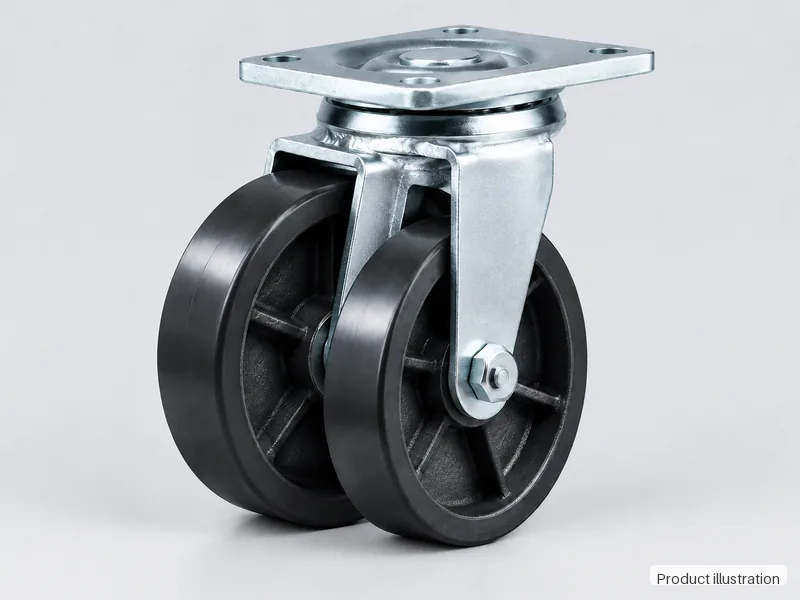
A dual wheel caster carries its load on two wheels mounted side by side on a shared axle instead of one wide wheel. The pair does three jobs a single wheel cannot: it spreads the same weight over twice the tread contact, it turns with less scrub because each wheel rolls a shorter, narrower arc than one wide wheel would, and it bridges floor debris and joints instead of teetering on them. The published class framing is exactly this — easier turning with higher stability — which is why heavy platform trucks, tow trains, dough troughs and aviation ground support equipment land on dual wheels when single wheels run out of room or capacity.
Structurally, a serious dual wheel is not two casters bolted together. Manufacturer kingpinless dual lines add a third full leg to the fork for durability, run larger swivel raceways, and — at the aviation end — oscillate and compensate on the axle so both wheels stay planted on uneven ground with cushion suspension leveling. Our dual wheel line is built to that logic and quoted per configuration: capacity, wheel material and swivel construction are matched to your load and tow duty, and the rating for your sizes is confirmed at quotation.
Specifications
| Type | Dual wheel swivel and rigid casters — two wheels on a shared axle |
|---|---|
| Class positioning | Easier turning with higher stability vs an equivalent single wide wheel (published industry class framing) |
| Capacity | No published family rating — confirmed per configuration at quotation |
| Industry class bands (reference) | Published retail-class bands run up to 2,500 lb on the popular 4.5 × 6.25 in plate and up to 9,500 lb on 6.25 × 7.5 in plates |
| Construction (industry reference) | Kingpinless dual forks add a third full leg; aviation GSE duals add an oscillating, compensating axle with cushion suspension leveling |
| Typical duty | Heavy platform trucks, tow trains, dollies and dough troughs, tooling fixtures, scrap carriers, aviation ground support |
| Lead time | 15–20 days (custom configurations 30–40 days) |
| MOQ | 200 pieces (standard catalog items ship in smaller quantities) |
| Warranty | 18 months |
Published capacity bands above are per-plate retail-class references for how the class is sold, not a family rating — the same footprint carries very different loads depending on wheel material, bearings and swivel construction. The rating for your configuration is confirmed at quotation.
Applications & Selection
Why two wheels beat one wide wheel
The naive alternative to a dual wheel is a single wheel twice as wide. The problem is turning: a wide wheel pivots in place by twisting its whole tread against the floor, and the wider the tread, the more scrub — floor glare, flat spots and steering effort that grows with load. Two narrow wheels on one axle turn the same pivot as two independent small scrub arcs, which is why heavy tow trains that a driver steers from the front spec duals: the tractor effort stays human, and the wheels do not chew the floor on every turn.
Capacity and height are the second win. Two wheels carry roughly twice the tread contact of one wheel of the same diameter, so a dual reaches a given capacity at a smaller wheel — and overall height shrinks with it. Published class ladders reflect this: the same popular plate size that tops out near 2,500 lb in ordinary single-wheel configurations supports higher bands in dual-wheel builds, and heavy-duty lines continue up through 9,500 lb classes on larger plates. Where deck height is fixed and the load keeps growing, going dual is usually the only move that does not require redesigning the frame.
The stability claim is about the footprint between the wheels. A single wheel can drop into a floor joint or ride up on debris and tip its load sideways; a dual pair spans the gap. At the extreme, aviation ground support duals make the axle itself oscillate and compensate so both wheels stay loaded on uneven aprons — the same principle, engineered to certification duty.
Selection points to settle before you RFQ
Start with load and plate: total working weight, divide by the casters sharing it, and name your existing top plate size if the duals must bolt onto current trucks. Published class bands (up to 2,500 lb on 4.5 × 6.25 in, higher on larger plates) are retail-class references — your material, bearing and duty factor decide the honest number, and it is confirmed at quotation.
Then swivel construction and duty: for towed and high-cycle use, kingpinless construction is the standard above light loads because constant swiveling is what kills kingpins; manufacturer dual lines add the third fork leg for exactly this reason. State tow speed and train length — axle, bearing and raceway specs scale with them.
Environment last: floor joints and debris favor the dual footprint (state the worst obstacle); wash-down needs stainless or sealed construction; powered vs manual towing changes bearing class. Say which wheels you want — polyurethane for finished floors, cast iron or forged steel for scrap, debris and tow lines — or ask for the material to be quoted per position.
Frequently Asked Questions
Are dual wheel casters stronger than single wheel casters?
For the same wheel diameter and footprint, yes — two wheels give roughly twice the tread contact, and heavier class bands are offered on the same mounting plates. But the honest comparison is at equal deck height: a dual reaches a given capacity with smaller wheels, which is often the real reason to switch. Capacity still depends on wheel material, bearings and swivel construction, so treat published class bands (for example up to 2,500 lb on the popular 4.5 × 6.25 in plate, with higher bands on larger plates) as sizing references and have your actual configuration confirmed at quotation.
When should I choose dual wheels instead of one wide wheel?
Three situations: the load exceeds what a single wheel of acceptable diameter carries; steering effort matters (two narrow wheels scrub far less in a pivot than one wide wheel of the same capacity); or the floor is jointed and debris-strewn, where a dual pair bridges what a single wheel would drop into or teeter on. Tow trains, heavy platform trucks and aviation ground support equipment combine all three — which is why duals dominate there.
What should my dual wheel caster RFQ include?
Load per caster and total weight, top plate size and bolt pattern (or whether the truck frames are new), swivel vs rigid per position, towed or pushed duty with speed, wheel material and diameter preference, bearing type, floor condition and worst obstacle, environment (wash-down, temperature), and quantity per configuration. If the duals replace existing single wheels, say what you are replacing — matching overall height and swivel radius matters as much as capacity.
Ordering & Documentation
Documents
Every order ships with a packing list and commercial invoice. Dimensional drawings (plate, bolt pattern, overall height, swivel radius, wheel face split) are available on request, and any special axle or raceway specification is stated on the quotation for the configuration quoted.
Quotation
A quotation needs: load per caster, plate size, swivel/rigid mix, tow duty and speed, wheel material and size, bearing class, environment and quantity. The confirmed quotation states the capacity for your exact configuration — published class bands are references for sizing, not the order commitment.
Sample & supply
Standard configurations are produced to order with an MOQ of 200 pieces; smaller trial quantities of catalog items can ship in some sizes — ask with your RFQ. Lead time is 15–20 days for standard configurations and 30–40 days for custom plates, axles or aviation-style oscillating axle work. Samples ship freight collect and are refundable against a bulk order; a tow-train trial with instrumented steering effort is the usual validation for heavy fleets.
Storage & shipping
Dual wheel assemblies ship with the wheel pair retained on the axle; keep them cartoned and flat-stacked so the fork legs are not the resting plane. Before installation, spin each wheel pair by hand — both wheels should turn freely and together, without a gritty bearing sound. Torque axle hardware to the stated value after the first week of service on towed duty; initial settling is normal and a re-torque is cheap insurance.