
Product Catalog
Custom & OEM Casters — From Drawing or Sample to Serial Production
Updated 2026-11
A custom caster program is a tooling project with wheels on it. Published industry practice runs two entry paths: you supply a physical sample and the manufacturer models it in CAD, opens molds and reproduces it; or you supply drawings plus the load, material and environment requirements, and the manufacturer cuts samples for your approval before serial production. Both paths converge on the same gate — samples are tested and approved by the customer before mass production starts.
Our OEM/ODM and private-label programs run on in-house production lines across the full material range, with zinc plating, chrome and custom powder-coat colors on brackets and brakes. Owner-confirmed program terms: MOQ 500-1,000 pieces depending on the item, tooling fee quoted separately, lead time 30-45 days with tooling adding 15-20 days. Samples are refundable against a bulk order.
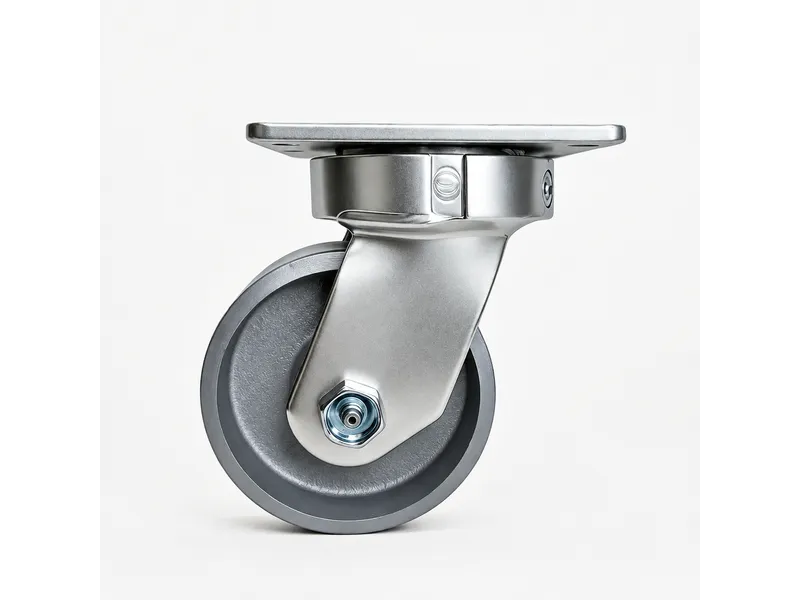
Specifications
| Program types (tenant) | OEM / ODM / private label on in-house production lines; full in-house material range |
|---|---|
| Customization scope (tenant) | Geometry, load rating, wheel and bracket materials, mount interfaces; finishes: zinc plating, chrome, custom powder-coat colors; Ø 25-300 mm size envelope |
| Development paths (industry reference) | Sample-based (CAD modeling from sample → molds → reproduce) or drawing-based (drawings + requirements → samples → customer test → production); mass production gated on sample approval in both |
| Tooling economics (industry reference) | Mold fee is a necessary cost at low volume and falls per-piece as quantity grows; fee depends on the number of casters and molds; die modification of an existing tool can save substantially versus cutting new |
| Program lead time (tenant) | 30–45 days (tooling adds 15–20 days where new tools are required) |
| MOQ (tenant) | 500–1,000 pieces by item; tooling fee quoted separately; samples refundable on bulk order |
| Warranty | 18 months |
| Industry span context (industry reference) | Published customization spans run 1-16 in diameters and 5 kg to 10 t loads (customized programs to 30 t) — industry context, not a tenant commitment |
Tenant program terms (MOQ, tooling, lead time, finishes) are owner-confirmed. Development-path, tooling-economics and span figures are published industry references — they describe how the trade runs custom programs, not promises about your project. Your program schedule, tooling quote and ratings are stated on the quotation.
Applications & Selection
How a custom program actually runs
The published workflow is worth reading closely because it prices discipline in: a manufacturer case study walks a drawing through review against existing stamping dies (two dimensions found that would not clear the die), a die modification instead of a new tool (reported tooling saving around 60% and three weeks of lead time), first-article samples measured against the drawing and air-freighted, a six-week customer field test on the real machine, one revision (a brake pedal 8 mm too low for the operators boots), then the container order. Every stage is a checkpoint the customer controls.
The economics follow the tooling. Published guidance is explicit: there is no universal MOQ floor for custom casters, but the mold fee is a necessary cost at low volume and the per-piece price falls as quantity spreads it; fee depends on the caster count and the number of molds. Delivery is equally honest — custom lead times depend on the complexity of the caster, the process requirements and the difficulty of mold opening, which is why our program terms quote tooling separately and add its 15-20 days explicitly rather than hiding it in a blanket promise.
What we need from you is what the sample path and the drawing path both consume: the sample or drawing, load per caster, speed and floor, environment (temperature, moisture, chemicals), mount interface, finish and brand requirements for private label, and the target quantity per release.
Frequently Asked Questions
What is the minimum order for custom casters?
Our OEM/ODM terms are 500-1,000 pieces depending on the item, with the tooling fee quoted separately. Published industry practice matches: customization itself has no universal MOQ floor, but the mold fee makes very small runs uneconomical — the per-piece cost falls as the quantity spreads the tooling. Samples are refundable against a bulk order.
Can you copy a caster I already have?
Yes — that is the sample-based path. Published practice: the manufacturer CAD-models your sample, opens or modifies molds, and reproduces the product; samples come back to you for testing before mass production. Bring the sample plus its duty context (load, floor, environment) so the reproduction is verified against how it actually works, not just its geometry.
How long does a custom caster program take?
Our confirmed program terms: 30-45 days production, with tooling adding 15-20 days where new tools are required. Published case studies show why the range is honest — drawing review, die work, first articles, field testing and revision each consume calendar time, and a die modification (versus a new tool) is where the published schedule savings live.
Ordering & Documentation
Documents
Custom orders ship with packing list and commercial invoice; program documentation can include dimensional drawings, material and finish statements, and first-article inspection records against your drawing. Private-label packaging and labeling are specified in the program agreement.
Quotation
A program quotation needs: the sample or drawing, load per caster and duty cycle, environment, mount interface and finish, private-label requirements, and the target quantity per release. The confirmed quotation states the tooling fee (separately), the unit price at your quantity, and the program schedule — industry span figures are context, the quotation is the commitment.
Sample & supply
First-article samples are produced on the program tooling and measured against the drawing before shipment; samples are refundable against a bulk order. The published gate applies to our programs too: serial production starts after your sample approval. Validation on your side — mounting the samples on the real equipment for a real shift cycle — is the step the case-study workflows all keep.
Storage & shipping
Program orders ship in batch-consistent packaging with finish protection (bagged or interleaved where powder-coat or chrome surfaces are specified). Store finished casters flat and dry; bracket finishes tolerate warehouse conditions, but packaging stays on until line-side.