
Product Catalog
Silent & Elastic Casters — Super-Elastic TPR Treads for Quiet Indoor Equipment
Updated 2026-11
Some environments measure a caster by its sound before its load rating: hospital corridors at night, restaurant floors during service, offices, libraries, hotel back-of-house. Silent and elastic casters are built for those floors — a super-elastic grey rubber tread that absorbs the vibration a hard wheel transmits, rolls without the rumble of polyurethane on tile, and stays non-marking on finished surfaces. Our line is thermoplastic rubber (TPR) based, with noise level test reports produced per production batch, so "quiet" arrives as a measurement instead of an adjective.
The same elasticity does quiet work on push force: the tread's deflection at start-up is what lets a loaded cart begin rolling without a jerk, and our line is designed to save up to 30% of push/pull force against standard wheels — the figure that matters to the nurse, the waiter or the picker pushing the cart two hundred times a shift. Diameters run 25 mm to 300 mm on our line, covering everything from medical case carts to logistics trolleys.
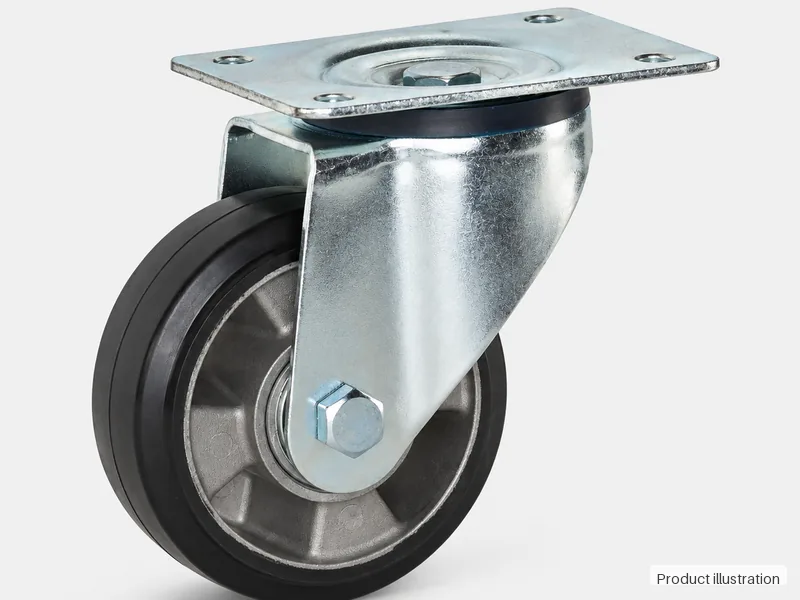
Specifications
| Wheel material | Thermoplastic rubber (TPR), super-elastic grey tread |
|---|---|
| Noise control | Noise level test reports per production batch |
| Effort design | Low rolling resistance design — saves up to 30% push/pull force (tenant design claim, confirmed at quotation for your load and floor) |
| Size range | Ø 25–300 mm on our line |
| Load rating | Confirmed per configuration at quotation (industry per-SKU reference: 250–400 lb in common 4–6 in sizes) |
| Typical environments | Hospitals, food service, offices, hotels, retail — finished-floor indoor duty |
| Lead time | 15–20 days (custom configurations 30–40 days) |
| MOQ | 200 pieces (standard catalog items ship in smaller quantities) |
| Warranty | 18 months |
Noise performance and push-force saving depend on load, floor and speed — the batch test report documents the tread's measured behavior, and the figures for your duty are confirmed at quotation. Industry capacity figures are per-SKU references in common sizes, not a family rating.
Applications & Selection
Where quiet rolling is a specification, not a preference
Hard wheels on hard floors make two kinds of noise: the continuous rumble of vibration through the fork and frame, and the percussion of every floor joint, threshold and tile edge. An elastic tread attacks both — it deflects over surface irregularities instead of ticking across them, and its damping soaks up the vibration before it reaches the bracket. That is the whole reason hospital, food-service and office fleets specify silent casters: the equipment disappears into the background the way the environment requires.
Elasticity also pays at start-up. A hard wheel begins rolling by overcoming static friction in one jump, which is the jerk you feel when a loaded cart starts moving; an elastic tread squats slightly under the start and rolls into motion, spreading the effort. Published ergonomic-caster lines make exactly this low-start-force claim for their elastic tread classes, and our line's design target is up to 30% lower push/pull force — a difference that compounds over a shift into fewer strained shoulders and easier one-handed steering. The batch noise report and the push-force figure for your load and floor are confirmed at quotation.
Know the trade before you standardize on the softest wheel in the catalog. Super-elastic treads carry less than hard wheels of the same size, flat-spot faster under long static loads, and age under UV and near heat sources — which is why silent casters belong on finished indoor floors at light-to-medium loads, and why a freezer dock or a debris-strewn shop floor is the wrong address for them. Where a fleet mixes environments, the quiet line serves the front-of-house equipment and a PU or nylon line serves the back dock, and the two are quoted on the same RFQ.
Selection points to settle before you RFQ
Load first, honestly: divide the equipment's working weight by the casters actually sharing it — three of four on an imperfect floor — and match against the confirmed per-configuration rating. Published per-SKU references in common TPR sizes run roughly 250 to 400 lb (4 to 6 inch diameters); if your per-caster number approaches the top of what the size class carries, step up a diameter or move to the PU family — the confirmed quotation settles it.
Then the two numbers the environment actually cares about: the noise requirement (is there a spec from the facility, or is "noticeably quieter than PU" the goal — the batch test report documents what we ship) and the floor (TPR treads are non-marking on vinyl, tile, epoxy and hardwood; debris floors chew soft treads). State both in the RFQ.
Hardware last: bearing type changes rolling effort more than anything else on a light-duty cart — ball bearings for easy push, bushings where cost leads — plus mount type per position (plate or stem, swivel/rigid/brake). Medical and institutional equipment often pairs this tread with total-lock brakes; food service wants washable configurations; say which yours is and the configuration quotes as a set.
Frequently Asked Questions
Are silent casters and TPR casters the same thing?
Not exactly — TPR is the most common material, silent is the requirement. "Silent casters" describes any tread engineered for quiet rolling (elastic rubber compounds, thermoplastic rubber, soft PU), and TPR is the workhorse material of that group: molded as one piece, non-marking, quiet, and inexpensive at volume. True rubber treads are the traditional alternative — quieter still under some loads, but heavier and pricier. Our silent line is TPR-based; if your environment needs a different elastic compound, the RFQ is the place to say so.
How much quieter are silent elastic casters, really?
Enough that it is measured, not marketed: our production batches ship with noise level test reports, so the comparison on your floor is between two numbers rather than two adjectives. The perceived difference against a hard PU wheel is usually immediate — the rumble and the click over floor joints both go — but the honest answer depends on your floor and your load, which is why the report travels with the order and the figure for your duty is confirmed at quotation.
What should my silent caster RFQ include?
Load per caster and the equipment's working weight, wheel diameter and width, floor type (vinyl, tile, epoxy, carpet transitions), the noise requirement or facility spec, push-force constraints (who pushes the cart, how often), bearing type, mount configuration per position (including total-lock brakes if the equipment stands occupied), hygiene or wash-down needs, and quantity per size. Equipment type — hospital, food service, office, retail — helps quote the right compound and bearing defaults.
Ordering & Documentation
Documents
Every order ships with a packing list and commercial invoice. Noise level test reports for the production batch are provided on request and filed against the batch; wheel dimension sheets (diameter, width, bore, bearing) and the tread compound statement are available for equipment and compliance documentation.
Quotation
A quotation needs: load per caster, size, floor type, noise requirement, bearing and mounting configuration, environment and quantity. The confirmed quotation states the rating and the documentation (batch noise report) for your exact configuration — the up-to-30% effort figure is a design target, and its value for your load and floor is what the quotation commits to.
Sample & supply
Standard configurations are produced to order with an MOQ of 200 pieces; smaller trial quantities of catalog items can ship in some sizes — ask with your RFQ. Lead time is 15–20 days for standard configurations and 30–40 days for custom compounds or stem work. Samples ship freight collect and are refundable against a bulk order; a floor trial with two braked and two free-swiveling units is the usual validation path for hospital and food-service fleets.
Storage & shipping
Elastic treads are the part that needs care in storage: keep casters cartoned, out of direct sunlight, away from heaters and ozone sources (motors, welders), and do not leave them stacked under load — a tread that takes a set in storage runs out of round and noisy in service. Store flat, keep bearing bores packaged until assembly, and before installation cycle each wheel by hand; a caster that sat compressed should roll true before it enters a quiet environment.