
Product Catalog
Pneumatic Casters — Air-Filled Wheels for Rough Floors, Outdoor Duty and Fragile Loads
Updated 2026-11
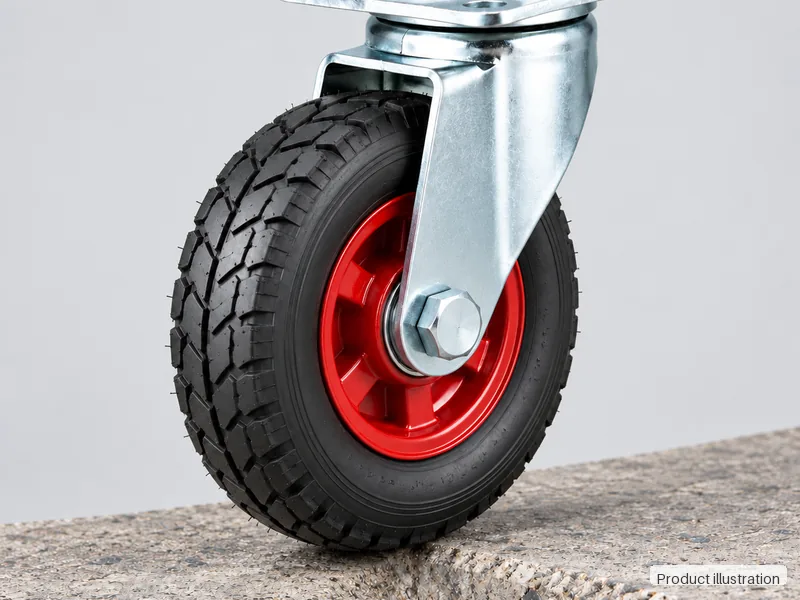
A pneumatic caster rides on an air-filled tire — the same idea as the tire on a truck, scaled down and mounted in a caster fork. The trapped air does the work no solid wheel can: it flattens over every crack, stone and lip instead of bouncing off it, so the load above glides where a hard wheel would jar. Manufacturer lines describe the class exactly this way — pneumatic casters are recommended for the greatest possible protection to both load and floor, or for off-road applications, cushioning the load on air akin to an automotive tire. Yard carts, nursery equipment, towed trailers over aprons, and any cart carrying fragile or delicate instruments across rough floors are the natural territory.
The trade is the air itself. A pneumatic tire punctures, loses pressure under standing load, and needs its pressure maintained; published material guides note the class plainly — outdoor and rough-surface use, load 150 to 350 lb in common sizes, punctures possible. Where the risk is unacceptable, two alternatives exist on the same page: semi-pneumatic and never-flat solid-urethane tires, which keep most of the rollability with nothing to burst — published never-flat lines rate up to 350 lb in 8 and 10 inch diameters. Our pneumatic line is quoted per application, with tire class, pressure class and hub chosen for your floor, and the rating for your configuration is confirmed at quotation.
Specifications
| Tire type | Air-filled pneumatic rubber tire on hub; semi-pneumatic and solid never-flat urethane alternatives |
|---|---|
| Cushioning | Air cushion protects load and floor — ride akin to an automotive tire (industry class description) |
| Capacity | No published family rating — confirmed per configuration at quotation |
| Industry class band (reference) | Published material guides list pneumatic wheels at 150–350 lb common-class, outdoor/rough-surface use |
| Never-flat alternative (reference) | Published solid-urethane pneumatic-replacement lines: up to 350 lb, 8 in and 10 in diameters |
| Typical duty | Outdoor yards, rough or debris-strewn concrete, fragile loads, towed trailers and carts |
| Lead time | 15–20 days (custom configurations 30–40 days) |
| MOQ | 200 pieces (standard catalog items ship in smaller quantities) |
| Warranty | 18 months |
Pneumatic capacity depends on tire size, pressure and hub construction, and published figures are common-class references rather than family ratings — the rating for your tire class, load and floor is confirmed at quotation. Air-filled tires need pressure maintenance; where that is not practical, ask for the semi-pneumatic or never-flat solid urethane options on the same quotation.
Applications & Selection
Where air beats every solid wheel
A solid wheel — polyurethane, rubber, nylon — meets the floor at whatever hardness it was molded to, and the bump energy it absorbs comes back into the frame as vibration. An air-filled tire absorbs by deforming: the carcass flexes around the obstacle, the pressure redistributes, and the spike never reaches the frame. On smooth concrete the difference is a comfort detail; on aprons, gravel, brick pavers or cracked yard slabs it is the difference between cargo arriving whole and cargo arriving stressed. That is why the class description on published manufacturer lines pairs load protection with floor protection and off-road use in one sentence.
The second advantage is footprint. An underinflated-capable tire sits on the floor with a wider, softer contact patch than any solid wheel of the same size, which rolls easier over soft ground — grass, gravel, mud edge cases — where a hard wheel digs in. Nursery and landscaping equipment, outdoor event carts and yard trailers exploit this every day.
Respect the trade-offs: pressure is a maintenance item (a tire parked loaded for weeks flattens and needs re-inflation before service), punctures are a real failure mode on debris routes, and load capacity is modest per tire size compared with solid wheels. Heavy outdoor duty that cannot tolerate downtime usually lands on never-flat solid urethane — published lines rate that alternative up to 350 lb in 8 and 10 inch sizes — accepting a slightly harder ride for eliminating the flat.
Selection points to settle before you RFQ
Name the floor honestly: smooth indoor concrete does not need air, and a solid wheel will outlast it; rough, outdoor or mixed routes are the pneumatic case. State the worst surface feature — gravel depth, joint lips, dock-plate edges — and whether the route crosses thresholds, because tire diameter and pressure class are chosen against the obstacle, not the average floor.
Load per tire next, with the divide-by-three rule for four-caster equipment, and against the published common-class band (150–350 lb in ordinary sizes) as a sanity check rather than a promise — heavier loads move to larger tires, higher-pressure classes or the never-flat urethane alternative, and the honest number is confirmed at quotation.
Then decide the air question deliberately: who maintains pressure, how long the cart stands loaded, and what a puncture costs you in downtime. If the answer is "nobody, forever, too much", quote the semi-pneumatic or solid never-flat class on the same RFQ. Close with bearings (sealed for outdoor wash-down and dust), mount type, and brake needs on the manually parked positions.
Frequently Asked Questions
Pneumatic vs solid casters — which should I choose?
Choose by floor and by consequence. Pneumatic (air-filled) tires cushion the load on air — the ride is closest to an automotive tire — and they are the class to specify for rough, outdoor or debris-strewn surfaces and for fragile or vibration-sensitive loads; the published trade-off is puncture risk and pressure maintenance, with common-class loads of 150–350 lb in ordinary sizes. Solid wheels (polyurethane, rubber, phenolic, nylon) carry more per size, never go flat, and need no pressure checks, but they transmit the floor to the load. If your floor is smooth and your loads are sturdy, solid wins. If your floor is rough or your load is fragile, air wins — and if it is rough but downtime is unacceptable, quote the never-flat solid-urethane class on the same RFQ.
How much weight can a pneumatic caster carry?
It depends on tire diameter, width and pressure class, so there is no single family number — published material guides put common pneumatic wheels in the 150–350 lb band, and published never-flat solid-urethane lines (the flat-free alternative) rate up to 350 lb in 8 and 10 inch diameters. Larger or higher-pressure tires rate higher. Size with the usual rule — total load divided by the casters actually sharing it (three of four in practice) — then have the rating for your exact tire class, load and floor confirmed at quotation rather than sizing from a class band.
What should my pneumatic caster RFQ include?
Load per caster, the worst surface along the route (gravel, joints, aprons, thresholds), indoor/outdoor mix, whether the equipment stands loaded for long periods, towed or pushed duty with speed, tire preference (air-filled, semi-pneumatic, or never-flat solid urethane), wheel diameter constraints, bearing type and sealing needs, mount type, brake positions, environment (rain, wash-down, temperature), and quantity per size. A photo of the worst 10 feet of the route tells us more than a paragraph about the best 100.
Ordering & Documentation
Documents
Every order ships with a packing list and commercial invoice. Tire specification (size, pressure class, hub and bearing) and the recommended operating pressure are stated on the quotation and repeated on the packing documentation; dimensional drawings of the fork and mount are available on request.
Quotation
A quotation needs: load per caster, floor description with the worst obstacle, tire class preference, diameter, bearing and mount configuration, environment and quantity. The confirmed quotation states the tire spec and the rating for your configuration — published class bands are sizing references, not the order commitment.
Sample & supply
Standard configurations are produced to order with an MOQ of 200 pieces; smaller trial quantities of catalog items can ship in some sizes — ask with your RFQ. Lead time is 15–20 days for standard configurations and 30–40 days for custom hub, tire or mount work. Samples ship freight collect and are refundable against a bulk order; the usual validation is a loaded run over your actual worst surface with attention to rolling effort and cargo behavior.
Storage & shipping
Air-filled tires ship at operating pressure and store best unloaded, out of direct sunlight, away from ozone sources (motors, welders) and not under a stacked load — a tire that takes a set over months runs out of round. Before service, check pressure against the stated operating value and inflate if the cart stood loaded; cycle each swivel by hand. Semi-pneumatic and never-flat urethane variants ship and store like any solid wheel, with no pressure checks.