
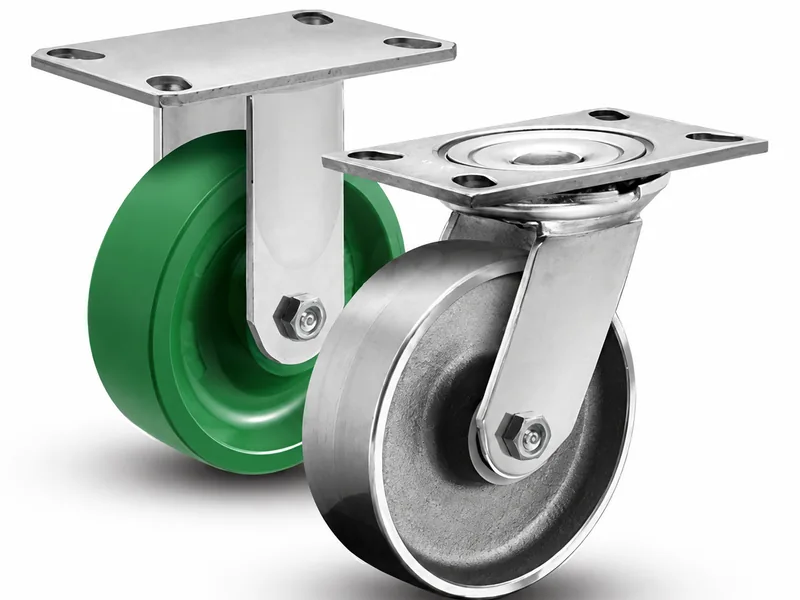
The RM-Heavy series is the middle tier of the RollMaster heavy-duty line, rated from 500 kg to 1500 kg per caster. It is the series for die carts, heavy trolleys, warehouse platforms and machinery-moving equipment — loads where a light bracket rivet line or an undersized wheel shows up as premature raceway wear.
Construction matches the rest of the line: welded brackets, precision ball or roller bearings with lubrication fittings, wheel diameters from 100 mm to 300 mm, and dynamic load testing on every production batch. For loads above 1000 kg per caster we recommend 200 mm or larger wheels.
Process Overview
A heavy duty caster is the band where construction, not just the rating, changes character: welded steel brackets replace stamped housings, and the wheel and bearing choices decide whether the rating survives daily shock. The RM-Heavy series spans 500 kg to 1500 kg per caster - the middle tier of the RollMaster heavy-duty line.
Selection works from the cart, not the label: divide total weight plus payload by 3 to place the load, and once the per-caster figure passes 1500 kg the RM-Extreme series takes over rather than the top of this band.
Casters by Load Range
| Series | Load per caster | Typical wheel options | Best for |
|---|---|---|---|
| RM-Light | up to 150 kg | Nylon, rubber, elastic | Light trolleys, medical and display carts |
| RM-Medium | 150–500 kg | Polyurethane, nylon | Warehouse carts, racks, AGV/AMR platforms |
| RM-Heavy | 500–1500 kg | Polyurethane on steel, forged steel | Die carts, machinery moving, heavy trolleys |
| RM-Extreme | 1500 kg and up | Forged steel, double wheel | Steel mills, ovens, extreme-load skates |
Specifications
- Load capacity 500-1500 kg per caster (count 3 of 4 casters at full load for uneven-floor safety)
- Welded heavy-gauge steel brackets, zinc or powder-coated finish
- Wheel options in PU on steel core, cast nylon (PA6) and forged or pressed steel
- Precision ball or roller bearings, lubrication fittings as standard
- Speed rating ≤ 4 km/h; precision-bearing options rated to 8 km/h for continuous duty
- Dynamic load testing on every production batch
- ISO 9001 certified quality management; salt spray test chambers verify finishes before release
Finishes
Zinc plating, chrome plating, powder coating
| Bracket finish | What it does | Specify it when |
|---|---|---|
| Zinc plating (blue/white) | Baseline corrosion protection | Standard dry indoor use |
| Chrome plating | Hard, decorative, easy to clean | Visible / cleanroom-adjacent equipment |
| Powder coating | Custom color, good corrosion resistance | Brand colors, outdoor-adjacent use |
| Stainless steel 304 | No plating to fail | Washdown, food, medical |
| Stainless steel 316 | Resists chlorides | Salt, brine, marine air, harsh cleaning chemicals |
Testing
Wheel concentricity and bracket alignment per internal QC standard; load ratings based on EN 12530 testing protocols
| Selection factor | Rule of thumb | Effect on performance |
|---|---|---|
| Load sizing | Total load ÷ 3 (not ÷ 4) | On uneven floors only three wheels carry the cart |
| Wheel diameter | Bigger rolls easier | Larger wheels cut push force and bridge gaps |
| Tread hardness | Softer = quieter, harder = easier rolling | Pick the softest tread that carries the load |
| Bearing choice | Precision ball for manual pushing, roller for heavy loads | Bearings dominate rolling resistance at high load |
| Swivel vs rigid | 2 swivel + 2 rigid is the standard cart setup | All-swivel carts wander; all-rigid carts cannot steer |
| Floor condition | Rough floors need bigger wheels and softer treads | Small hard wheels on bad floors destroy both |
Surface Finish Reference
- Truck lock is zinc-plated, blue-passivated, Cr6-free.
- Guardrail systems must be smooth-surfaced.
- Connectors must have a corrosion-resistant finish.
- Stair rail systems must be smooth-surfaced.
- Surface roughness of Ra 0.8 µm or lower is specified for sealing, sliding, fatigue, or cleanliness mechanisms.
Materials We Machine
- Cast Iron/Steel
- Forged steel
- ductile steel
- polyurethane
- Ductile Iron Caster Wheel
Common Applications
- Automated Guided Vehicles
- Construction Equipment
- Factory
- Furnace Carts & Heat Equipment
- Heavy Platforms
- Industrial Carts
- Industrial Machinery
- Large Equipment
- Mold Transfer
- Oversized Goods Transport
- Rough or Uneven Surface
- Scaffolding
- Steel Fabrication Rigs
- Storage Racks
- Transport Cart
- Transport Platforms for Oversized Loads
- Warehouse Carts
- die cart
- manufacturing facilities
- rough outdoor surfaces
- smooth indoor hard floors
RM series comparison
| Series | Load per caster | Typical wheel materials | Temperature range |
|---|---|---|---|
| RM-Light | Up to 150 kg/caster | Polypropylene (PP), Cast nylon (PA6), TPR, Solid rubber | - |
| RM-Medium | 150–500 kg/caster | Polyurethane (PU) on steel core, Cast nylon (PA6), Steel | −20…+80 °C (std PU); −40…+120 °C (special PU) |
| RM-Heavy (this series) | 500–1500 kg/caster | Polyurethane (PU) on steel core, Cast nylon (PA6), Forged steel / pressed steel | −20…+80 °C (std PU); −40…+120 °C (special PU) |
| RM-Extreme | 1500 kg+/caster (family line specified to 2000 kg) | Forged steel | −20…+80 °C (std PU); −40…+120 °C (special PU) |
| RM-Hot | - | High-temp nylon, Phenolic resin, Cast iron, Forged steel | +120…+280 °C (tread options) |
Ordering, Lead Times & MOQ
Standard catalog items in small quantities; custom MOQ depends on tooling.
Standard lead time 15-30 days; samples faster.
Business models: OEM manufacturing, ODM design, private labelling, standard catalog sales, replacement parts supply.
Frequently asked questions
When does a load need the RM-Heavy series instead of RM-Medium?
Work from the load per caster, not the cart: total weight plus payload divided by 3. Once that figure passes 500 kg, the RM-Heavy series is the appropriate band, and above 1500 kg per caster the RM-Extreme series takes over. Frequent movement, rough floors and shock loading (kerbs, dock plates) all justify moving up a band even below the rating limit.
Which wheel material suits a 500-1500 kg cart?
PU on a steel core carries the load while protecting painted or epoxy floors; cast nylon (PA6) wins where floors are rough, wet or loaded with debris; steel and forged wheels maximise capacity and tolerate heat but are the harshest on floors. Confirm the operating temperature too — standard PU compounds are rated -20 °C to +80 °C, with special compounds rated -40 °C to +120 °C.
What should an RM-Heavy RFQ include?
Load per caster, wheel diameter and width, wheel material, top-plate dimensions and bolt pattern, brake requirement, operating environment and floor condition, and expected daily duty. Drawings or the equipment weight breakdown speed up the quote.
What are the ordering terms?
Standard lead time is 15-20 days (custom configurations 30-40 days). MOQ depends on tooling: standard catalog items ship in small quantities. Packing is individual box, master carton or palletized; samples are freight collect and refundable on a bulk order.
What is confirmed only at quotation on an RM-Heavy order?
The 500-1500 kg band is the series definition, but the rating for a specific wheel diameter, material and bearing combination is confirmed at quotation, never assumed from the band. Material certificates, special compounds or finish test reports should be requested with the RFQ so they are part of the confirmed scope.
How do I calculate the required caster load capacity?
Total load = cart weight + payload. Divide by 3 (not 4) to stay safe on uneven floors. Add margin for speed, shock and rough floors.
What is the typical lead time?
Standard lead time 15-30 days. Samples faster than bulk orders. Confirmed at quotation.
What is the minimum order quantity?
Standard catalog items in small quantities. Custom casters depend on tooling. OEM/ODM/private label programs welcome.
What certifications do you hold?
ISO 9001 certified quality management. Load ratings based on EN 12530 testing protocols. In-house salt spray and dynamic load testing.
Can you manufacture under our brand?
OEM manufacturing, ODM design, private labelling. Custom brackets, compounds, colors and packaging. Samples then pilot then mass production.
Sources · 4
- promovecaster.comUnclassified source
- casterresource.comIndustry publication
- qualitycastersupply.comUnclassified source
- techincastor.comManufacturer technical documentation
Technical references cited for verifiability — not supplier recommendations.Browse the research library.
Related products
Related Knowledge
Capability commitments on this page are owner-confirmed (2026-09-29).