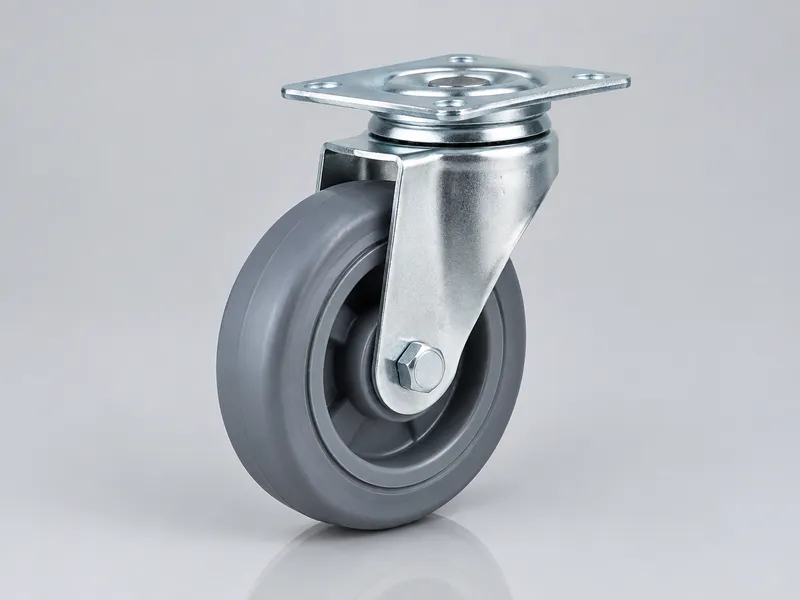
Cao su xám siêu đàn hồi chạy êm hơn rõ rệt so với cao su đặc hay nylon, lăn với lực rất nhẹ và đệm qua bậc cửa ngưỡng và mối nối.
Bánh xe tiêu chuẩn cho xe đẩy y tế, thiết bị phòng thí nghiệm, xe đẩy khách sạn và bất kỳ môi trường trong nhà nào mà tiếng ồn là phàn nàn.
Thông số kỹ thuật
- Cao su xám siêu đàn hồi, không để vết
- Lực cản lăn rất thấp dù lớp lăn mềm
- Vòng bi êm chính xác là tiêu chuẩn
- Tải từ 40 đến 300 kg mỗi bánh xe
Vật liệu thông dụng
Cao su siêu đàn hồi trên lõi thép / PP / nhôm
| Wheel material | Typical hardness | Floor protection | Where it fits |
|---|---|---|---|
| Cast polyurethane (PU) | Shore A 92–95 | Very good: non-marking compounds | AGV/AMR, trolleys on painted or epoxy floors, heavy duty |
| Injected PU | Shore A 90–95 | Good | Cost-sensitive medium duty, light equipment |
| Cast nylon (PA6) | Shore D 70+ | Fair: hard tread | High load, dry indoor logistics, washdown |
| Glass-filled nylon | Shore D 75+ | Fair | Higher loads and temperatures than PA6 |
| Solid rubber | Shore A 65–75 | Good | Shock absorption, outdoor thresholds, economy |
| Super-elastic rubber | Shore A 55–65 | Excellent | Quiet running: medical, hotel, laboratory |
| Phenolic resin | — | Fair | Baking lines and ovens up to +280 °C |
| Forged steel | — | None: needs steel plate or heavy concrete | Extreme loads, heat, harsh floors |
| Stainless (wheel/bracket) | — | Good | Food, pharma, washdown, corrosive areas |
Xử lý bề mặt
Giá đỡ mạ kẽm hoặc thép không gỉ
| Bracket finish | What it does | Specify it when |
|---|---|---|
| Zinc plating (blue/white) | Baseline corrosion protection | Standard dry indoor use |
| Chrome plating | Hard, decorative, easy to clean | Visible / cleanroom-adjacent equipment |
| Powder coating | Custom color, good corrosion resistance | Brand colors, outdoor-adjacent use |
| Stainless steel 304 | No plating to fail | Washdown, food, medical |
| Stainless steel 316 | Resists chlorides | Salt, brine, marine air, harsh cleaning chemicals |
Kiểm nghiệm
Độ ồn và lực cản lăn được so sánh theo từng lô hợp chất
| Selection factor | Rule of thumb | Effect on performance |
|---|---|---|
| Load sizing | Total load ÷ 3 (not ÷ 4) | On uneven floors only three wheels carry the cart |
| Wheel diameter | Bigger rolls easier | Larger wheels cut push force and bridge gaps |
| Tread hardness | Softer = quieter, harder = easier rolling | Pick the softest tread that carries the load |
| Bearing choice | Precision ball for manual pushing, roller for heavy loads | Bearings dominate rolling resistance at high load |
| Swivel vs rigid | 2 swivel + 2 rigid is the standard cart setup | All-swivel carts wander; all-rigid carts cannot steer |
| Floor condition | Rough floors need bigger wheels and softer treads | Small hard wheels on bad floors destroy both |
Capability commitments on this page are owner-confirmed (2026-09-29).