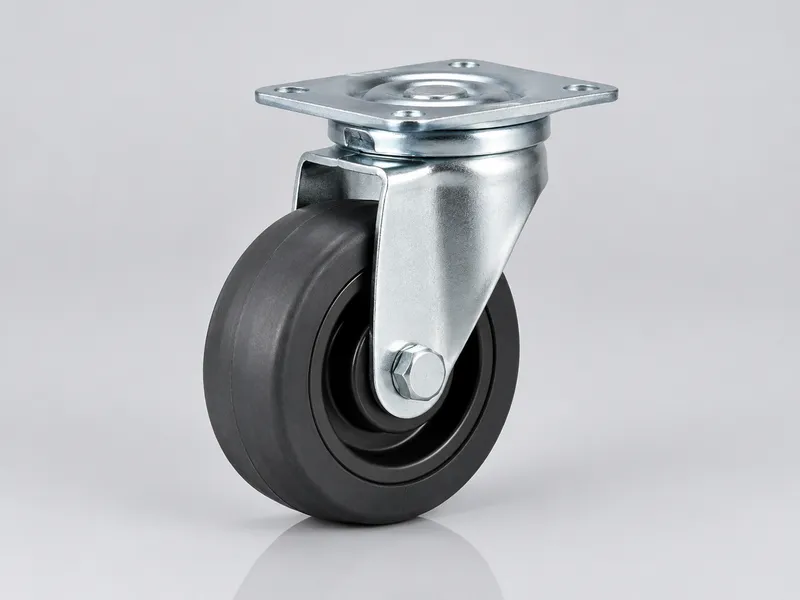
Rodas condutivas dissipam as cargas estáticas pela banda de rodagem até o piso, protegendo PCBs, wafers e processos com manipulação de pós; compostos antiestáticos evitam o acúmulo perigoso de carga em carrinhos e racks.
Os valores de resistência são medidos por lote e podem ser documentados por entrega.
Especificações
- Compostos de PU e borracha condutivos com resistência superficial medida
- Relatórios de teste de resistência disponíveis por lote
- Compatíveis com sistemas de pisos ESD
- Opções de suporte em aço e aço inoxidável
Materiais típicos
PU condutivo / borracha condutiva sobre núcleos condutivos
| Wheel material | Typical hardness | Floor protection | Where it fits |
|---|---|---|---|
| Cast polyurethane (PU) | Shore A 92–95 | Very good: non-marking compounds | AGV/AMR, trolleys on painted or epoxy floors, heavy duty |
| Injected PU | Shore A 90–95 | Good | Cost-sensitive medium duty, light equipment |
| Cast nylon (PA6) | Shore D 70+ | Fair: hard tread | High load, dry indoor logistics, washdown |
| Glass-filled nylon | Shore D 75+ | Fair | Higher loads and temperatures than PA6 |
| Solid rubber | Shore A 65–75 | Good | Shock absorption, outdoor thresholds, economy |
| Super-elastic rubber | Shore A 55–65 | Excellent | Quiet running: medical, hotel, laboratory |
| Phenolic resin | — | Fair | Baking lines and ovens up to +280 °C |
| Forged steel | — | None: needs steel plate or heavy concrete | Extreme loads, heat, harsh floors |
| Stainless (wheel/bracket) | — | Good | Food, pharma, washdown, corrosive areas |
Acabamentos
Galvanizado ou aço inoxidável
| Bracket finish | What it does | Specify it when |
|---|---|---|
| Zinc plating (blue/white) | Baseline corrosion protection | Standard dry indoor use |
| Chrome plating | Hard, decorative, easy to clean | Visible / cleanroom-adjacent equipment |
| Powder coating | Custom color, good corrosion resistance | Brand colors, outdoor-adjacent use |
| Stainless steel 304 | No plating to fail | Washdown, food, medical |
| Stainless steel 316 | Resists chlorides | Salt, brine, marine air, harsh cleaning chemicals |
Testes
Resistência superficial medida por lote
| Selection factor | Rule of thumb | Effect on performance |
|---|---|---|
| Load sizing | Total load ÷ 3 (not ÷ 4) | On uneven floors only three wheels carry the cart |
| Wheel diameter | Bigger rolls easier | Larger wheels cut push force and bridge gaps |
| Tread hardness | Softer = quieter, harder = easier rolling | Pick the softest tread that carries the load |
| Bearing choice | Precision ball for manual pushing, roller for heavy loads | Bearings dominate rolling resistance at high load |
| Swivel vs rigid | 2 swivel + 2 rigid is the standard cart setup | All-swivel carts wander; all-rigid carts cannot steer |
| Floor condition | Rough floors need bigger wheels and softer treads | Small hard wheels on bad floors destroy both |
Produtos relacionados
Capability commitments on this page are owner-confirmed (2026-09-29).